
 EN
Quick Links

A restaurant guest can ask for attention in several ways: making eye contact, raising a hand, turning a table lamp, or pressing a call button. For a buyer comparing service equipment, the first question is not which device looks most modern. It is where the signal goes and whether the people responsible can act on it.
A visual flip-to-call lamp changes its light at the table. Staff need a clear view and a routine for responding. A wireless waiter call system typically transmits a request to a compatible receiver, pager, display, or other device; the exact route depends on the system. Both may support a restaurant’s service process, but they should not be treated as interchangeable without testing the specific products.
This guide gives restaurant operators, hotel purchasing teams, and distributors a practical framework for comparing a calling table lamp with a wireless call system. It uses the JB-TL01 as an example of a lamp providing a visible red service cue and ambient table lighting.
Consider a visual flip lamp when table ambience matters and staff can see the relevant tables from normal working positions. Consider a receiver-based system when the intended workflow requires an alert to reach staff away from the table, such as in a separate room or behind a partition. Some operations may use both approaches for different needs, provided the team understands each system’s role.
Neither choice guarantees a faster response. Visibility, receiver coverage, staff assignments, training, and what happens when several tables call all affect the result. Test the actual equipment in the actual venue before making a volume commitment.
A flip-to-call lamp is a cordless table light designed to change state when a guest turns it over. Depending on the model, it may provide an ambient color in one orientation and a visible service color in the other. Guests and staff use that color change as a local cue at the table.
The supplied JB-TL01 product information describes a selected ambient color in the normal position and a solid red alert when the red-ring end faces up. The selected ambient color is configured using the compatible charging station. Confirm the sample’s actual operation and available colors with the supplier before specifying a project.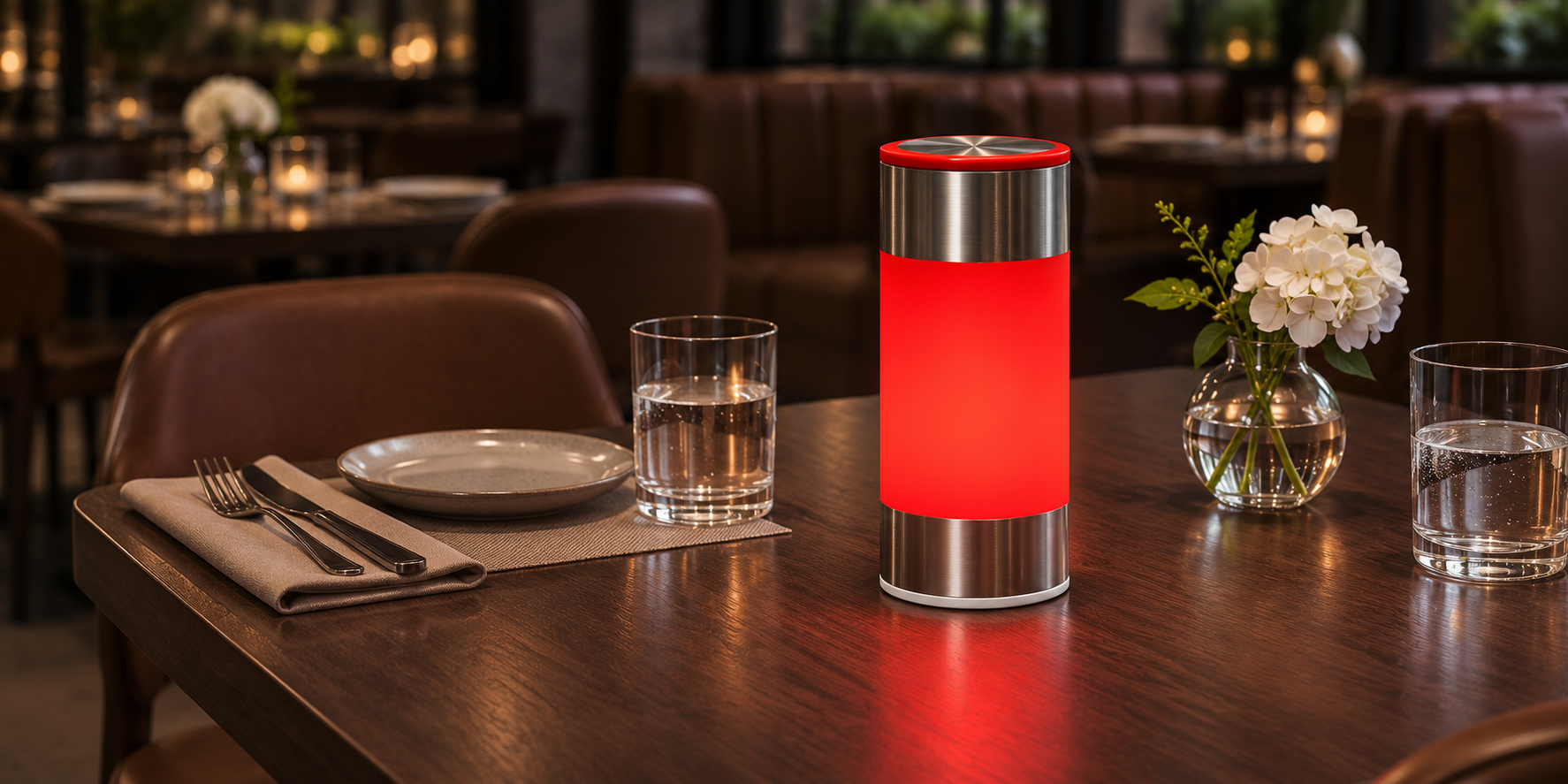
That red light is a visual signal. It does not by itself demonstrate that the lamp transmits a table number, calls a watch, or connects to an app or point-of-sale system. Buyers who need electronic routing should ask for a separate product specification and demonstration.
A guest flips the lamp; a staff member sees the red state; the team responds and returns the lamp to its normal position according to the restaurant’s procedure. The useful information is that a particular visible table needs attention. The light alone does not tell staff whether the guest wants water, a bill, or something else.
A receiver-based system generally starts with a table transmitter or button. Depending on the model, a request may appear on a staff pager, wearable receiver, counter display, or other compatible endpoint. Some systems support different request types or table identifiers, while others have simpler functionality. Ask the vendor to show the exact components and configuration included in the quotation.
Wireless communication introduces different questions: where receivers are worn or placed, whether a signal reaches each area, how table identifiers are assigned, how alerts are acknowledged, and what happens if equipment is uncharged or unavailable. Coverage and integration claims should be verified with the chosen system and in the venue rather than assumed from a product category.
A visual lamp asks the floor team to notice a change at the table. It can fit an open room where staff regularly scan their assigned section. The lamp’s effectiveness depends on sightlines, background light, obstacles, and the restaurant’s normal service pattern.
A wireless device may route a request to a receiver without requiring a direct view of the table. That can be useful when staff move through several rooms, but only if coverage, receiver use, and notification handling are reliable for the selected system. A receiver that is left uncharged or unattended is not a complete workflow.
A red table lamp indicates that a table wants attention; the server learns the details by visiting. A call system may identify a table or request type if the specified equipment supports those features. Buyers should ask to see how the recipient distinguishes multiple requests, recognizes a cancellation, and clears the alert.
A flip lamp combines lighting with a service cue in one visible object. A call button and a decorative lamp may require separate table space. On small tables, compare the actual footprint and the reach needed to operate the device alongside menus, glasses, and food.
Both options create operational tasks. A rechargeable lamp fleet needs collection, charging, placement, and cleaning. A pager system may require battery management, receiver assignment, table mapping, and staff training. Compare the full daily routine rather than assuming one product category is maintenance-free.
Begin with a floor plan and mark the places where staff normally stand, walk, collect orders, and deliver food. Identify representative tables in the center, at the edge of the room, behind partitions, and near bright windows or decorative lighting. Place a sample at normal table height and check the service state from those working positions.
Repeat the observation during the lighting conditions that matter: daylight where relevant, the usual evening setting, and a busy service environment where people and table decorations may obstruct the view. Ask more than one staff member to observe. A clear view from the manager’s position does not prove that a server assigned to a different zone can see every table.
Use simple categories such as clearly visible, intermittently obstructed, or not visible from the expected observation point. Note why: a pillar, high-backed seating, flowers, glare, or a long viewing distance. Then decide whether to move the lamp, change a staff route, assign an observation point, or choose a different signaling method for that zone.
A sample test should document the lamp setting and the conditions observed. It is not a substitute for the restaurant’s normal service standards, and a result in one venue should not be represented as a guaranteed range for another.
If a wireless solution is being considered, use the same floor plan and operating hours. Request the actual transmitter and receiver configuration. Test each area where guests may call, including corners, separate rooms, and any areas behind walls. Confirm who receives the alert and whether the indicated table is correct.
Ask staff to carry or monitor the receiver as they would during a normal shift. Test multiple requests, cancellation if supported, and acknowledgement. Check how staff notice an alert amid the venue’s noise and movement. If a system claims app or POS integration, ask for written compatibility details and a working demonstration with the intended software.
Do not infer a coverage radius or number of supported devices from another brand. The supplier should specify the system’s limits and the equipment needed for the restaurant’s layout.
Planning a restaurant project? Share your table count, floor layout, and the kind of service signal you need. Jbian Lighting can discuss JB-TL01 sample and charging-station options. Send Your Requirements
A service cue should be understandable without making the table feel like a control panel. For a flip lamp, explain the action in a short phrase on a table card or during seating, then let guests decide whether to use it. Ask a person who has never seen the device to try it with only the proposed instruction.
Observe whether the guest can reach the lamp comfortably, turn it without disturbing nearby objects, and distinguish the ambient state from the alert. Test the same questions for a call button: can guests identify the correct button, and do they know whether a request has been sent or cancelled?
Service remains personal. A signal is a way to indicate attention is needed, not a replacement for conversation, accessibility considerations, or a well-planned floor routine.
Assign each table or section to a primary role and decide who provides backup. For a lamp, specify when staff scan their section and how they hand off an unattended table. For a receiver, specify who carries or monitors it and how its battery is checked before service.
Decide when the light should be returned to ambient mode or the electronic alert cleared. One possible rule is to reset the visual cue once a staff member has acknowledged the request, but the restaurant should choose a procedure that matches its own service style. The rule matters because an uncleared cue can create uncertainty for other staff.
Walk through a realistic peak-service scenario. A server may be carrying plates while two tables request attention. Establish how staff prioritize, when a colleague can help, and how the team notices a missed request. A visible red lamp does not automatically queue requests in chronological order; an electronic system’s queue behavior must also be confirmed for the actual model.
The supplied JB-TL01 information describes charging through a compatible contact charging station rather than a USB-C port on the lamp. It lists a 2,600 mAh battery, a stated 17-hour runtime, 6–8-hour charging time, and four brightness levels. Confirm these details and the conditions behind the figures with the supplier; actual use depends on settings and operating conditions.
For a restaurant fleet, map the closing and opening routine: who collects the lamps, where the station sits, how units are placed correctly, and how the team checks readiness before service. Ensure the available charging window fits the actual schedule. Confirm the selected station’s capacity, plug standard, replacement parts, and total station quantity in the quotation.
For a wireless system, ask separately about transmitter and receiver power, charging or battery replacement, setup, and spare devices. A complete comparison includes the number of lamps, stations, buttons, receivers, and chargers needed, rather than comparing one lamp price against one button price.
Importers and restaurant groups should prepare a written request that identifies the destination market, quantities, intended indoor or outdoor conditions, plug standard, packaging needs, and required documentation. Ask the supplier which documents apply to the exact model and configuration. Do not assume that a generic claim covers a different market, accessory, or installation.
For battery-powered equipment, discuss transport documentation with the supplier and freight provider. Shipping arrangements depend on the goods, destination, and transport method. Where a project has inspection requirements, agree on the scope, sampling plan, and acceptance criteria before dispatch.
Record the model, finish, station configuration, selected settings, and any agreed branding or packaging. Identify which characteristics the supplier will use to match the production order. If the buyer measures runtime or charging time, record the conditions so the result can be understood and compared.
1. Where must the signal be received? If a staff member must be alerted outside the line of sight, specify the receiver requirement explicitly.
2. What information must the signal carry? Decide whether a visible request for attention is sufficient or whether table identification and request categories are needed.
3. Who owns the daily routine? Identify the staff responsible for observation, charging, acknowledgement, reset, and backup.
4. What must be tested on site? List the zones, operating hours, background lighting, obstacles, and sample equipment required for a meaningful trial.
5. What does the quotation include? Request quantities and prices for all required components, accessories, documentation, packaging, freight terms, and any customization. Confirm current lead times and warranty terms in writing.
Imagine an open dining room connected to a private room behind a closed door. In the open area, a visual lamp may be worth testing if staff can see the tables during their usual routes. For the private room, a visual cue visible only inside that room may not meet a requirement to notify staff outside it. The buyer could test an alternative signaling method or change the service arrangement.
This is a planning example, not a reported customer installation or a measured result. The right choice depends on the actual layout and the specific equipment. A trial should include the normal door position, staff locations, and the process for acknowledging a request.
Ask whether the product changes its own light, transmits a signal, or does both. Identify the receiver and evidence of compatibility before writing the purchase specification.
People, menus, flowers, and table placement can change what staff can see. Repeat the observation under representative service conditions.
A well-specified product still needs a person to charge it, place it, explain it to guests, and respond to requests. Include training and an opening checklist in the rollout.
A lamp-only price, a lamp-and-station set, and a button-and-receiver package are different offers. Normalize quantities, accessories, shipping, and support before comparing totals.
Not when its function is limited to a visible signal at the table. A product that also transmits to a receiver must be specified and verified separately.
The supplied JB-TL01 information describes a visible red service alert and does not establish a connection to a watch or phone. Confirm any required connectivity with the supplier and a product demonstration.
Only if the staff responsible for responding can see it from their actual working positions or have another procedure for that area. Test the layout; a partition can block the cue.
List every powered item and its charging method, available charging window, station or charger quantity, plug standard, and spare equipment. Ask for the conditions behind stated runtime and charging figures.
It may choose different tools for different zones or roles. Confirm the systems’ capabilities independently and train staff on which signal they must monitor; using both does not imply the products are connected.
Agree on the desired signal path, request representative samples, and test the equipment during actual operating conditions. Record the results and resolve open questions before approving the order.
A visual flip-to-call lamp and a wireless waiter call system answer related but distinct needs. Start with the signal path, the venue’s sightlines, and the responsibilities of the people responding. Then compare the guest experience, equipment, charging, documentation, and total project scope.
For restaurants considering the JB-TL01, a sample can help the team evaluate ambient lighting and the fixed red visual alert in representative table positions. Confirm the current configuration and charging equipment with the supplier before placing a bulk order.
Tell Jbian Lighting about your venue, estimated table count, destination, and expected service workflow. Request a JB-TL01 sample and a current quotation for the compatible lamps and charging stations. Get a Quote