
 EN
Quick Links

A flip-to-call table lamp can give a restaurant two functions in one compact product: ambient table lighting and a visible way for guests to request assistance. But a lamp that looks attractive in a product photograph may not be the right choice for every dining room.
Before placing a bulk order, buyers should test more than the light itself. The most useful sample evaluation covers five areas: table appearance, guest operation, visibility of the service signal, charging workflow, and the supplier’s ability to meet the agreed order requirements.
This guide explains how a restaurant, hotel group, importer, or hospitality distributor can organize a practical sample test. It also uses the JB-TL01 as an example of the questions to ask when evaluating a lamp with a fixed red service alert and a central contact charging station.
Start with the way the lamp will actually be used. Place the sample on a prepared table, select the intended ambient setting, and observe it during normal service conditions. Then ask someone unfamiliar with the lamp to use the service function.
A useful first test answers four questions: Does the lamp fit comfortably alongside the menu, tableware, and drinks? Is the ambient light suitable without uncomfortable glare? Can a guest understand how to request service? Can staff recognize the red signal from their normal working positions?
If the answer to any question is unclear, adjust the setup or request clarification before moving to a bulk order.
Restaurant lighting operates in a demanding environment. Lamps are moved, cleaned, stored, and handled by different people. Their appearance also changes with surrounding lighting, wall finishes, table surfaces, and daylight.
For a flip-to-call lamp, the service signal needs to be visible and understandable. A lamp can be attractive on a single display table yet difficult to see from the service station when the restaurant is busy.
Sample testing helps buyers turn general supplier claims into project-specific acceptance criteria. Does it suit the table layout? Can staff manage charging between shifts? Is the alert recognizable where it is needed? What documentation and spare components are available? Can the delivered order match the approved sample?
The aim is not to create a complicated laboratory program for every restaurant. It is to identify the conditions that could affect purchasing, daily use, or customer experience.
A supplier can recommend a more appropriate configuration when the customer’s requirements are clear. Prepare a short project brief before ordering samples.
Describe where the lamps will be used: a fine-dining room, hotel lounge, café, bar, private dining area, or another setting. If the project includes outdoor tables, explain the level of exposure and ask the supplier for the relevant product documentation before specifying the lamp.
Do not assume that a lamp described as suitable for hospitality automatically meets the requirements of every terrace, cleaning method, or weather condition.
Provide an approximate number of tables, expected lamps per table, and the length of a typical service period. Include planned spare units and explain whether the restaurant operates one long service or multiple shifts. These details help the supplier discuss lamp quantities, compatible charging equipment, and sample configuration. Confirm final quantities after testing the workflow.
For distributors and importers, include the destination market, expected volume, packaging needs, branding requirements, and required documentation. Restaurant operators should involve a purchasing manager, floor manager, server, and designer where appropriate: each may notice different issues.
A useful table test begins with the complete setting, not an empty surface. Place the lamp alongside menus, glasses, plates, cutlery, and any table number or decorative item normally used during service.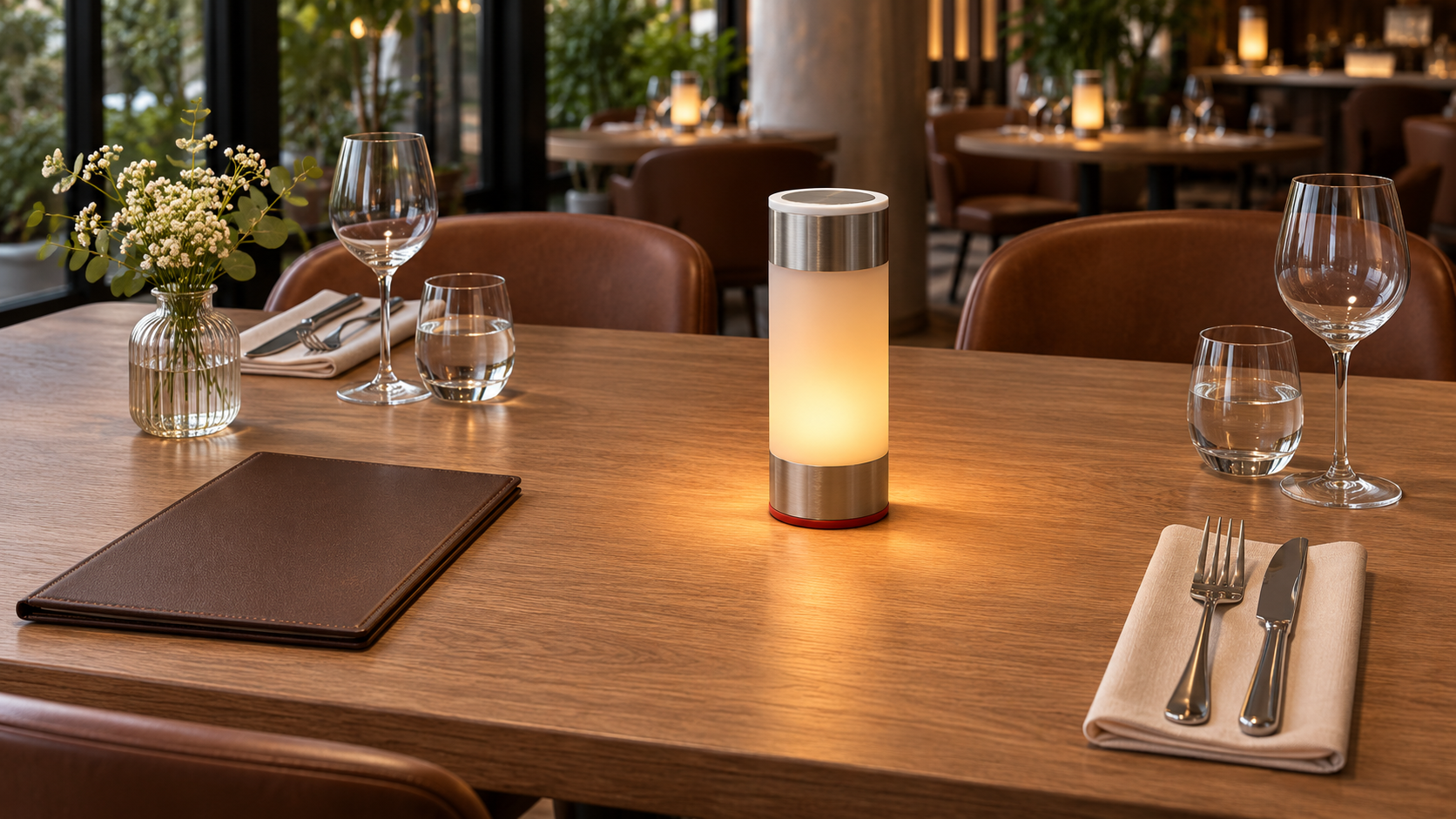
The lamp should not obstruct conversation or take up space needed for food and drinks. Check whether it remains accessible when a table is fully set and when staff need to clear or replace items. Observe it from seated and standing positions. A guest should be able to reach it without moving other objects, while a server should be able to see the service signal from relevant parts of the room.
Test the available ambient setting in the actual venue or a comparable lighting environment. A color that looks comfortable on a bright showroom table may appear different at night. Observe the illuminated surface from several directions. Ask whether the light supports the intended atmosphere and whether nearby menus and tableware remain comfortable to use.
The JB-TL01 product information describes four brightness levels. Buyers should confirm the sample’s configuration and evaluate the settings in their own environment.
A flip-to-call lamp uses a visible change in the lamp itself to indicate a request for service. It should not be confused with a wireless paging system unless the supplier explicitly confirms that functionality.
According to the supplied JB-TL01 product information, the lamp displays the selected ambient color in its normal position. When the red-ring end is facing up, it switches to a solid red service alert. Confirm the operation with the actual sample and supplier instructions.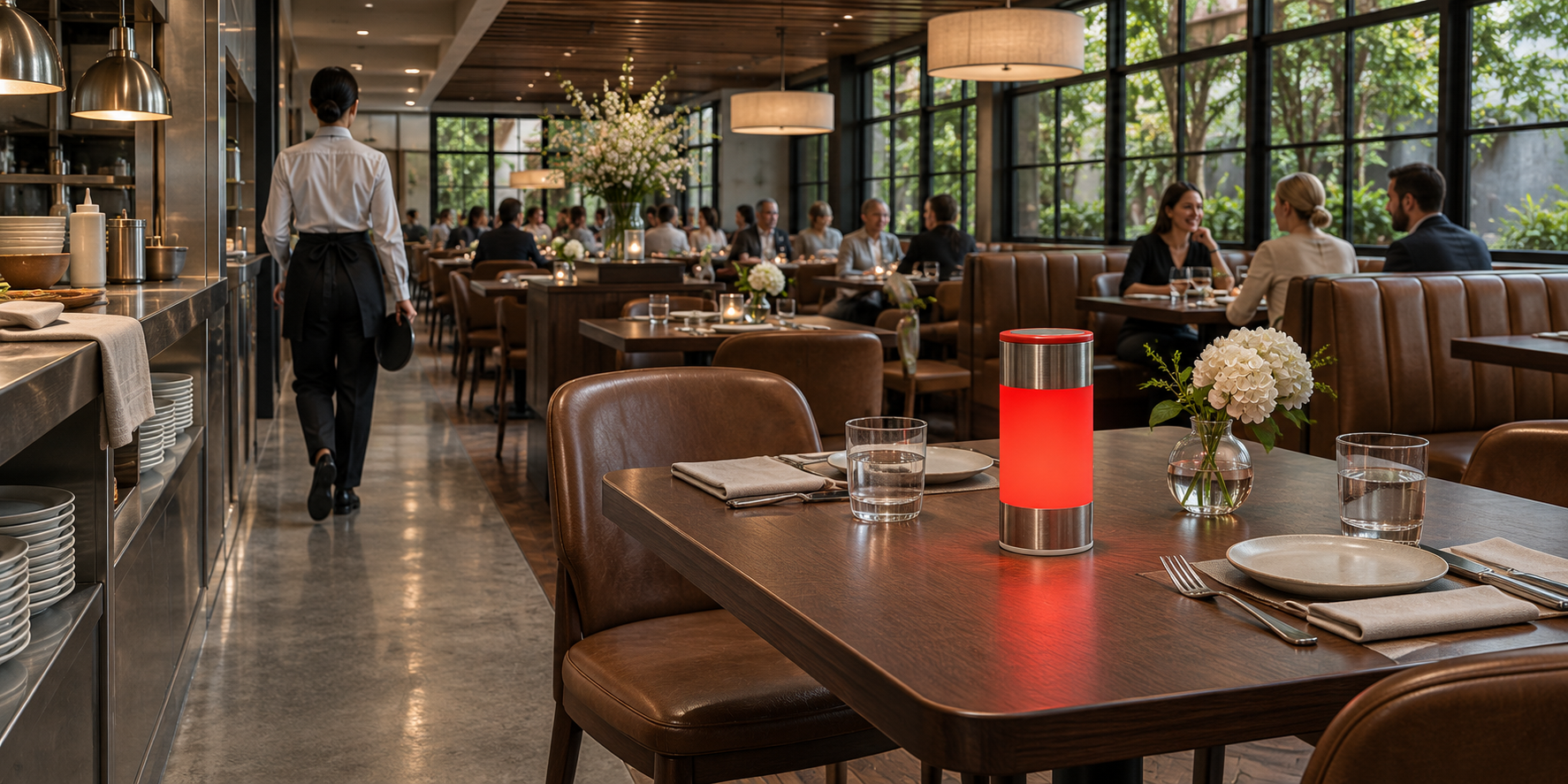
Give the sample to someone who has not seen a demonstration. Explain only that it can be used to request assistance, then ask them to try it. Observe whether the person understands which action changes the lamp’s state, can flip it without disturbing the table, recognizes the red alert, and knows how to return it to its normal position.
If the action is not obvious, consider a short table card or a brief explanation from staff. The goal is to make the service option clear without adding unnecessary complexity to the guest experience.
Place the sample on tables in different locations and inspect the signal from the service station, main aisle, and other normal working positions. Check for obstructions such as tall decorations, partitions, plants, or guests. Consider background colors and decorative lighting. If red lighting is already prominent, assess whether the alert remains distinct.
A visible signal does not guarantee a particular response time. Restaurants should decide how staff will monitor and respond to it within their existing service procedure.
The team should decide who returns the lamp to its ambient position after responding. A simple ownership rule helps prevent a table from continuing to display an alert after the request has been handled.
Planning a sample evaluation? Send Jbian Lighting your table count, destination market, and operating schedule. Ask for the JB-TL01 sample configuration and compatible charging-station options. Send Your Requirements
For a restaurant purchasing multiple lamps, charging is an operating process rather than a minor product detail. The best arrangement is one the team can repeat reliably after a busy service.
The supplied JB-TL01 product information specifies charging through a compatible contact charging station. It lists a 2,600 mAh battery, a stated runtime of 17 hours, and a stated charging time of 6–8 hours. Confirm these figures with the supplier; actual performance depends on the sample, settings, use, and test conditions.
Walk through the steps with the people who would perform them: collect lamps, wipe them using the supplier’s approved method, carry them to the charging area, place them correctly in the compatible station, check the station and connections as instructed, and return charged lamps to tables before service.
Identify the space needed for the charging station, a suitable power outlet, and an organized way to store units. Keep the charging area accessible to staff and clear of items that could interfere with the equipment.
Compare the available charging window with the supplier’s stated charging time. If lamps are collected after a late dinner service and needed early the next day, test whether the actual routine leaves sufficient time.
Do not rely on a battery-capacity number alone. Ask the supplier what brightness, color, operating pattern, and test conditions support any runtime claim. Then conduct a representative sample test with the settings the venue intends to use.
Before ordering, confirm the number of lamps supported by the selected station, the supplied plug standard, power requirements, and availability of replacement components. Do not assume stations from other lamp models are compatible. Ask the supplier to quote the intended lamp-and-station combination explicitly.
A sample is most useful when the buyer records what constitutes acceptance. Criteria should be specific enough that purchasing, operations, and the supplier understand the same requirements.
Record the model, finish, accessories and sample date; selected color and brightness; how the alert is activated and where staff checked visibility; table fit and sightlines; compatible station and charging window; requested documentation; packaging requirements; and open questions.
Where a buyer performs a measured test, record the method and conditions. A runtime result without a stated brightness setting, starting condition, or observation method may be difficult to compare with another result. The supplier should confirm which sample characteristics will be used as the reference for the bulk order. Document any agreed customization separately.
A buyer can ask what checks the supplier is able to perform before shipment. Appropriate checks depend on the product and purchase agreement; agree on them before production or dispatch rather than assuming they are included.
Ask whether visible finish, basic lamp operation, the flip function and red alert can be checked on an agreed sampling basis. Confirm how lamps and stations will be identified, what packaging protects them during transport, what information appears on cartons and shipping documents, and what happens if products do not match the agreed specification.
If the project requires third-party inspection, agree on the scope, timing, and acceptance criteria with the supplier and inspection provider. For battery-powered products, ask the supplier and freight provider which documents and shipping arrangements apply to the destination and transport method. Requirements can vary.
A lower lamp price does not necessarily mean a lower project cost. Compare quotations using the same configuration and scope: lamp and station quantities, sample and delivery charges, branding, packaging, replacement components, warranty terms, documentation, lead times, freight terms, and destination.
Ask each supplier to clarify exclusions. A quotation for lamps alone should not be compared directly with one that includes charging stations, packaging customization, and freight. For JB-TL01 projects, request a current written quotation for the exact quantities and configuration. Prices and lead times should be confirmed at the time of inquiry.
The lamp may look right but prove difficult for guests to operate or staff to see. Include both groups in the sample evaluation.
A signal that is easy to see near the service station may be less visible behind a partition or in a crowded section. Test representative positions across the room.
Brightness, color, usage pattern, and test conditions can affect results. Ask for the basis of the supplier’s claim and test the intended configuration.
A large number of cordless lamps requires a practical power and storage plan. Confirm station quantities, outlet access, and staff responsibilities before placing the order.
A product description, sample demonstration, and documented project test serve different purposes. Record what was actually checked and resolve outstanding questions with the supplier.
It is a table lamp designed to change to a visible service signal when a user flips it. The exact operation varies by model. Confirm whether the product provides only a visible signal or includes separate wireless notification capability.
Not necessarily. A visible lamp signal depends on staff seeing the table. A paging system may use separate transmitters or receivers. Compare the venue’s operating requirements and confirm each product’s capabilities.
The appropriate number depends on the project. A single sample can help assess appearance and basic operation, while several samples may be more useful for evaluating multiple table positions and charging workflow. Discuss the planned test with the supplier.
Ask for the stated runtime, the settings and conditions used to obtain it, the charging method, and expected charging time. Test the sample under a representative operating schedule before relying on the figures for a project plan.
The supplied product information describes charging through the compatible contact charging station and states that the lamp does not have a Type-C charging port. Confirm the current sample and accessories with the supplier before ordering.
The supplied JB-TL01 information describes a selected ambient color and a fixed red service alert. Confirm available ambient colors and the configuration procedure with the supplier.
Include the destination country, application, estimated lamp quantity, compatible charging-station requirements, branding or packaging needs, required documentation, and delivery timeline.
A successful bulk purchase begins with a sample test that reflects the restaurant’s real conditions. Check table fit, ambient appearance, guest operation, signal visibility, charging, and order documentation before approving the product.
For buyers considering the JB-TL01, confirm the current sample configuration and test it against the venue’s service and charging routines. Record the results, resolve open questions, and use the approved requirements as the basis for the bulk quotation.
Tell Jbian Lighting about your venue, estimated table count, destination, and preferred sample requirements. Our team can discuss the JB-TL01 configuration, compatible charging stations, available documentation, and a current project quotation. Get a Quote