
 EN
Quick Links

A logo on a cordless restaurant table lamp may occupy only a small area, but the purchase decision extends well beyond the artwork. Hospitality buyers need to consider where the mark will appear, whether it remains legible on the selected finish, how the lamp will be handled, and what must be approved before a bulk order.
Packaging adds another set of decisions. A restaurant group may prioritize easy distribution to multiple sites, while a distributor may need individual product identification, local-language instructions, or branded presentation. In both cases, the useful specification is the one that describes the complete lamp, compatible charging equipment, destination, quantities, and acceptance requirements.
This guide offers a practical framework for requesting customized restaurant table lamps. It uses the JB-TL01 flip lamp as an example where relevant. Availability, minimum quantities, pricing, branding methods, and production timing must be confirmed for the actual order.
Start with the intended application and the approved base product. Provide the lamp model, finish, destination, quantity, compatible charging-station requirements, and target delivery date. Then specify the proposed logo position and appearance, packaging needs, required documents, and who will approve the sample.
Ask the supplier to confirm whether each requested option is available for the exact model and order quantity. A digital mockup can help discuss placement, but it should not automatically replace a physical sample when material, color, legibility, or durability are important to the project.
Wholesale restaurant table lamps often move through several teams before they reach the dining room. Purchasing manages the order; a designer may approve appearance; operations checks charging and daily handling; and a distributor may need packaging that identifies stock accurately. When those requirements are discussed separately without a shared specification, a quotation can omit something that matters later.
A concise brief lets the supplier identify open questions before sampling. It also gives the buyer a basis for comparing offers. A quoted lamp price may include a standard finish and carton but exclude a custom logo, artwork setup, printed packaging, charging stations, or freight. Request an itemized scope rather than assuming that every option is included.
Record the approved product first: model, appearance, lamp quantity, station quantity, charging method, and destination plug standard. Then list the requested changes. Separating these details helps both parties see whether a revision affects only a printed mark or also changes the product, packaging, or delivery plan.
For JB-TL01, the supplied product information describes an ambient lighting state and a fixed red visual service alert when the red-ring end faces up. Charging is described through a compatible contact station. Confirm the current model and configuration with the supplier before placing an order.
Begin with the setting: restaurant tables, a hotel dining room, a bar, a distributor’s product range, or a multi-property hospitality project. Explain whether the lamps will be used in one location or allocated among several sites. If the project includes outdoor use, state the expected conditions and request the relevant model-specific documentation; do not infer an outdoor rating from a promotional image.
Give an estimated number of lamps, compatible stations, and any spare components required. Explain whether the order will be delivered in one shipment or divided by location. Include the date by which the buyer needs samples, the expected approval date, and the target delivery window.
Customization can introduce additional artwork, sample, packaging, and approval steps. Ask the supplier to confirm the schedule for the exact scope rather than adding an assumed number of days to a standard lead time. Identify which date is dependent on the buyer’s approval and which is dependent on production or freight.
Name the person responsible for approving the lamp appearance, the person responsible for packaging content, and the operations contact who will check the charging and service workflow. For a distributor, include the team that controls product labels and destination-market documentation. A clear approval route reduces the risk of conflicting versions of a logo or carton design.
A mark should be visible enough to serve its purpose while fitting the lamp’s shape and daily use. Ask the supplier which surfaces are suitable for the selected model, and request an artwork template or a photograph with dimensions. The curved metal end of a cylindrical lamp, for example, may present a different artwork challenge from a flat carton panel.
A flip lamp can be viewed in more than one position. For the JB-TL01, the red-ring end faces up when the lamp displays the red service alert. Review the proposed mark in both the ambient and alert orientations so the logo does not make the operational cue harder to understand.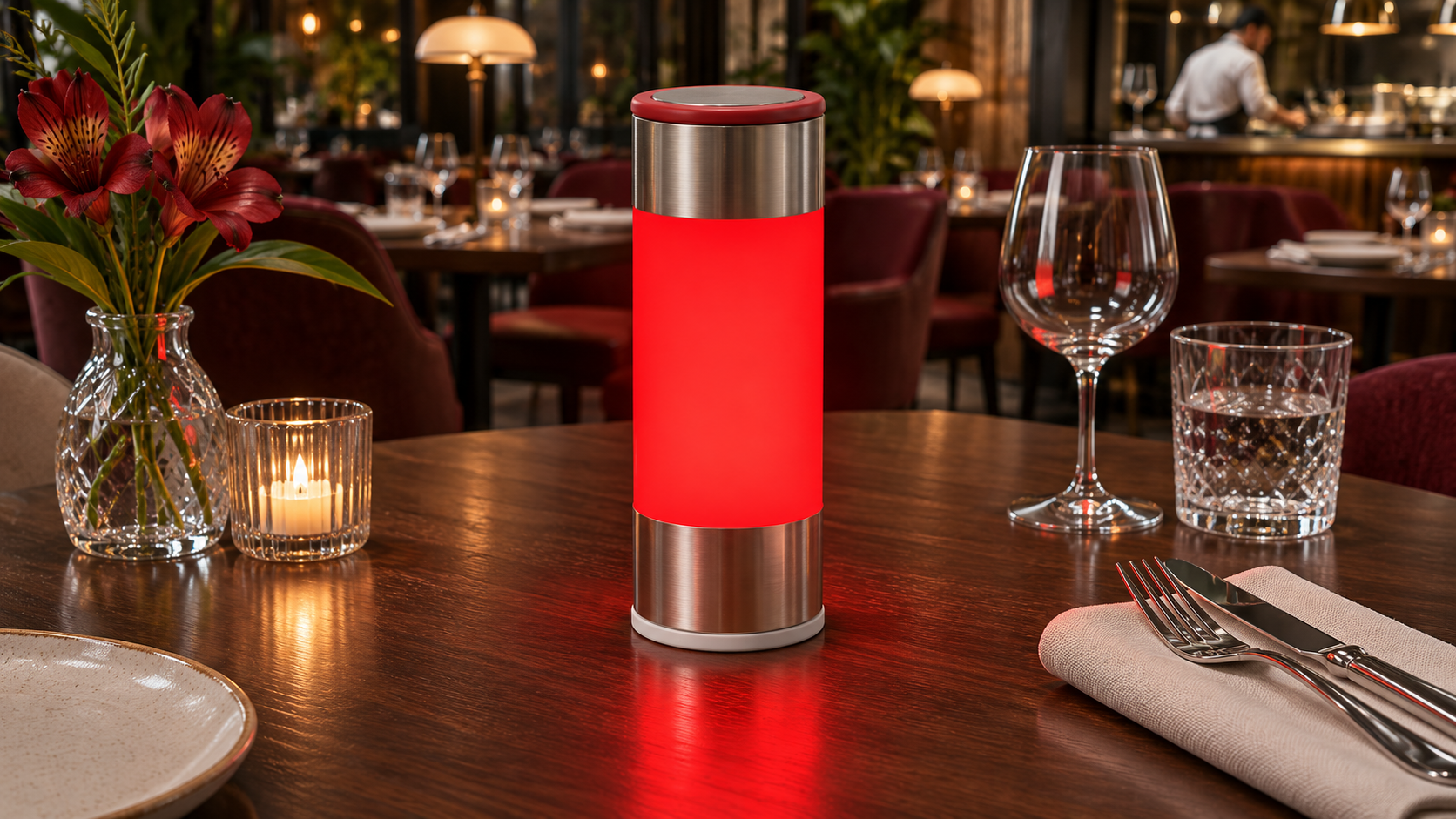
Avoid placing artwork where it could obscure a necessary label, interfere with charging contacts, or cover information required for the product. Confirm the permissible location and any size limits with the supplier. The buyer should also check how the mark appears when a lamp is placed among menus, glassware, and table decorations.
Small lettering and fine lines can be difficult to reproduce or read on a compact lamp. Ask for an actual-size proof on the proposed material and finish. Review the result under lighting similar to the restaurant’s conditions, from both seated and standing positions.
Do not assume that a mark visible on a bright computer screen will remain equally clear on a brushed or reflective surface. If necessary, discuss a simpler mark, different position, or other available approach with the supplier before approving the order.
Provide the supplier with the approved logo file, authorized brand name, and any written brand guidelines. Ask which file format, dimensions, color references, and background treatment are required. Confirm whether the design is one color or multiple colors and whether the mark must match a particular approved reference.
For a project involving several brands or properties, use a clear naming convention and identify which artwork belongs to each quantity and destination. Keep earlier versions distinct from the final approved file. The supplier and buyer should both know which revision is authorized for production.
Ask for a proof showing the lamp model, logo placement, orientation, approximate dimensions, and artwork revision. A proof is useful for confirming the intended layout, but a screen rendering may not accurately represent the final surface, color, or scale. When those details matter, request a physical sample or another mutually agreed approval method.
Record feedback in one consolidated list. For example, “move the mark away from the bottom rim” is more actionable when accompanied by a marked image and a dimension. Once the proof is approved, save the approved version alongside the purchase order.
Different suppliers may offer different marking processes for a given material and order size. Ask the supplier which methods are available for the exact JB-TL01 finish and how each method affects the appearance, minimum quantity, tooling or setup, and sample cost. Do not assume that every method is suitable for every surface.
If the lamp will be handled and cleaned frequently, discuss how the mark is expected to perform under the venue’s approved care routine. Request the manufacturer’s cleaning guidance and ask whether the sample can be evaluated using that method. A single informal wipe does not establish long-term durability; agree on any acceptance test and its conditions before production.
Ask whether the logo is priced per lamp, per artwork, or as a separate setup item. Request the applicable minimum quantity and ask whether different artwork versions count as one project or separate runs. Prices, minimums, and lead times may change, so the final quotation should state the terms for the specific order.
Keep customization separate from unsupported performance claims. A branded exterior does not by itself change the battery runtime, water resistance, charging method, or service signal. Any change to functional components requires its own specification and confirmation.
Planning a branded hospitality project? Send Jbian Lighting your logo, estimated quantity, destination, and preferred lamp and station configuration. Ask for a current customization quotation and sample options. Send Your Requirements
Packaging should support both presentation and the movement of goods. A restaurant group may need cartons divided by location; an importer may need a clear count and product identifiers; a distributor may need individual boxes with approved artwork. Explain how the products will be transported, stored, opened, and distributed.
Specify whether each lamp needs an individual box, whether charging stations are packed separately, and how items should be grouped in outer cartons. Confirm the contents of each package: lamp, compatible station or shared station allocation, power supply, instructions, and any other agreed component.
Ask the supplier to identify carton quantities, dimensions, and weights in the quotation or packing information for the confirmed configuration. Do not reuse numbers from a different set size or assume that a decorative package provides the same protection as an approved transport carton.
Identify the destination market, languages, product identifiers, brand details, and any information your organization requires on the package. Ask the supplier which labels and instructions apply to the exact product and destination. Regulatory and transport requirements depend on the goods and market; confirm them with the appropriate supplier, freight provider, and advisers.
Where multiple locations receive the order, consider a location code on the outer carton or a packing list that maps cartons to sites. Keep the code legible and separate from mandatory product information. Obtain approval for any final wording, barcode, or artwork before printing.
A cordless lamp project still needs a charging plan. For JB-TL01, the supplied product information describes a compatible contact charging station rather than a Type-C port on the lamp. Confirm the station capacity, power supply, plug standard, and quantities for the selected order.
The same supplied information lists a 2,600 mAh battery, a stated 17-hour runtime, a stated 6–8-hour charging time, and four brightness levels. These figures should be confirmed with the supplier, including the test conditions. Actual performance depends on settings and use; a logo or carton specification should not be presented as changing these values.
Explain how the restaurant plans to collect lamps after service, where the station will be placed, and when the team needs lamps ready again. Ask for the current charging and care instructions. Confirm how staff identify a compatible station and what to do if a unit shows visible damage or does not operate as expected.
For a group order, document the allocation of lamps and stations to each property. A branded carton is useful only if the correct number of working lamps and compatible charging components reaches the right location.
A sample can bring together details that are difficult to judge separately: lamp finish, logo scale, visual appearance under restaurant lighting, ambient and alert states, and the way the product fits the charging station. Ask whether the sample uses the final production method and materials; if it differs, record the differences.
Place the sample on a prepared table alongside menus, glasses, and tableware. Check the logo from typical viewing positions, observe whether it remains legible on the selected finish, and confirm that it does not obscure the red-ring service cue. Have a staff member unfamiliar with the sample try the flip function using the proposed guest instruction.
The JB-TL01 red state is a visual cue at the table. Staff must be able to see it; do not assume that a custom logo adds a wireless notification, table identifier, or app connection. Test representative sightlines in the venue and agree on who monitors and resets the lamp.
If printed packaging is part of the project, ask for a packaging proof or sample that shows the approved artwork and product information. Check spelling, model, quantity, intended language, logo revision, and placement of required labels. Confirm what is inside each package and how the outer carton is identified.
Record the approval date, approved artwork revision, product configuration, and any exceptions. If a change is requested after approval, ask the supplier to explain its impact on pricing, production, and delivery before authorizing the revision.
A meaningful comparison uses the same lamp quantity, compatible station quantity, customization scope, packaging, destination, and freight terms. Ask each supplier to identify what is included and excluded. Confirm whether samples, artwork setup, packaging tooling, replacement components, and destination documents have separate charges.
Use a simple comparison sheet: base lamps; charging stations and power supplies; logo setup and unit marking; packaging; samples; freight; applicable taxes or duties as quoted; and any other project-specific costs. Keep supplier assumptions visible so a lower initial figure is not mistaken for an equivalent complete offer.
Confirm the warranty terms for the exact order, the process for reporting a problem, and availability of replacement components. For multi-site projects, ask how to order additional matching lamps or stations later and whether a future order would require a new artwork setup or minimum quantity. Obtain the answers in writing rather than relying on a general catalog statement.
Imagine a group preparing lamps for three dining locations. The purchasing team defines the number of lamps and stations for each venue. The designer submits one approved logo file and reviews a mockup showing its position. Operations checks a physical lamp in ambient and red alert states, while logistics reviews the carton split and destination plug standard.
After the teams agree on the sample and packaging proof, the buyer records the approved versions and asks the supplier to quote the final scope. This is a planning example, not a description of a completed customer project. The appropriate sequence may differ for another buyer, destination, or supplier.
A digital proof can show layout, but it may not capture the appearance of a mark on curved metal under warm lighting. Agree on the physical approval needed for the project.
A logo specification does not replace a charging plan. Include compatible stations, power supplies, plug standard, and allocation across locations.
Keep a single approved file and revision record. If different properties need different marks, specify quantities and destinations for each version.
Confirm packaging contents, transport method, language, labeling, and presentation requirements for the actual order.
Use the supplier’s confirmed specification for the exact model. A visible red service cue should not be described as an electronic pager connection unless separately supported.
Logo options depend on the supplier, model, finish, and order quantity. Share the artwork and proposed placement, then request a written quotation and sample or proof for approval.
Ask the supplier for its preferred artwork format and template. Provide the authorized file, size, color reference, position, and revision, together with any brand guidelines relevant to production.
Not necessarily. Branded presentation and transport protection are separate requirements. Describe both and ask the supplier to confirm the individual and outer packaging for the proposed route.
Confirm the current minimum with the supplier for the exact marking method, artwork, finish, and quantity. Minimums and charges should be stated in the project quotation.
The mark should be positioned so it does not obscure necessary labels, charging contacts, or the red-ring cue. Confirm the proposed position and assess the sample in both orientations.
Ask the supplier about the availability, minimum quantity, artwork setup, and lead time for future orders. Keep a record of the approved finish and branding revision.
A useful customization specification connects brand presentation to the product, station, packaging, destination, and service workflow. Start with the approved base lamp, agree on artwork and logo placement, evaluate a representative sample, and compare complete written quotations.
For JB-TL01 projects, confirm the current model configuration, compatible contact charging station, logo options, minimum quantity, and lead time with the supplier. Keep the approved sample and artwork records available through production and receiving.
Share your venue or distribution market, estimated quantities, logo file, packaging requirements, destination, and target schedule with Jbian Lighting. Request a JB-TL01 sample and an itemized current quotation for lamps, compatible stations, and any agreed customization. Get a Quote