
 EN

SEO Title: How to Evaluate Restaurant Table Lamp Samples Before a Bulk Order
Meta Description: Learn how hospitality buyers can evaluate restaurant table lamp samples before a bulk order, covering light quality, fit, charging, cleaning, packaging, and RFQ details.
URL Slug: restaurant-table-lamp-samples-bulk-order
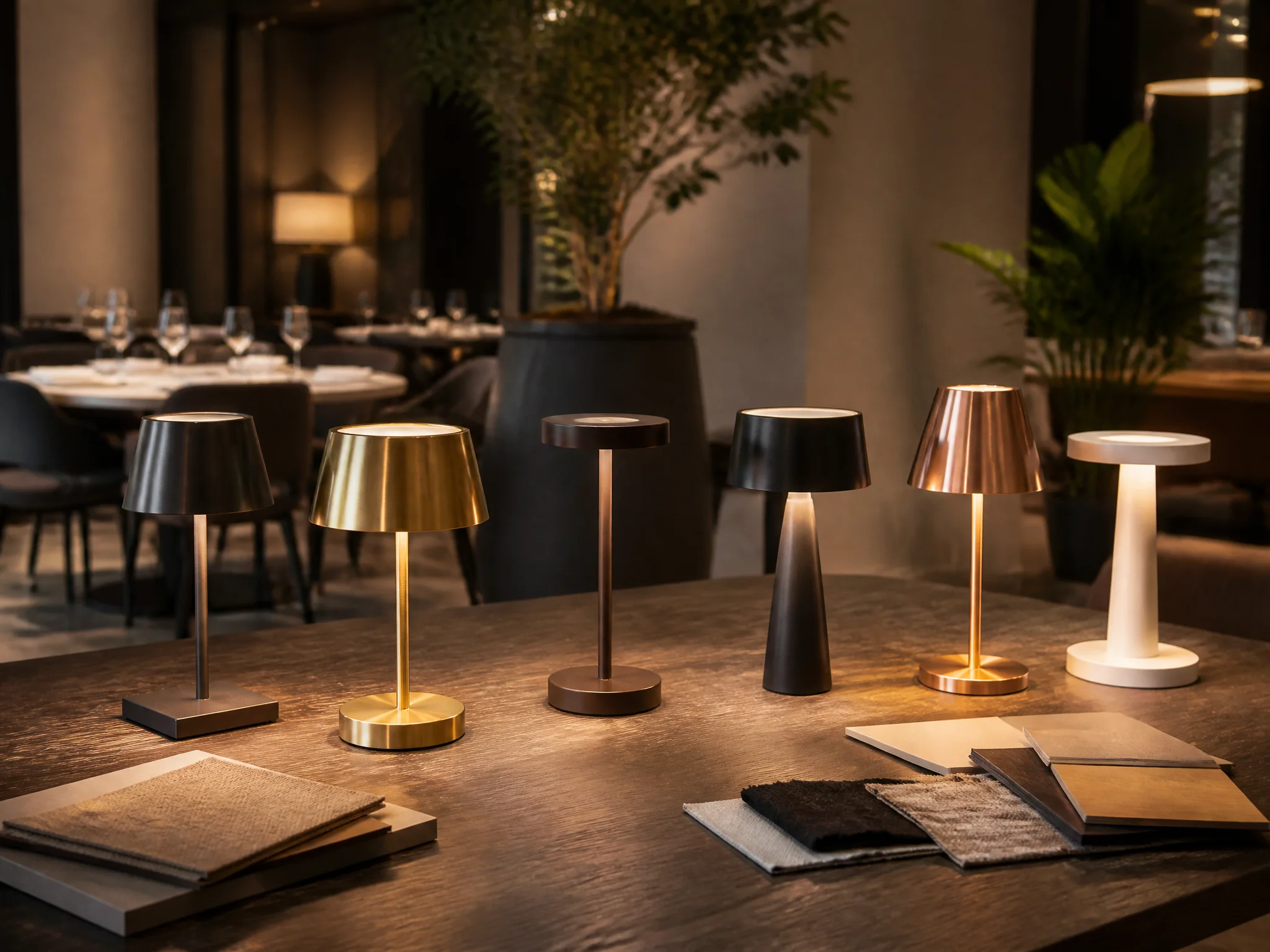
Ordering restaurant table lamps in quantity is not only a product-selection exercise. A sample must be evaluated as part of a complete service environment: the dining table, the guest sightline, the staff routine, the charging area, the cleaning schedule, the packaging method and the procurement documents all affect whether a lamp is suitable for a commercial project.
For buyers planning a restaurant table lamps bulk order, the safest process is to evaluate representative samples against a written checklist before confirming the full quantity. The purpose of sampling is not to assume that one attractive photograph represents every production detail. It is to identify the requirements that must be confirmed by the supplier and the requirements that the buyer can inspect in the intended setting.
This guide is for restaurant groups, hotels, bars, cafés, interior designers, lighting consultants, distributors and purchasing teams comparing commercial cordless table lamps. It uses a practical question-and-answer structure so that procurement teams can turn a sample review into a clear RFQ and an approval record. It does not assume a particular battery runtime, protection rating, certification, material grade, minimum order quantity or delivery promise. Those details should be confirmed for the selected model and destination.
Direct Answer: What Should a Restaurant Check Before a Bulk Table Lamp Order?
A restaurant should check seven areas before approving a bulk order: physical fit, light quality, stability and handling, controls, charging workflow, cleaning and service, and supplier documentation. Review the samples on representative tables during the intended service period, then record the required specification, the observed result, the supplier-confirmed detail and any open question.
A sample is ready for commercial approval when the buyer can answer these questions:
- Does the lamp fit the table without interfering with plates, glassware, menus or guest conversation?
- Does the light create the desired atmosphere without uncomfortable glare or distracting shadows?
- Can staff move, clean, store and recharge it without adding an impractical step to service?
- Is the control method clear for the people who will use it every day?
- Can the supplier document the model, finish, accessories, packaging and after-sales process for the requested quantity?
If an answer is uncertain, keep it as an open item in the RFQ instead of filling the gap with an assumption.
1. Start With the Restaurant Use Case
Map the locations before judging the sample
A lamp for a small two-person café table may need a different footprint and visual scale from a lamp for a large hotel dining table. A bar, lounge, private dining room and outdoor-adjacent service area may also impose different handling or cleaning requirements. Before opening the sample carton, create a simple location map.
Record the table types, approximate table sizes, number of seats, distance between lamps, ambient lighting conditions and expected service periods. Identify whether lamps will remain on the table throughout a service, be placed only for evening dining, move between areas or be stored between shifts. Note where staff members will pick them up and where charging or storage could realistically happen.
This step improves procurement quality because it prevents a buyer from comparing a lamp only as a decorative object. The same model can appear successful in a showroom and become inconvenient when a server must clear a crowded table or when dozens of units need to be returned to a charging area.
Define the approval setting
Use at least one representative table for the evaluation. If the project includes different table families, use a small sample set across the main layouts. Review the samples with the people who represent design, purchasing and operations. Each role sees a different risk: design may focus on proportion and finish, purchasing on documentation and repeatability, and operations on daily handling.
2. Check Physical Fit and Guest Sightlines
Measure the relationship, not only the lamp
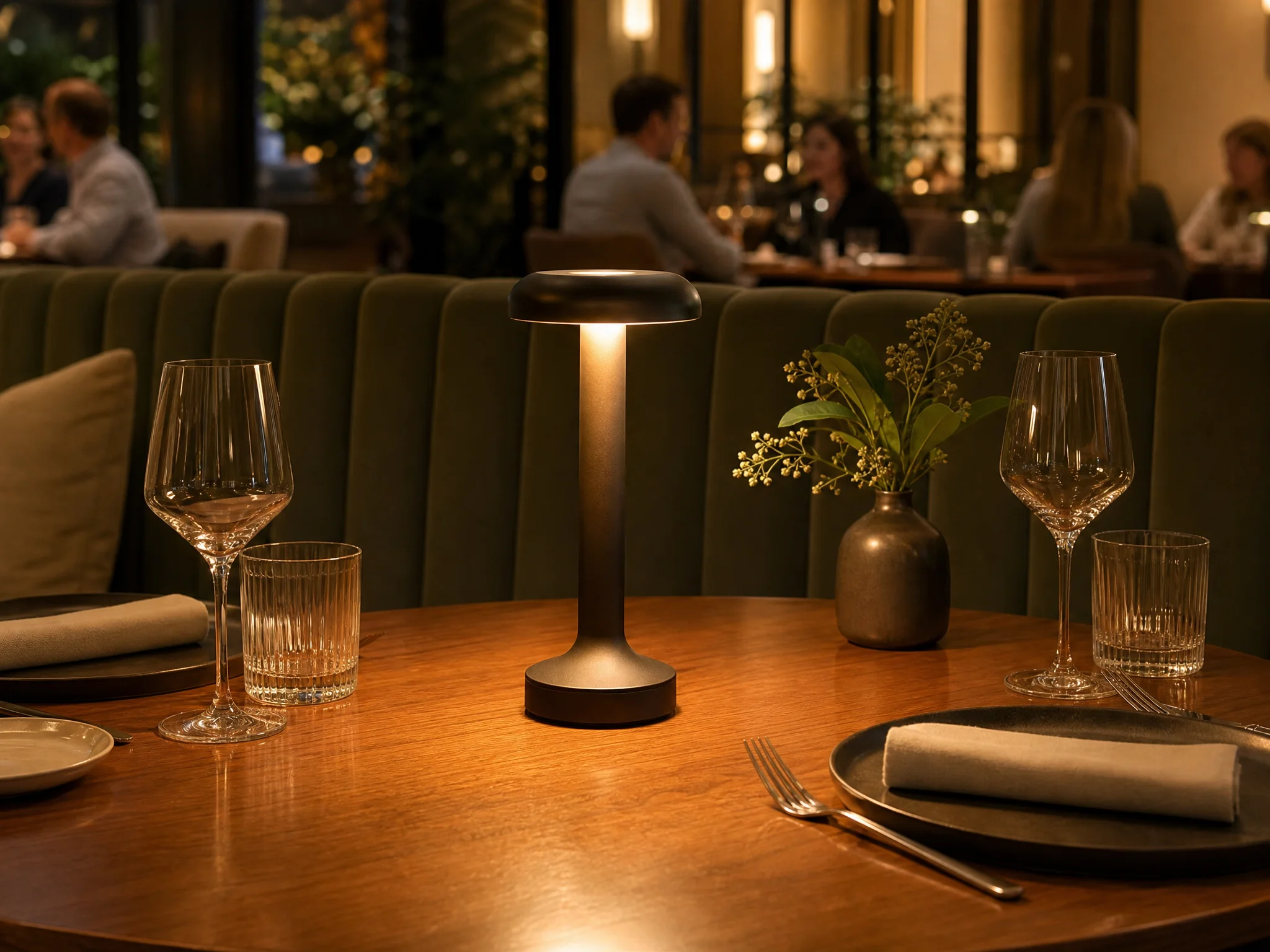
Record the sample's externally confirmed dimensions and compare them with the clear space available on the table. Check the base footprint, overall height and the position of the light source relative to plates, glassware and shared dishes. Do not treat a catalogue dimension as a substitute for a physical check if the table arrangement is tight.
Look at the lamp from a seated guest's eye level. The shade, diffuser or light source should not create a distracting bright point. Check sightlines across the table and between adjacent tables. In a hospitality setting, a lamp can be visually attractive but still interrupt conversation if it is too tall, too wide or placed directly between guests.
Use a fit record
A useful sample record includes:
| Check | What to observe | What to confirm with the supplier |
|---|---|---|
| Table footprint | Clearance from plates, menus and glassware | Confirmed base dimensions and acceptable surface guidance |
| Height and sightline | Guest view across the table and toward adjacent tables | Model drawing or approved dimensional sheet |
| Stability | Movement when the table is lightly touched or reset | Construction details and available variants |
| Finish | Visual match under the restaurant's lighting | Finish name, sample reference and repeatability process |
| Handling | Ease of moving during setup and clearing | Unit weight and handling guidance, if applicable |
Use the same record for every sample so that the final choice is based on comparable observations.
3. Evaluate Light Quality During Realistic Service Conditions
Review the light where guests will experience it
A sample should be assessed in the actual or simulated restaurant environment, not only against a white wall. Observe the table surface, nearby faces, menu readability and the surrounding ambience. Record whether the light feels warm, neutral or otherwise appropriate for the design intent, but do not write an exact colour value unless it has been confirmed for the specific model.
Check for glare from the light source, reflections on glassware, harsh shadows under plates and uneven illumination across the table. If the lamp has multiple control levels, test each level and record which level works for breakfast, lunch, dinner, bar service or an event setting. If it is dimmable, document how the control behaves rather than assuming that every level will suit every location.
Separate visual approval from technical claims
The sample review can confirm what the buyer sees: apparent glare, atmosphere, control response and table illumination in the test setting. It should not be used to invent laboratory results, photometric figures or universal performance claims. If the project requires photometric files, colour data or a specific lighting calculation, list those as supplier documentation requirements.
A practical approval note might say: “At the representative table, the selected control level produced the preferred visual atmosphere with no obvious direct glare from the seated positions reviewed.” This is more defensible than claiming a fixed brightness or performance result that was not measured.
4. Test Controls and Daily Staff Interaction
Controls should be understandable to a new staff member. Check how the lamp is switched on, adjusted, turned off and reset after use. Observe whether the control is easy to reach without lifting the lamp or disturbing tableware. If there is a touch, button or other interface, assess whether it responds consistently during a short repeated-use test.
Ask the supplier for the approved operating instructions and any limits on use. Confirm whether controls can be configured consistently across the requested quantity. If the project needs a particular control behaviour, write it into the approval record rather than relying on a verbal description.
Also consider guest interaction. In some venues, guests may adjust the lamp; in others, staff will manage it. The preferred control method and placement may differ between these service models. Include the operating decision in the RFQ so the supplier understands the intended environment.
5. Evaluate the Charging and Storage Workflow
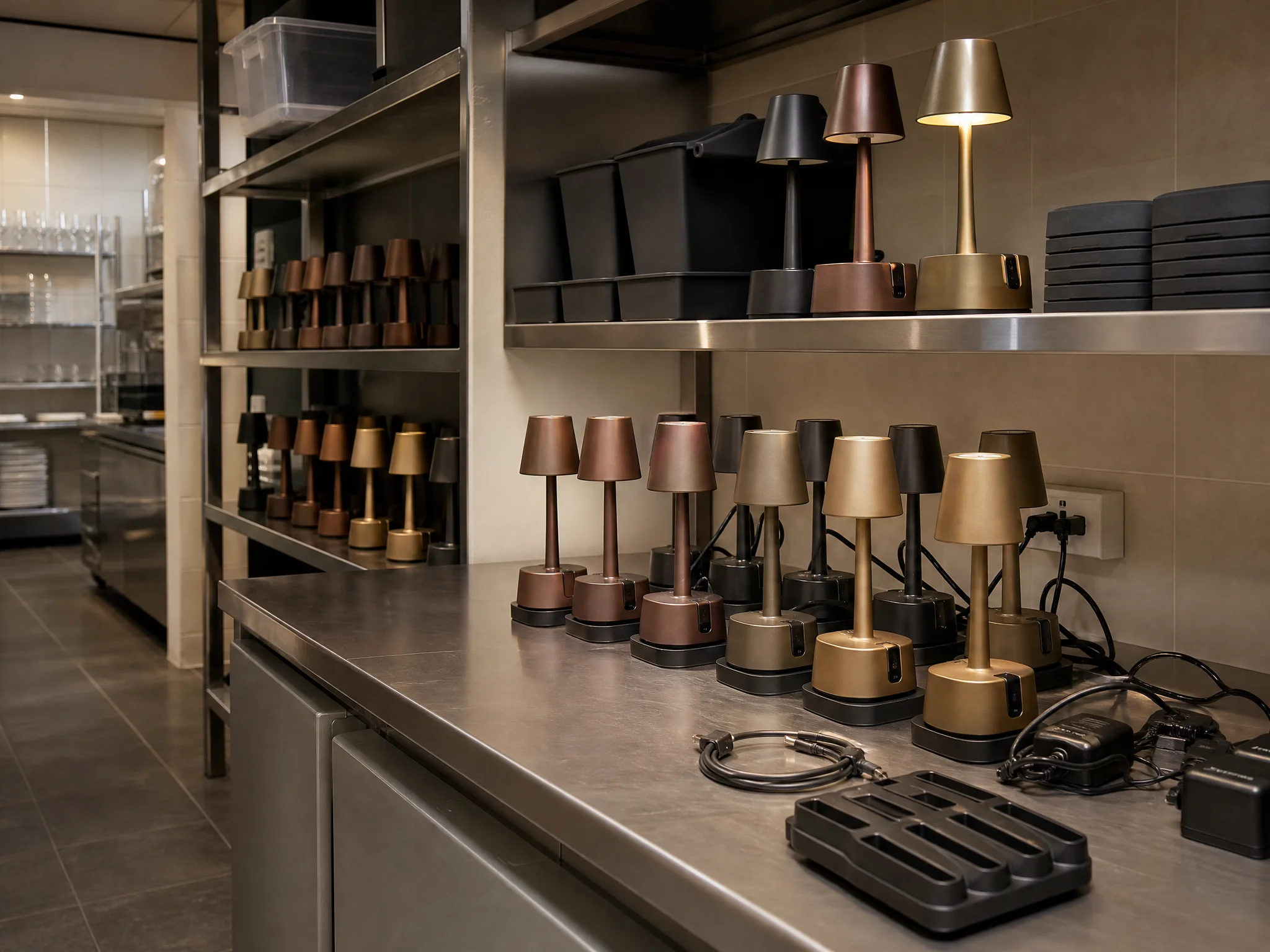
For commercial cordless table lamps, charging is an operational system, not a minor accessory. A buyer should map what happens after a lamp leaves the table: who collects it, where it is inspected, where it is charged, how fully charged units are identified, and how lamps are returned to service.
Questions for a charging review
- What charging method and accessories are supplied for the selected model?
- How many units can the restaurant practically organize in its available area?
- Can staff identify a unit that is charging, ready, or requiring attention?
- How will cables, adapters or charging accessories be stored and protected?
- What happens when one unit is not available for service?
- Are replacement or additional charging accessories available through the supplier?
Do not state a fixed operating duration unless the supplier provides a model-specific value and the project accepts the conditions behind it. Instead, document the restaurant's required service window and ask the supplier to confirm whether the proposed configuration supports it.
Run a workflow simulation
A short workflow simulation is often more useful than a long discussion. Place the sample on the representative table, remove it as staff would after service, move it to the proposed charging point, connect it according to the supplier's instructions, label or organize it, and return it to the table. Record each step that requires special training or creates a bottleneck.
For a restaurant group, repeat the mapping for one venue and then identify which steps must remain consistent across locations. This makes the final bulk order easier to operate and provides a clear basis for training and spare-accessory planning.
6. Check Cleaning, Materials and Serviceability
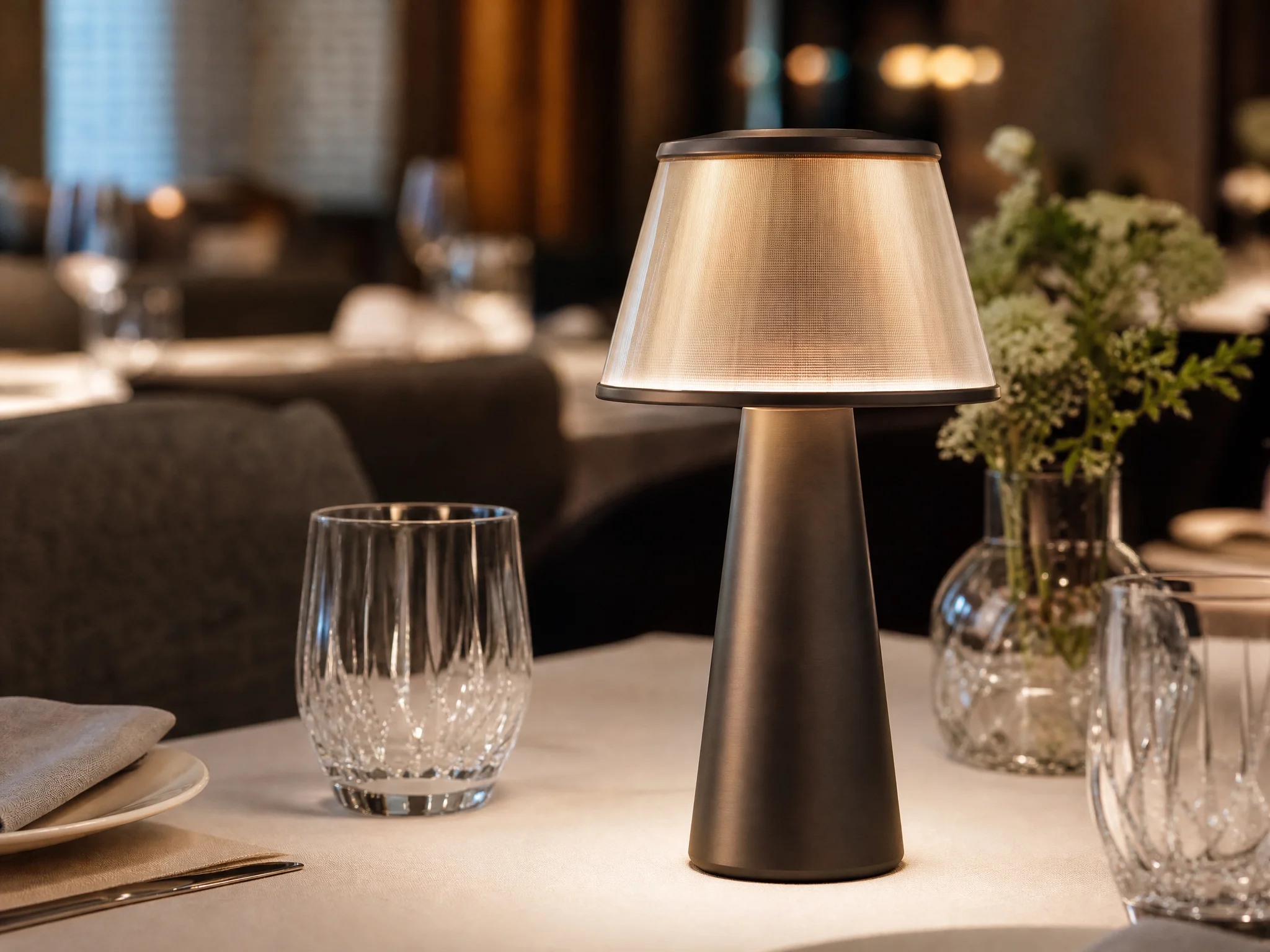
Restaurant lighting is exposed to fingerprints, food residue, cleaning agents and frequent handling. Ask what cleaning method is approved for the selected finish and what materials or surfaces require special care. Review the sample after the intended cleaning routine, but do not claim chemical resistance or a protection rating unless that information is documented for the model.
Inspect joints, controls, charging contacts and accessible surfaces for areas that could collect residue or be difficult to wipe. Consider how the finish looks under the venue's lighting and whether a replacement unit would be visually consistent with the installed fleet.
Request information about service support, replacement parts and the process for handling a unit that is damaged or no longer performs as expected. The buyer does not need to assume that every component is field-replaceable. The point is to understand what the supplier can support and what the restaurant should plan for operational continuity.
7. Review Packaging and Delivery Requirements
A bulk order can involve more risk at the packing and receiving stages than at the product-selection stage. Confirm how units, charging accessories and documentation are separated and labelled. Ask how the supplier identifies model, finish or variant information on cartons and whether the packing list can be matched to the purchase order.
The RFQ should identify the destination, required quantity by variant, carton-marking requirements, inspection expectations and any special documentation needed by the buyer. Do not infer shipping terms, delivery dates or packaging performance from a sample carton. Ask the supplier to state the proposed terms and what is included.
If the buyer needs retail-ready packaging, project packaging, spare units or consolidated cartons, list those requirements before quotation. Packaging decisions affect receiving time, storage space and the cost of handling after delivery.
8. Compare Samples With a Weighted Approval Matrix
A weighted matrix helps a team avoid choosing only the most attractive sample. Set the weights according to the project. For example, a design-led restaurant may give more weight to atmosphere and finish, while a multi-location group may give more weight to charging workflow, repeatability and service support.
| Evaluation area | Suggested buyer question | Evidence to record |
|---|---|---|
| Fit and proportion | Does it suit the table and guest sightline? | Sample observation and dimensional document |
| Light experience | Does it create the intended atmosphere without obvious glare? | Location, control level and observation |
| Controls | Can staff or guests operate it as planned? | Operating test and instructions |
| Charging workflow | Can the venue collect, charge and return units efficiently? | Workflow map and accessory confirmation |
| Cleaning and handling | Can staff maintain it using an approved routine? | Cleaning guidance and sample review |
| Consistency | Can the selected finish and configuration be repeated? | Sample reference and supplier confirmation |
| Commercial support | Are quotation, packaging and service questions answered? | RFQ response and open-item list |
Score only what has evidence. Use “pending” for any category that requires supplier confirmation. A pending item should block final approval when it affects safety, operation, compliance, commercial terms or the ability to deliver a consistent fleet.
9. Build a Complete Restaurant Table Lamp RFQ
After the sample review, convert the findings into a structured request for quotation. Include the primary use case, table environment, quantity by location, selected sample reference, dimensions, finish, control expectations, charging workflow, cleaning requirements, packaging, destination and requested documents.
A clear RFQ should ask the supplier to identify assumptions and exclusions. It should also request the validity period of the quotation, available variants, sample or approval process, lead-time basis, service contact and replacement-part approach. These commercial fields must be confirmed for the project rather than copied from an unrelated listing.
The strongest RFQs make comparison easier. Ask every supplier to respond in the same order and to separate confirmed specifications from optional recommendations. This reduces the risk that a low initial price hides a different configuration or missing accessory.
Mid-article CTA: request a sample and RFQ review
Planning a restaurant table lamps bulk order? Send the table type, approximate quantity, destination, preferred finish, service window and charging constraints to a commercial lighting supplier. Request a sample review plan and a line-by-line quotation so the proposed configuration can be checked before approval.
10. Decide When the Sample Is Ready for Approval
A sample is ready for the next procurement stage when the intended users agree on fit, light experience, controls, charging workflow, cleaning approach and visual finish, and when the supplier has responded to the material open items. The approval should identify the exact sample reference and any conditions that must remain true in production.
Do not approve a bulk order solely because the sample looks right. Confirm that the quotation corresponds to the reviewed model, finish, accessories and quantity. If the supplier proposes a substitution, variant change or packaging change, treat it as a new approval item.
For multi-location projects, define which conditions are universal and which are site-specific. A single sample may be approved for one table type but not automatically for every room, venue or service format.
Frequently Asked Questions
How many samples should a restaurant review before a bulk order?
There is no universal number. Review enough samples to compare the meaningful alternatives and representative table settings. If the project has multiple table types or finishes, include those variations in the approval plan. The important control is not an arbitrary sample count; it is documented comparison against the same criteria.
What is the most important check for cordless restaurant table lamps?
The most important check is whether the complete operating workflow fits the venue: table placement, staff handling, charging, storage and return to service. Light appearance matters, but a lamp that creates an impractical charging or clearing routine can increase operating friction across every service.
Should buyers test a sample during actual restaurant service?
When possible, yes. A realistic service simulation reveals sightline, glare, table-clearance and handling issues that may not appear in a showroom. Record the setting and observations, and distinguish what was visually observed from technical information that still requires supplier documentation.
What details should be confirmed for a restaurant table lamps bulk order?
Confirm the model and variant, quantity, dimensions, finish, control method, charging configuration, accessories, cleaning guidance, packaging, destination, quotation terms, delivery basis, documentation and service process. Also record any required samples, approval gates and substitution rules.
Can a buyer rely on product-page specifications?
A product page is a starting point, not necessarily a complete project specification. Ask the supplier to confirm the exact model and configuration for the quotation. Where a requirement affects operation, compliance or commercial acceptance, keep a written confirmation in the RFQ or approval record.
How should buyers compare two similar samples?
Use a weighted matrix with the same table setting and control conditions. Compare fit, light experience, glare, stability, controls, charging workflow, cleaning, finish consistency and supplier response quality. Mark unknowns as pending instead of awarding a score based on an assumption.
Should the RFQ include a target price?
A buyer may include a budget range when useful, but price should be compared with the same configuration and service requirements. A lower unit price may not represent a lower project cost if accessories, packaging, documentation or operational requirements are excluded. Ask suppliers to separate included and optional items.
What should happen if the supplier changes the sample after approval?
Request a written explanation and recheck any changed feature that affects appearance, fit, light, control, charging, cleaning or packaging. A variant change should be treated as a new approval point rather than silently accepted as equivalent.
Conclusion
Evaluating restaurant table lamp samples before a bulk order is a way to reduce procurement uncertainty and protect daily operations. The best process connects the visual decision with the full service cycle: table fit, guest sightlines, light quality, controls, charging, cleaning, storage, packaging and supplier documentation.
For a restaurant table lamps bulk order, create a representative test setting, use a consistent checklist, separate observed evidence from supplier-confirmed specifications and keep unresolved items visible in the RFQ. This approach helps design, purchasing and operations teams approve the same product for the same reasons, while giving the supplier a clearer brief for quotation and fulfilment.
Final CTA: request a commercial lighting quotation
Ready to compare options for a restaurant, hotel dining area or hospitality project? Share your table format, estimated quantity, preferred finish, lighting objective, destination and charging workflow. Ask for a sample, a configuration-specific quotation and the documents needed for approval before placing the order.