
 EN
Quick Links

Commercial cordless lamps can reduce installation cost because they provide task or ambient light without a dedicated cable run to every table, counter or movable seating position. The project may avoid some electrical rough-in, conduit, wall opening, outlet installation, finishing work and subsequent repair. The saving is not automatic: buyers must compare the avoided installation cost with the lamp fleet, charging equipment, replacement planning, staff workflow and any compliance requirements.
Estimated installed cost of a cordless option = lamp fleet cost + charging and storage cost + deployment labour + operating provisions.
Compare that with wired fixture cost + electrical materials + installation labour + access, finishing and disruption cost for the same lighting function. Use written quotations and the exact venue layout rather than assuming that every cordless lamp will be cheaper.
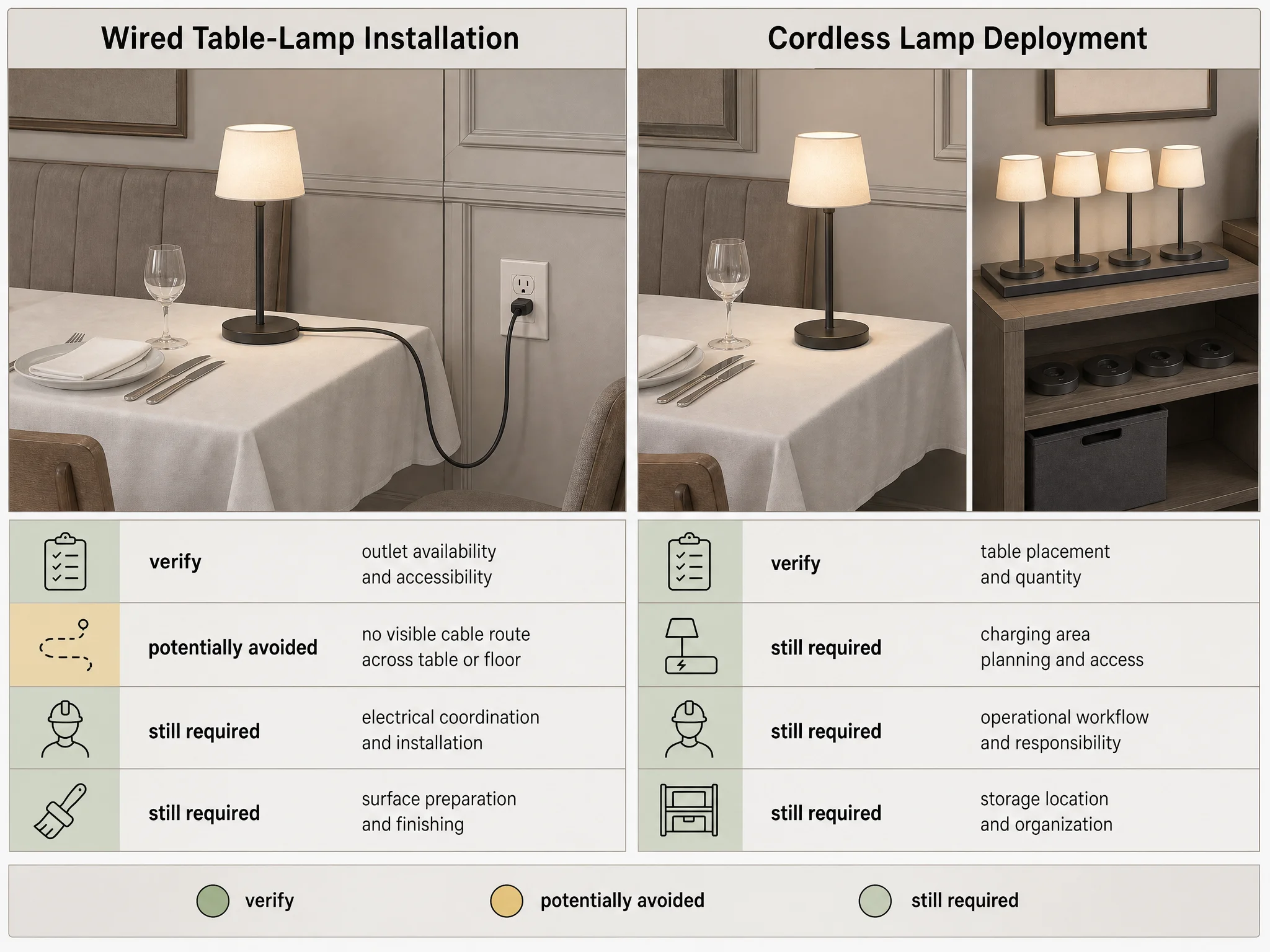
For hotels, restaurants, bars, lounges and other commercial venues, a table lamp can look like a small purchasing decision. The installation method, however, can affect the entire project. A wired lamp may require a nearby outlet, a floor or wall route, coordination with electrical contractors and repairs to finished surfaces. A commercial cordless lamp can be positioned where the guest experience requires light without permanently connecting each table to the building’s electrical system.
That flexibility is especially relevant during refurbishment, fit-out and phased opening work. A procurement team can place light where tables move, seasonal layouts change or outdoor dining operates temporarily. At the same time, cordless products introduce a different operating model: lamps must be charged, stored, inspected and replaced or serviced according to a documented routine.
This guide explains how do commercial cordless lamps reduce installation cost in practical terms. It focuses on cost categories that hotel, restaurant and commercial lighting buyers can verify, not on unsupported payback claims. Product specifications, local electrical rules, venue conditions and supplier terms vary, so every project should be assessed using its own drawings, labour quotations and operating assumptions.
A wired table lamp normally needs a power source at or near its operating location. Depending on the layout, this can mean new outlets, floor boxes, cable routes or concealed connections. Each point may require design coordination, materials, installation, testing and finishing.
A cordless lamp uses an internal rechargeable power source instead of a permanent cable during service. The venue therefore has more freedom to place lighting on a dining table, reception console, lounge side table or temporary event setting. The saving is greatest when the original design does not already include suitable outlets or when the table positions are likely to change.
Procurement should ask the electrical contractor to identify which work is genuinely avoided. If an outlet is already planned for another purpose, the cordless option may not eliminate the whole electrical package. It may still reduce accessories, cable management or table-level connection work, but the value should be recorded accurately.
Installing power in an existing hotel or restaurant can involve opening walls, lifting flooring, routing cable through joinery or working around finished decorative surfaces. The final scope depends on the building and the applicable electrical requirements. Where a cordless lamp removes the need for a new table-level supply, some of those activities may no longer be needed.
This is not a claim that cordless lamps eliminate all electrical work. Charging stations still need a suitable power arrangement, and the venue may need compliant sockets, circuit capacity and safe storage. The difference is that power can be concentrated in a designated charging area rather than distributed to every service position.
Ask for a marked-up layout showing:
That drawing helps separate a real installation saving from a simple change in where work occurs.
A wired installation often requires a sequence of trades: electrical preparation, fixture connection, testing, furniture coordination and final making-good. A cordless lamp can usually be deployed by placing it on the approved surface and completing the charging and operational checks. The exact labour requirement still depends on the product, quantity and venue policy, but point-of-use installation is generally less construction-intensive than permanent wiring.
For a multi-area project, estimate labour by work package rather than using a broad percentage.
Potential point-of-use labour reduction = avoided outlet or connection tasks + avoided surface reinstatement + avoided fixture coordination − cordless deployment and charging setup.
The result may be positive in a refurbishment or flexible layout. In a new build with outlets already included, it may be smaller. Request separate labour lines for electrical work, finishing, furniture installation and lamp deployment so the alternatives can be compared fairly.
Cost is not limited to an invoice. A restaurant that closes an additional service period for electrical work may lose operating capacity. A hotel may need to protect finished flooring, relocate furniture or coordinate access between guest areas and contractors. Dust, noise and restricted circulation can also affect a soft opening or phased refurbishment.
Cordless lamps can reduce the number of locations where construction work is required. That may shorten coordination around dining tables and public areas, although the actual effect depends on the scale of the electrical scope. Treat this as a project-risk and scheduling benefit, not as a guaranteed monetary saving.
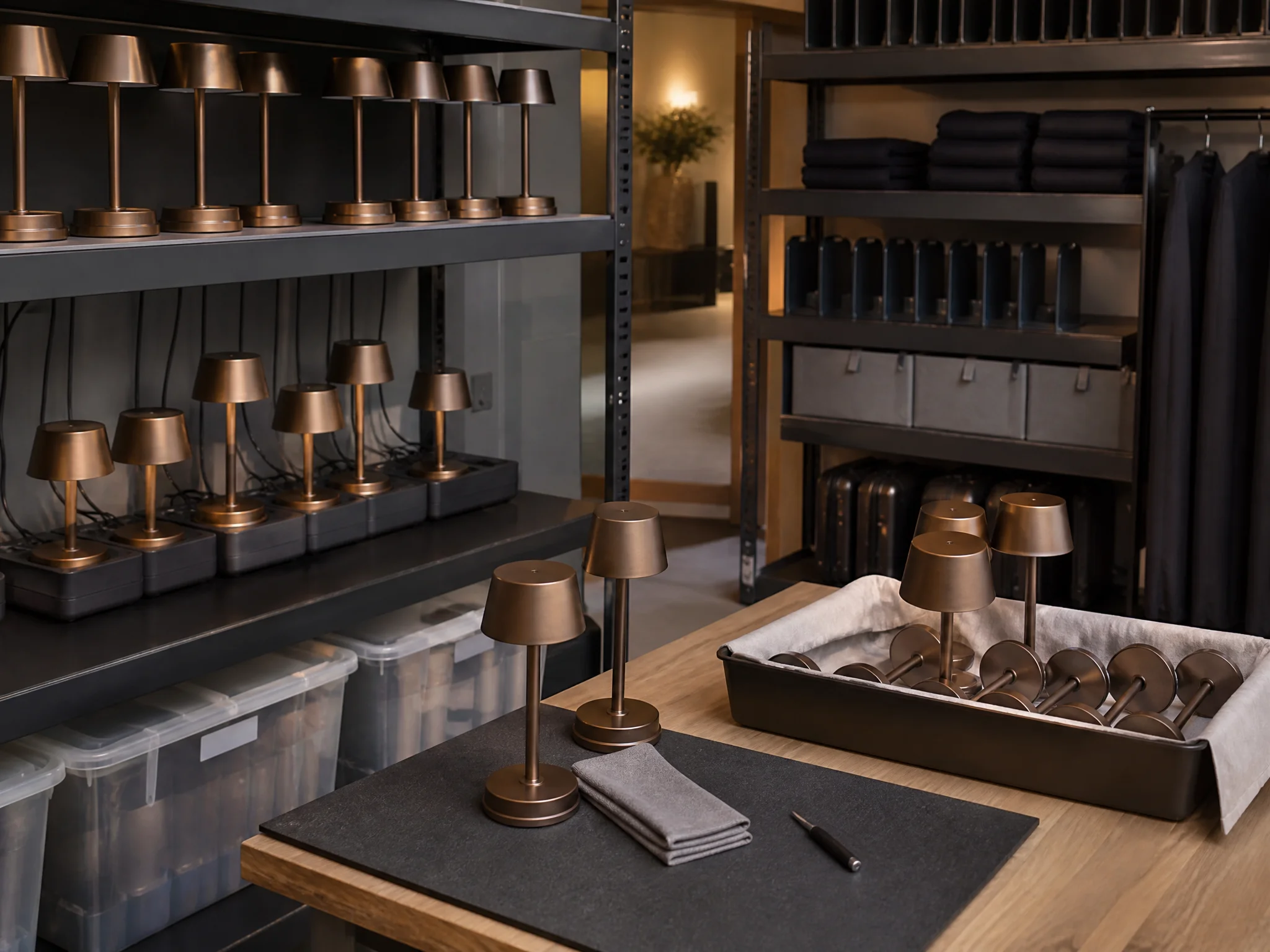
In a quotation comparison, record:
A lower-disruption approach can be valuable even when the purchase price of the cordless fleet is higher than a basic wired lamp.
Hotels often combine fixed public areas with changing event, lounge and dining configurations. Cordless lamps can be useful where furniture moves between breakfast, conference, reception and evening arrangements. The procurement question is not only whether a lamp is attractive; it is whether housekeeping, banqueting and facilities teams can collect, charge, store and redeploy it consistently.
For hotel projects, map each area separately. A lobby may need a different handling routine from a restaurant. Event storage may require identification by room or finish. If a property has several sites, record the approved model, finish, charging method and service process so future orders remain compatible where possible.
Restaurants often need clean table presentation, quick resets and minimal visible cabling. A cordless lamp can avoid cable crossings and give the operator more freedom to change table spacing. It can also support seasonal or temporary outdoor arrangements, subject to written confirmation of environmental suitability for the exact model.
The operating calculation should include the service rhythm. Estimate how many lamps are in use, how many are being cleaned or charged, where staff handle them and what happens when a unit is unavailable. A charging setup that is difficult to access may reduce the installation advantage through additional daily labour.
In offices, members’ clubs and mixed-use spaces, tables may be reconfigured for meetings, dining or informal work. Cordless lighting can reduce dependence on fixed furniture positions. Buyers should still distinguish decorative ambient light from task lighting and confirm the required light level, glare control and user expectations for each area.
A credible evaluation compares the complete system, not only the lamp unit price.
| Cost category | Wired approach to verify | Cordless approach to verify | Procurement question |
|---|---|---|---|
| Point-of-use infrastructure | Outlets, floor boxes, cable routes and connection accessories | Usually no permanent table-level cable during service; charging area still required | Which electrical work is avoided, and which remains? |
| Labour | Electrical installation, testing, furniture coordination and making-good | Deployment, charging setup, commissioning and staff familiarisation | Are labour assumptions itemised by trade and area? |
| Building disruption | Access, dust, noise, surface protection and reinstatement | Reduced work at tables, but possible charging-room preparation | What closure or access assumptions are included? |
| Product fleet | Wired fixtures, lamps and controls | Lamp units, batteries or internal power components and accessories | What exact configuration is quoted? |
| Charging and storage | Often limited to normal fixture power | Chargers, stations, sockets, shelving and labelled storage | Where will charging occur and who owns the routine? |
| Flexibility | Relocation may require electrical changes | Relocation is generally simpler after approval of the use area | Will layouts change seasonally or by service? |
| Maintenance | Fixed connection and lamp/fixture servicing | Cleaning, charging, battery-related service and replacement planning | What parts and support terms are documented? |
| Compliance | Fixed electrical installation requirements | Product, charging, storage and venue safety requirements | Which documents apply to the exact model and market? |
A useful internal decision metric is cost per service-ready lamp position, not simply cost per lamp. Define “service-ready” for the venue: charged, clean, functional, stored correctly and available when required. This prevents a low purchase price from masking avoidable operating work.
Use the following checklist in a request for quotation or specification review.
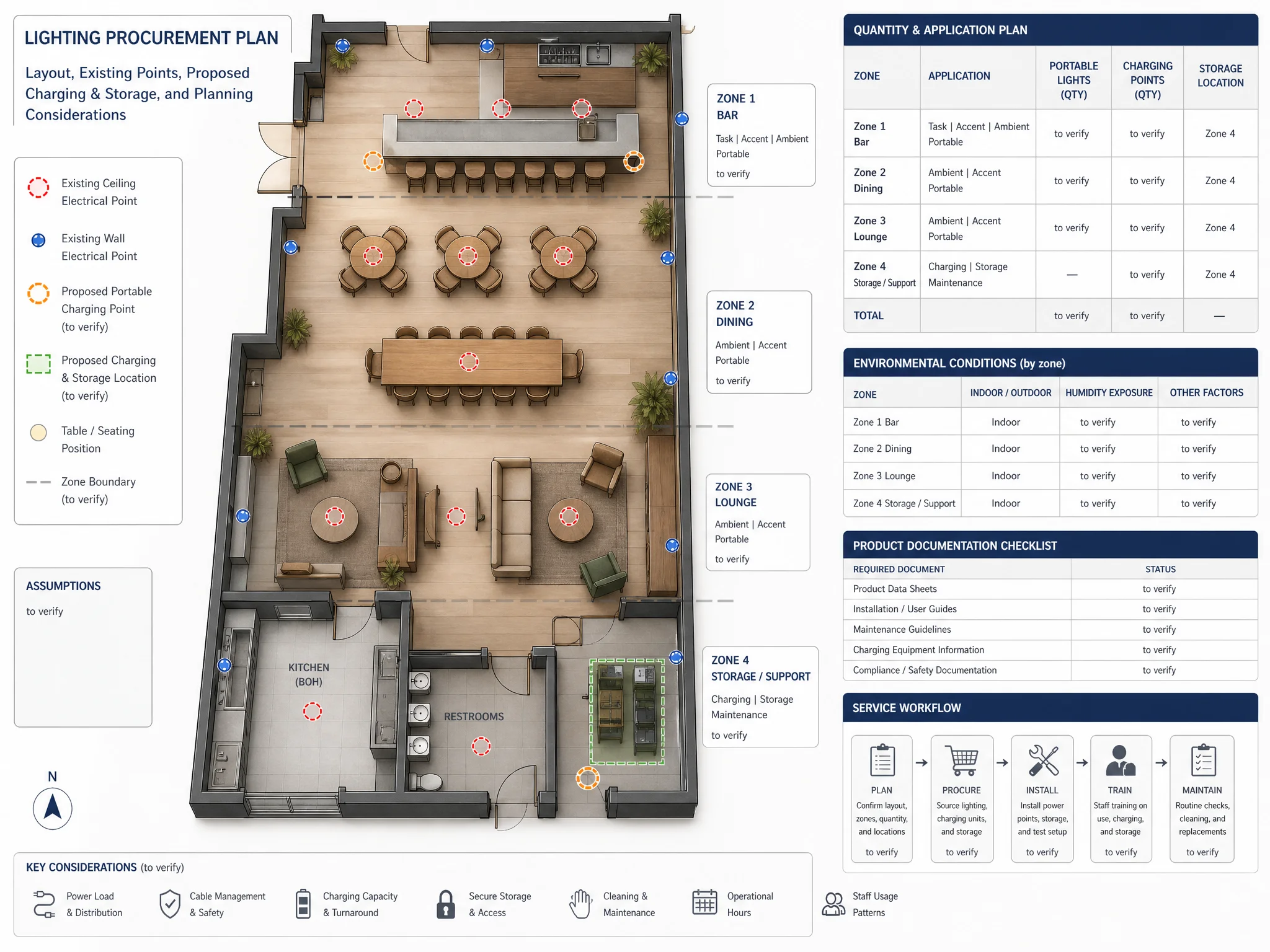
Planning a hotel, restaurant or commercial lighting project? Share the intended venue type, table or seating layout, estimated lamp quantity, indoor or outdoor use, existing electrical provisions, charging preference and target opening date. Ask for two clearly separated scenarios: a wired installation scope and a cordless supply-plus-deployment scope. A like-for-like comparison can show where the real saving exists and where operating costs still need attention.
A lamp-only quote does not represent a complete cordless solution. Include charging equipment, storage, labels, spare planning, delivery, deployment and staff setup. Conversely, a wired comparison should include electrical materials, labour, testing, access and surface repair. Use the same lighting purpose and quantity in both scenarios.
If staff must carry lamps across a long route, connect units individually or search for an unlabelled charger, the daily workflow may become inefficient. Designate a charging location before purchase and test the proposed process with a representative sample. The best installation saving is not useful if the operating routine is unreliable.
“Cordless” describes the power arrangement, not environmental protection. Outdoor dining introduces moisture, temperature, wind, cleaning and storage questions. Ask the supplier for written conditions and limitations for the exact model. If a required rating or use condition is not confirmed, keep it as an open item in the procurement schedule.
A commercial fleet may need service over time. Clarify whether replacement components, compatible chargers and future batches can be supplied. Do not assume that a visually similar lamp uses the same charging system or internal configuration.
Installation cost varies widely by building, labour market, floor construction and project timing. Avoid claims such as “always saves 30%” or “pays back in six months” unless the figures are supported by the project’s own quotations and operating records. Use a range of scenarios and show the assumptions behind each result.
They can reduce the need for dedicated table-level outlets, cable routes, floor boxes, connection work and surface repair. They may also reduce disruption when table positions change. The restaurant should compare those avoided costs with charging equipment, deployment labour, storage and ongoing staff handling.
No. They may be more economical when a project would otherwise require substantial new electrical work or when layout flexibility has value. If suitable outlets already exist, a wired option may have a lower initial cost. Use a site-specific total-cost comparison rather than a general assumption.
No. The lamps may avoid permanent connections at each table, but the charging area may still need compliant sockets, circuits, equipment and safe storage. Confirm the remaining electrical scope with the responsible professional for the venue and market.
Start with the number of service-ready lamps required by area and operating period. Then map cleaning, charging, storage, maintenance and peak-use rotation. Charging capacity should be based on the exact lamp and station configuration, the available charging window and the venue’s workflow. Ask the supplier to document the assumptions rather than relying on a generic port count.
They can be considered when the exact product is documented as suitable for the intended outdoor conditions. Confirm environmental limits, protection information, cleaning instructions, wind stability and storage requirements. Never infer suitability from the word “commercial” or from a product photograph.
Include avoided electrical materials and labour, reduced finishing or disruption where applicable, cordless product and charging costs, deployment labour, storage, maintenance, replacement planning and any compliance or training requirements. Use actual quotations or clearly labelled assumptions. ROI should be calculated for the project’s defined period and service requirement.
Request a product specification sheet, charging and care instructions, configuration details, sample approval record, warranty and service terms, replacement-part information, delivery assumptions and any relevant compliance documentation for the destination market. The required documents vary by project and jurisdiction.
Commercial cordless lamps can reduce installation cost by moving the power requirement away from every individual table or movable position. The strongest opportunities usually come from avoiding new point-of-use electrical work, reducing surface disruption, simplifying deployment and retaining layout flexibility. Those benefits are most meaningful in refurbishments, flexible hospitality layouts and projects where wired infrastructure would be difficult or disruptive.
The decision should still be made on total cost and operating practicality. Include the lamp fleet, charging and storage system, deployment labour, staff workflow, maintenance, replacement planning and the electrical work that remains. Ask suppliers and contractors to document assumptions for the exact model, venue and installation scenario. With a marked-up layout, itemised quotations and a service-ready workflow, procurement teams can evaluate whether cordless lighting offers a genuine installation advantage rather than relying on a broad marketing claim.
Ready to compare a cordless lighting approach for a hotel, restaurant or commercial venue? Prepare your venue type, layout, quantity, finish preference, operating hours, indoor or outdoor conditions, existing electrical provisions and charging location. Request a written product specification, sample plan and separated supply-and-deployment quotation. That information gives your design, facilities and purchasing teams a clear basis for approval.
Note: This article provides a procurement framework, not project-specific electrical, legal or compliance advice. Confirm applicable requirements with the responsible professionals and authorities for the installation location.