
 EN
EN
Quick Links

A hotel should choose a cordless table lamp charging system by matching the complete lamp fleet to the property’s operating routine. Start with the number of lamps used in each zone, the required illuminated hours, the time available for charging, the location where staff will collect and return lamps, and the exact compatibility requirements of the selected lamp family. Then compare centralized, distributed and hybrid charging layouts using verified supplier information.
The key procurement principle is simple:
Choose the charging system that supports the hotel’s real lamp-handling workflow, not the station with the highest advertised capacity.
A hotel may use cordless table lamps in a lobby lounge, restaurant, bar, private dining room, conference area, rooftop terrace or guest amenity space. Those zones may close at different times, have different cleaning routines and require different lamp quantities. A single back-of-house station may be efficient for one property, while several smaller stations may be more practical for a multi-floor hotel.
This guide provides a structured way to evaluate a commercial cordless table lamp charging system without relying on unsupported runtime claims, unverified certifications or generic consumer advice.
A charging system is part of the operating solution. Before requesting a quotation, the hotel team should create a short project brief covering the following inputs.
List every area that will use cordless table lamps:
Record the planned number of lamps for each zone instead of using the total number of tables as a substitute. Long communal tables, wide dining settings and decorative clusters may require different lamp ratios. A hotel may also keep a separate pool for events or seasonal outdoor service.
The same lamp fleet can require different charging arrangements depending on the hotel schedule. A restaurant that closes late may have a short overnight charging window. A lobby lounge may operate continuously and require rotation during the day. Event operations may need lamps returned to service between functions.
The procurement brief should record:
A professional hotel operation should define how lamps are handled when they are dirty, damaged, missing or awaiting inspection. A rotation pool can keep the guest-facing fleet consistent, but its size should be agreed with the operator based on service intensity and maintenance practice. Do not apply a universal spare percentage without understanding the property’s workflow.
The distance between guest areas and the charging location affects labor, handling time and the risk of misplaced units. A centralized charging room can simplify control, but it may require more staff trips. A zone-based system can shorten handling routes, but it introduces more locations to inspect.
Confirm the exact lamp models before approving a charging station. The supplier should state whether the system is designed for the selected lamp family, how lamps are positioned, what charging method is used, whether mixed models are supported and what happens if a position is not occupied correctly.
There is no universally correct layout. The right model depends on the property’s architecture, staffing pattern and operating schedule.
| Charging approach | Best fit | Operational advantages | Procurement points to verify |
|---|---|---|---|
| Centralized | One main hotel operation with a practical back-of-house route | Easier inventory counting, inspection and staff training | Travel distance, storage, electrical preparation, access control and capacity during peak turnover |
| Distributed | Multi-floor properties or zones with different closing times | Shorter handling routes and easier zone-based allocation | Multiple inspection points, consistent installation, cable management and inventory accuracy |
| Hybrid | Hotels with a main fleet plus separate terraces, bars or event areas | Central control with local flexibility | Which lamps remain in each zone, how stock is reconciled and how charging standards stay consistent |
Centralized charging is often easier to manage when the hotel has a suitable back-of-house room, predictable closing routines and a fleet that can be moved efficiently. It can also make it easier for a supervisor to inspect lamp condition, separate units for cleaning and confirm charging status in one place.
The hotel should still calculate staff movement. If employees must carry lamps through several floors or across a large property every day, the apparent simplicity of one station may create avoidable handling work.
Distributed charging may be appropriate when the lobby, restaurant, terrace and event teams operate independently. It can reduce movement and allow one zone to prepare its lamps while another remains open. The trade-off is greater operational discipline: each station needs clear ownership, inspection procedures and a way to reconcile the lamp count.
A hybrid layout may combine a main charging area with smaller zone-based units. For example, the main fleet may be managed centrally while terrace or event lamps are charged closer to the area where they are used. The specification should make the ownership and replenishment process explicit so that the hotel does not accumulate incompatible charging equipment.
A supplier may describe a station by its number of positions, but the hotel should ask for usable capacity under the selected lamp configuration. Define how many compatible lamps can be placed, connected and charged in the hotel’s actual operating cycle.
Questions to ask include:
The charging method should support a repeatable staff action. A good workflow is easy to describe: collect, wipe, inspect, position, confirm and return. If staff need to guess where a lamp belongs or whether it is charging, the system can create avoidable errors.
Review the physical placement of lamps, indicator visibility, cleaning access, cable routing, shelf height, ventilation and protection from moisture. The exact requirements depend on the selected equipment and the installation environment, so the supplier should provide product-specific guidance rather than generic statements.
Hotel buyers should not compare runtime numbers without the conditions behind them. Ask the supplier to identify the brightness level, operating mode, battery condition, charging method and other relevant test conditions used for any runtime statement.
The practical question is not simply “How many hours does the lamp last?” It is:
Will the lamp maintain the hotel’s required lighting level for the planned service cycle, with an operating reserve and a workable recharge process?
If the hotel uses different dimming levels in the lobby, restaurant and terrace, request a test approach that reflects those differences. Avoid publishing or approving a runtime figure that is not confirmed for the exact model and configuration.
The project team should confirm outlet locations, power requirements, cable routing, shelving or mounting needs, access restrictions and the location of the charging equipment. Outdoor and semi-outdoor zones require additional attention to where charging equipment is stored and protected. The charging station should not be placed in an unsuitable environment merely because the lamps are used outdoors.
Hospitality lamps are handled frequently. Review how the surface is cleaned, how the base is inspected, how damaged units are separated and how replacement parts are ordered. Ask whether the supplier provides a maintenance procedure, spare-part support and a defined route for technical questions.
A system that is easy to clean and inspect can reduce the chance that a low-performing or damaged unit reaches a guest-facing table. The exact service interval and replacement policy should be agreed with the supplier and hotel operator, not invented in the article or procurement brief.
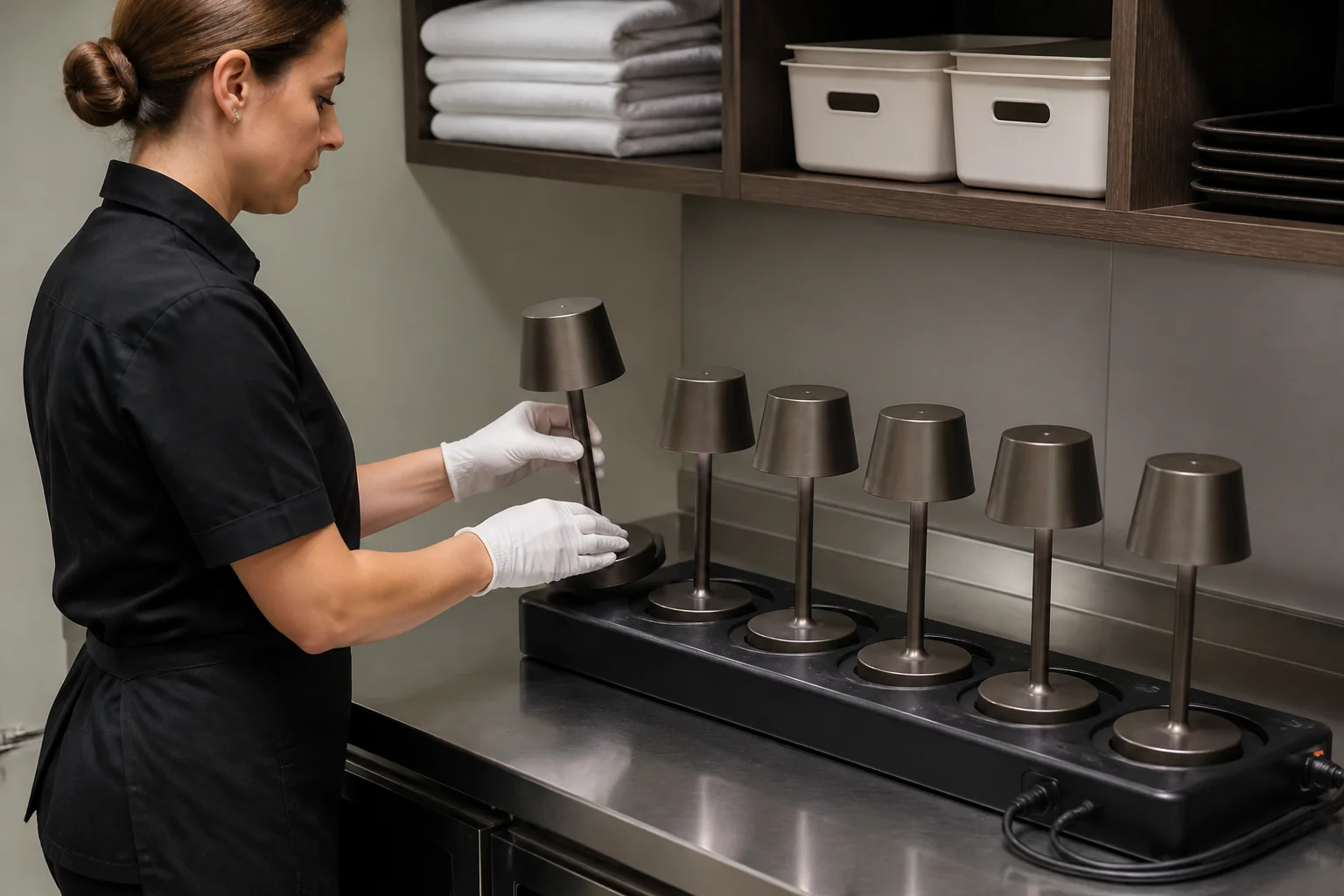
Caption: A repeatable collect–inspect–charge workflow helps hotel teams manage cordless table lamps consistently.
A weighted evaluation table helps the purchasing team avoid choosing only on price or port count. The hotel can score each supplier against its own priorities.
| Evaluation area | What to request | Why it affects the project |
|---|---|---|
| Compatibility | Written confirmation for the exact lamp family | Prevents incompatible equipment and replacement complexity |
| Usable capacity | Capacity under the selected lamp and charging configuration | Supports realistic fleet sizing |
| Workflow | Placement, indicators, cleaning and return-to-service steps | Reduces staff errors and handling friction |
| Site fit | Footprint, location, access, cable routing and environment | Determines whether the system is practical to install |
| Runtime evidence | Test conditions and operating assumptions | Makes performance comparisons more meaningful |
| Serviceability | Replacement parts, fault handling and technical support | Reduces downtime and operational uncertainty |
| Quality control | Sample approval, functional checks and shipment inspection plan | Creates clearer acceptance criteria |
| Commercial terms | Quantity, lead time, packaging, customization and delivery terms | Connects the system to project budget and schedule |
The scoring method should be transparent. A hotel may assign more weight to compatibility and workflow than to cosmetic options if the lamps will be used every day across several zones.
Before asking for a final quotation, prepare the following checklist:
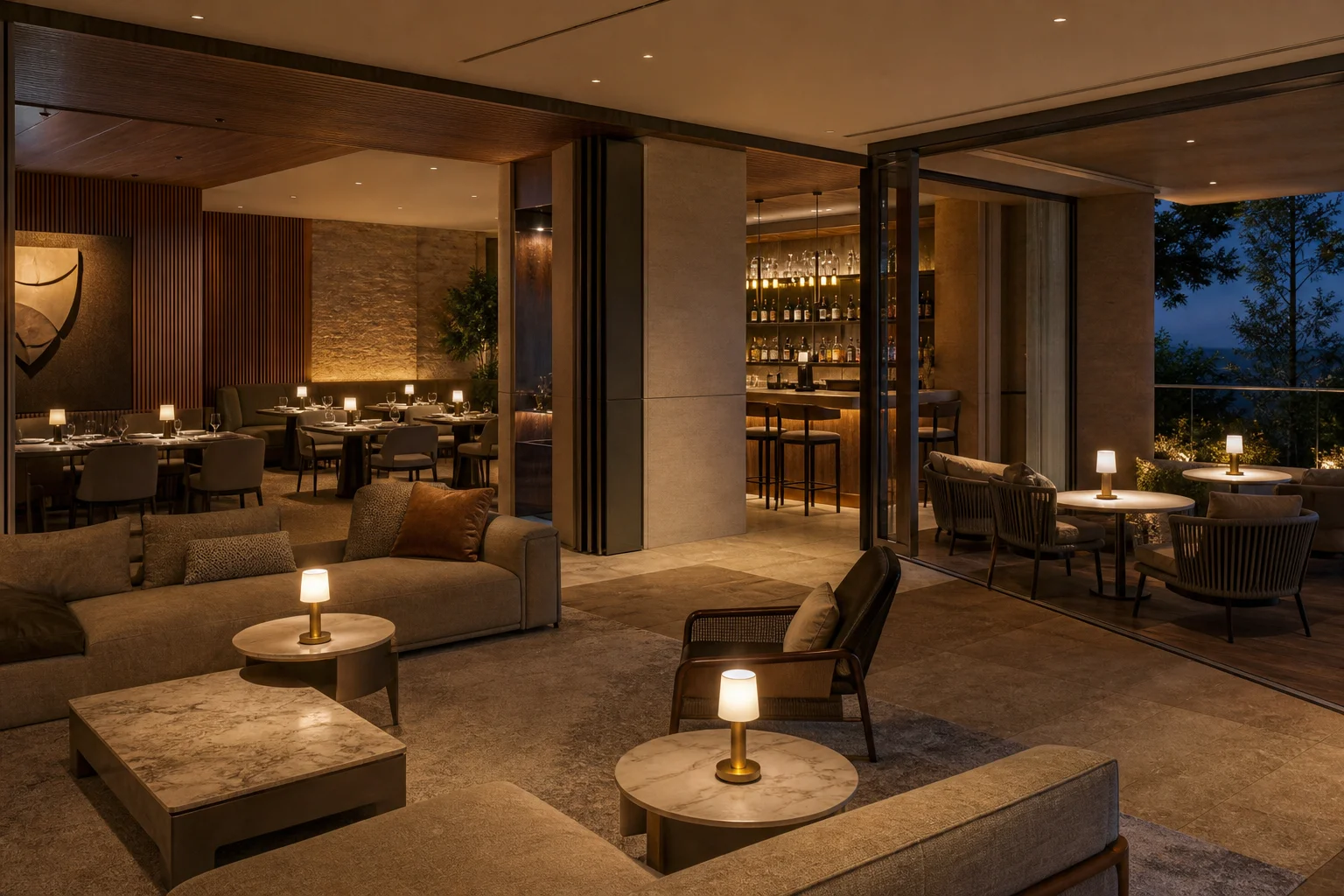
Caption: Zone-based planning helps hotel buyers match cordless table lamp quantities and charging locations to the property layout.
A representative sample or pilot workflow can expose problems that a specification sheet cannot show. The hotel and supplier should agree on what will be reviewed before a larger project order.
A practical review may include:
The purpose of a sample review is not to create unsupported performance claims. It is to confirm that the proposed system fits the hotel’s actual routine and that both parties understand the acceptance criteria.
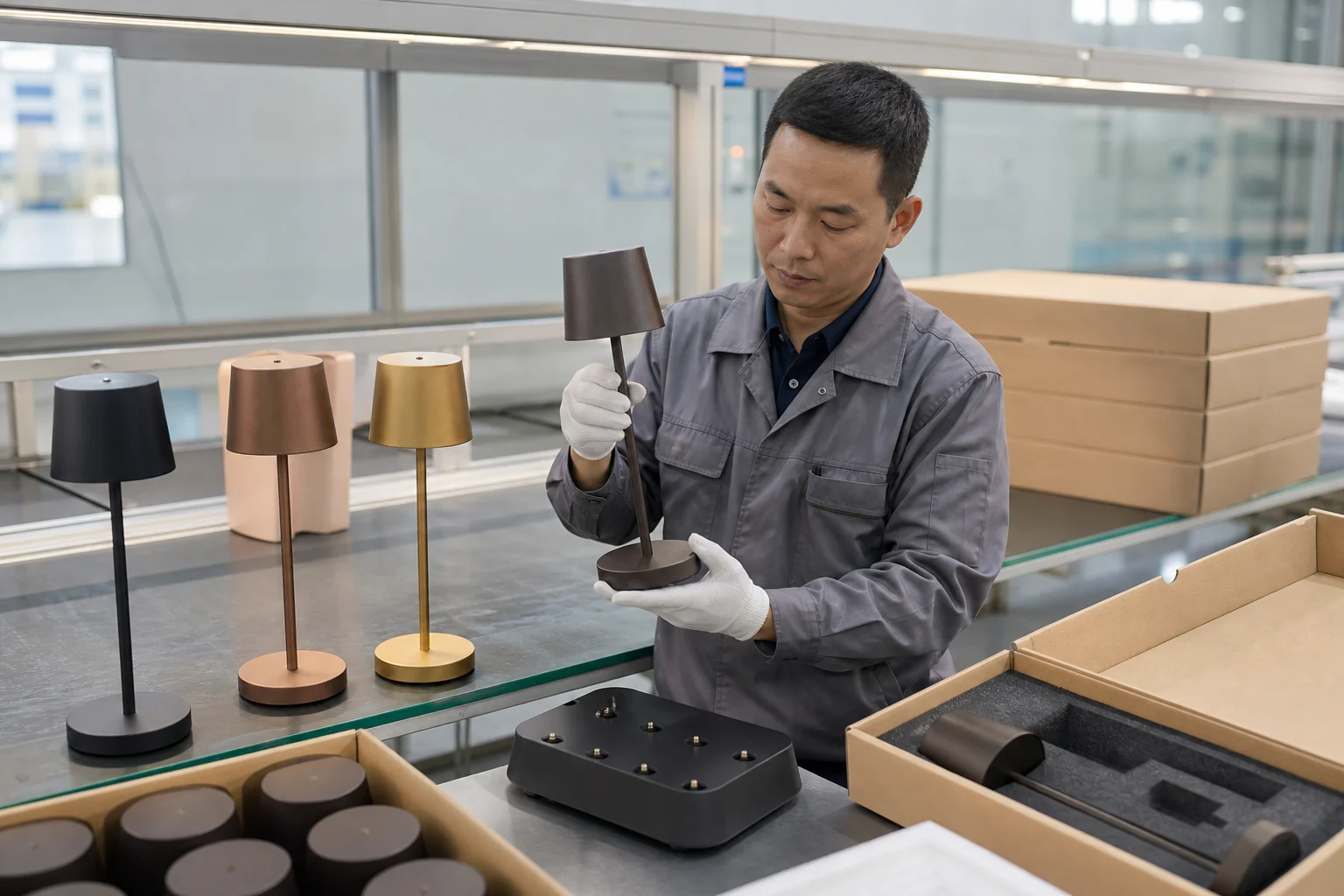
Caption: Supplier quality-control discussions should cover physical fit, finish, charging alignment and shipment readiness without relying on unverified claims.
Planning a hotel lighting project? Share the property’s zones, estimated lamp quantity, service hours, charging window and preferred charging layout. A commercial lighting supplier can use that brief to compare centralized, distributed or hybrid options and identify the information still needed for a quotation.
Button copy: Send Your Hotel Requirements
A larger station is not automatically better. It may be difficult to locate, difficult to expand or poorly suited to the hotel’s staff route. Compare usable capacity and workflow instead.
A lobby, restaurant and terrace may have different schedules and environmental conditions. Use a zone-based brief and decide whether the charging layout should be centralized, distributed or hybrid.
Runtime depends on the operating conditions and the exact product configuration. Request the test assumptions and compare them with the hotel’s service pattern.
Different charging methods or lamp families can increase training, inventory and replacement complexity. Confirm compatibility before approving a mixed fleet.
The charging station is part of daily operations. Define who collects lamps, who checks them, how damaged units are isolated and how the hotel confirms that the service fleet is ready.
A hotel should begin with its lamp fleet, service zones, charging window and staff workflow. Compare centralized, distributed and hybrid layouts, then verify compatibility, usable capacity, charging method, installation needs, runtime test conditions and supplier support for the exact lamp models.
No. Centralized charging can simplify counting and inspection when the hotel has an efficient back-of-house route. Distributed or hybrid charging may work better for multi-floor properties, terraces, bars or zones that close at different times.
The answer depends on the selected station and lamp configuration. Use the supplier’s verified usable capacity for compatible lamps under the hotel’s charging window. Do not rely only on a nominal position count.
Ask for the test conditions behind the runtime statement, including operating mode, brightness level, battery condition and charging assumptions. Then compare those conditions with the hotel’s real service cycle and required reserve.
Not necessarily, but outdoor deployment requires a separate review of lamp protection, storage, cleaning, handling and the environment where charging equipment will be placed. Confirm the requirements for the exact product and installation location.
Yes, a hybrid layout can combine a main back-of-house charging area with smaller zone-based stations. The hotel should document lamp ownership, replenishment, inspection and inventory reconciliation so that the system remains consistent.
Include zone-by-zone quantity, operating hours, charging window, lamp models, charging method, usable station capacity, installation location, finish or packaging requirements, sample expectations, quality-control checkpoints, delivery destination and any model-specific compliance documentation required by the project.
A sample or pilot review is useful when the project involves multiple zones or a new charging workflow. Test physical fit, staff handling, charging indicators, cleaning access, storage and the agreed acceptance criteria before scaling the order.
The best cordless table lamp charging system for a hotel is the one that fits the property’s daily operating model. Define the lamp fleet by zone, measure the charging window, plan a rotation and maintenance process, and choose a charging layout that staff can execute consistently. Then verify the exact lamp–station compatibility, usable capacity, installation requirements, runtime test conditions and supplier support.
A disciplined procurement brief helps a hotel compare systems on operational value rather than on port count or unsupported performance language. It can also improve the quality of supplier quotations, sample reviews and project handover.
Ready to specify a hotel cordless lighting system? Send your property layout, target lamp quantity, service zones, required runtime, charging window and delivery market. Our team can review the brief, recommend suitable charging configurations, arrange samples and prepare a project quotation based on confirmed product information.
Button copy: Request a Hotel Lighting Quote