
 EN
EN
Quick Links

Direct answer: To specify cordless table lamps for a hotel project, start with the guest area and operating schedule, then define the lamp's light quality, controls, environmental exposure, cleaning routine, charging workflow, documentation and service requirements. Do not select a lamp from a product photograph alone. A suitable specification must work for guests, housekeeping, food-and-beverage teams, purchasing, facilities and the supplier over the full operating cycle.
Hotels use cordless table lamps in restaurants, bars, lounges, lobby seating, terraces, suites, meeting areas and event spaces. These locations do not have the same lighting objective or operating conditions. A restaurant may need an unobtrusive lamp that supports table presentation and can be collected quickly after service. A lobby may prioritize visual consistency and flexible placement. An outdoor dining area may require a documented environmental rating appropriate to its exposure. The procurement decision is therefore a system decision rather than a simple decorative purchase.

A hotel specification should be written so that a buyer can compare suppliers on the same basis. It should describe the application, required appearance, functional expectations, operating environment, charging process, quality documentation and commercial terms. If an item is not yet decided, mark it as an open requirement rather than allowing a supplier to make an assumption.
| Specification area | Questions for the project team | Evidence to request from the supplier |
|---|---|---|
| Application | Which venue will use the lamp, and what guest experience should it support? | Application photographs, sample review and placement guidance |
| Light output and control | Is the light intended for atmosphere, table visibility, wayfinding or a combination? | Photometric information where available, control description and sample assessment |
| Operating cycle | When will lamps be switched on, collected, charged and returned to service? | Supplier guidance for the proposed operating workflow; do not accept an unsupported runtime promise |
| Environment | Will the lamps remain indoors, move between areas or be exposed to weather? | Relevant test or rating documentation for the exact model and intended environment |
| Cleaning and handling | What cleaning products, handling frequency and storage conditions are expected? | Care instructions, surface guidance and replacement-part information |
| Charging system | Where will charging happen, who will manage it and how will the fleet be organized? | Charging layout, compatibility information and safe-use instructions |
| Commercial terms | What quantity, delivery window, packaging and service support are required? | Quotation, lead-time statement, sample process and after-sales terms |
Begin with a room-by-room or zone-by-zone schedule. Record the number of guest tables or display positions, the required visual effect, the expected hours of use, the frequency of movement and the responsible operating team. Separate indoor restaurant tables from outdoor terraces, hotel bars from reception lounges and permanent placements from event inventory.
Restaurant lamps are judged in the context of table spacing, tableware, food presentation and service movement. The specification should address footprint, stability, glare control, dimming or other available control methods, finish consistency and whether the lamp can be moved safely during setup and clearing. Ask the supplier to explain how the lamp should be cleaned and stored between services. Avoid selecting a model solely because it looks attractive in a static lifestyle photograph.
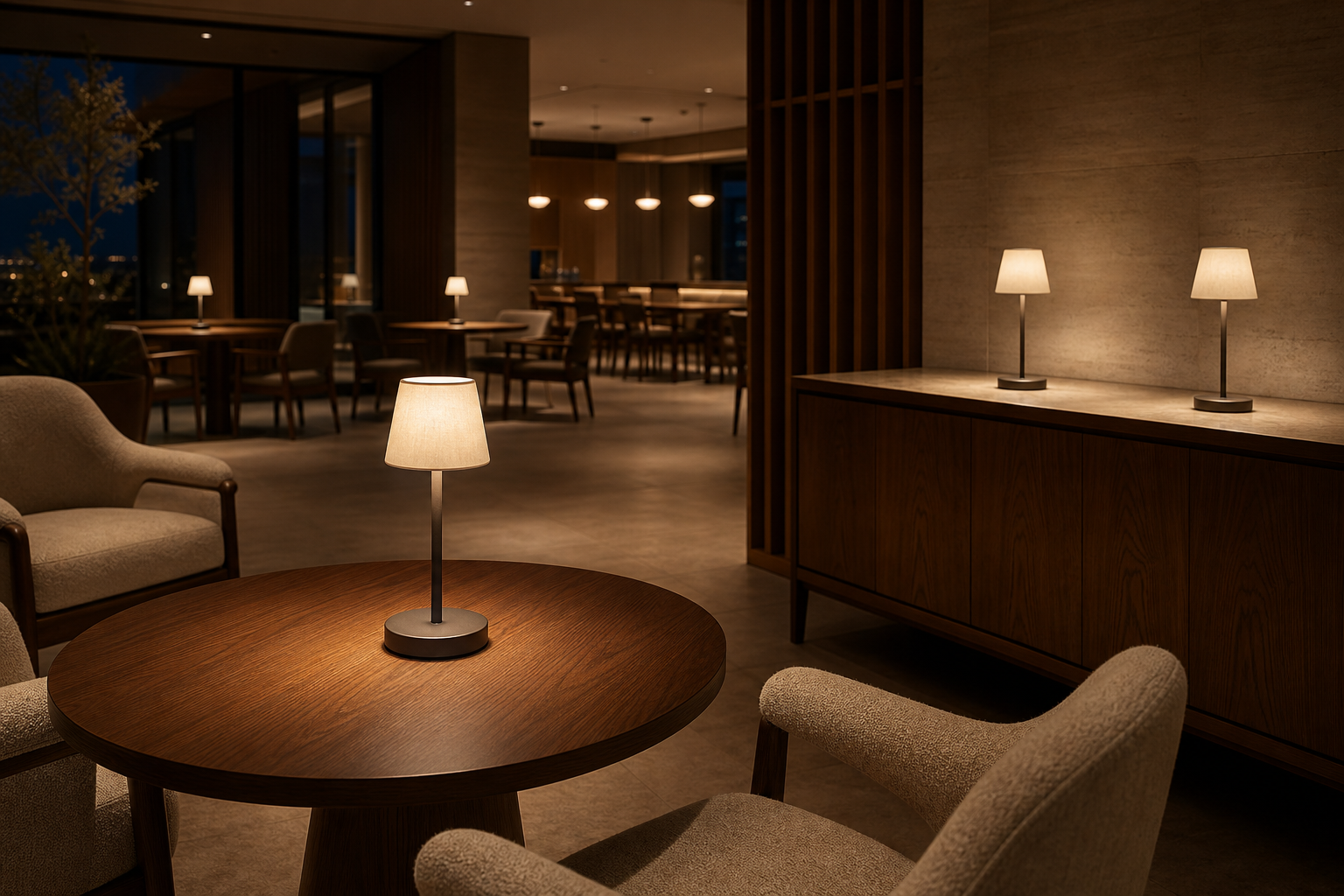
Lobby and lounge placements often need a coherent appearance across different furniture groups. Specify the intended visual family, finish consistency, light direction and the locations where the lamp may be moved. If the same fleet will serve multiple spaces, note which requirements are shared and which are location-specific. A lamp that works on a small restaurant table may not be the right choice for a deep lounge table or a high-traffic bar counter.
Outdoor use should be treated as a separate specification. Identify whether the lamp may encounter rain, splash, condensation, dust, salt air, direct sun or temperature changes. Request the exact environmental rating and supporting documentation for the proposed model; never infer suitability from the words "outdoor" or "water-resistant" in a sales description. Also define where lamps will be stored and charged, because the charging area may need a controlled indoor location even when the lamps are used outside.
Hotels should describe what guests and staff need to see, not force a supplier to guess from a vague phrase such as "warm light." Ask the design and operations teams to review the sample in the actual or representative setting. Record whether the light feels comfortable at the guest's eye level, whether it creates distracting glare, whether it supports table presentation and whether different samples appear consistent.
If the project has defined requirements for colour temperature, colour rendering, dimming range, beam distribution or illuminance, place those requirements in the specification only when the project team has approved them. Request the supplier's data for the exact model and configuration. If the project has not approved a number, use a descriptive requirement and a sample review gate instead of creating a false technical target.
The question "How long does the lamp last?" is incomplete without a defined operating cycle. A hotel should describe the expected start time, service duration, brightness or control pattern, collection time and contingency plan. The supplier can then state what runtime information is available for the exact configuration and how it was determined. Avoid publishing a single runtime figure as a universal promise when the result depends on settings, age, temperature and usage.
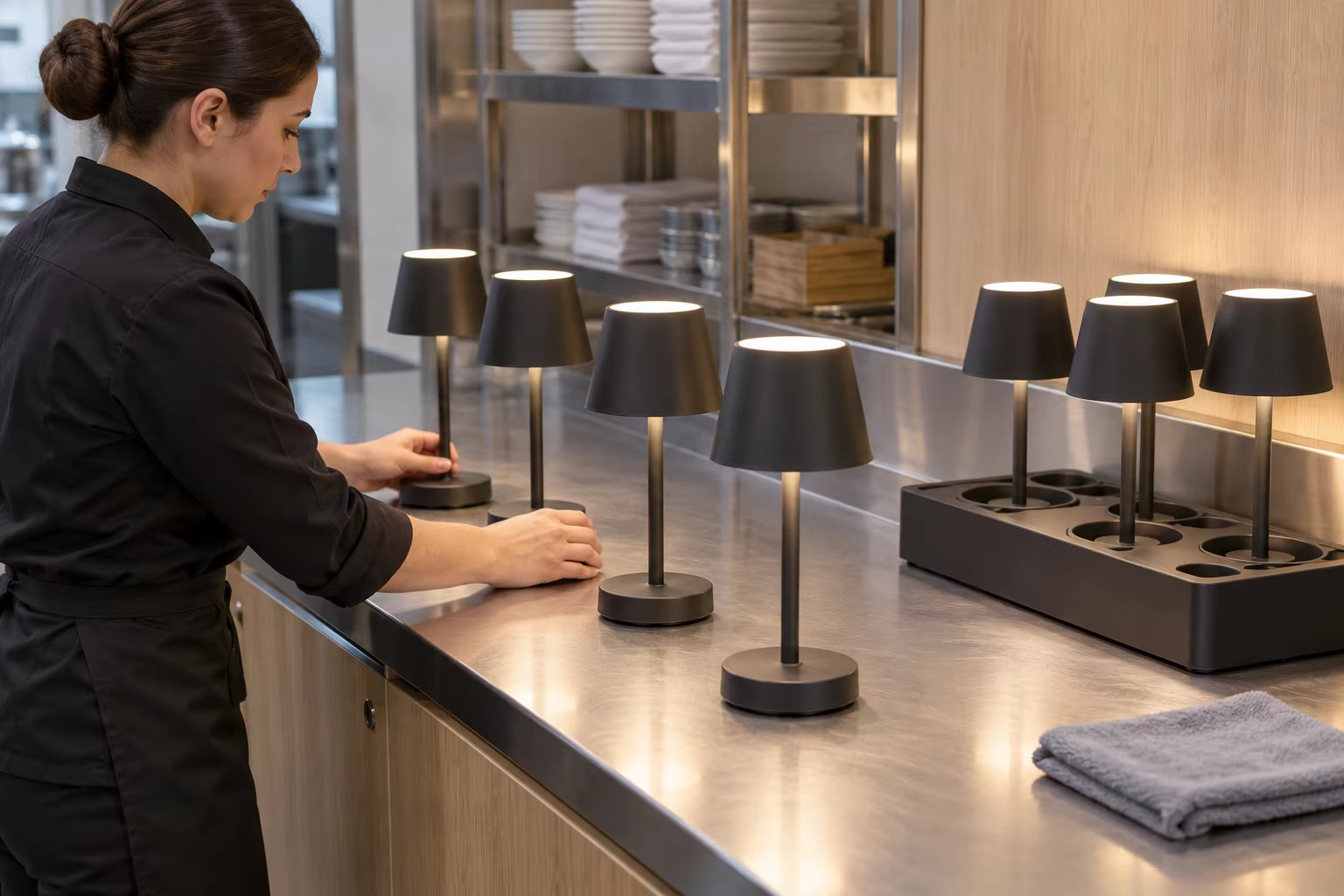
Plan charging as an operational process. Decide whether lamps are charged in a back-of-house room, service pantry, storage area or a mobile setup. Assign responsibility for collecting, checking, charging, cleaning and returning the lamps. Labeling can be considered if the hotel needs to separate fleets by venue, but the labels and workflow should be agreed by the operator rather than assumed in the product specification.
Mid-article procurement CTA: If you are planning a hotel restaurant, lounge or terrace lighting package, send the venue list, estimated fleet size, indoor/outdoor split and target delivery window to our team. We can help turn the operating requirements into a comparable cordless table lamp specification and quotation request.
Commercial suitability is not a label; it is the result of matching construction, finish, handling and service expectations to the venue. A hotel project should ask how the lamp will be transported, placed, cleaned, stored and inspected. Consider table turnover, trolley movement, accidental knocks, stacking limits, moisture exposure and the availability of replacement components.
Request documentation for the exact model rather than a generic product family. Useful documents may include a user manual, care instructions, charging guidance, material or finish information, relevant test reports and warranty terms. Where a certification or rating is important to the project, ask for the document that applies to the exact product and market. Do not treat a supplier's general statement as proof for a different model.
Use the same written brief for every supplier. Compare sample appearance, documentation quality, charging workflow, communication, packaging, lead-time clarity and commercial terms. A lower unit price is not necessarily lower total cost if the product creates more handling, unclear charging responsibilities, replacement difficulty or inconsistent appearance across a hotel portfolio.
| Approval gate | Pass condition | Common failure to avoid |
|---|---|---|
| Brief alignment | The supplier repeats the application and identifies open questions. | Quoting a visually similar item without confirming the venue or environment. |
| Sample review | The approved team records appearance, comfort, control and handling observations. | Approving from a catalogue image without seeing the lamp in context. |
| Documentation | Exact-model documents support the claims relevant to the project. | Accepting generic or incomplete documents. |
| Workflow review | Operations can collect, charge, clean, store and return the lamps consistently. | Leaving charging ownership undefined. |
| Commercial review | Quantity, packaging, delivery, service and warranty terms are written. | Comparing unit price while ignoring logistics and service requirements. |
| Pre-production approval | The final configuration is confirmed before the order is released. | Allowing an unapproved finish or configuration change late in production. |
Before requesting a final quotation, confirm that the brief answers the following questions:
They can be suitable when the lamp, environment and operating workflow are specified together. Hotels should review light comfort, handling, charging, cleaning, storage, documentation and service support for each venue rather than assuming that a lamp suitable for one area will suit every hotel space.
Choose through a controlled comparison of relevant samples, exact-model documentation, charging workflow, communication, lead-time clarity, packaging, warranty and after-sales support. The best supplier is the one that can document and support the complete operating requirement, not merely provide an attractive product photograph.
Send the venue types, estimated quantity, indoor/outdoor split, desired appearance, operating schedule, charging expectations, delivery destination, target timing and any project documentation requirements. If the quantity is uncertain, explain the number of tables or positions so the supplier can ask useful follow-up questions.
Not every project uses the same charging arrangement, but every project needs a defined charging process. Ask the supplier which charging method is compatible with the exact lamp model, how the lamps should be organized, who will manage the process and what reserve plan applies when a unit is unavailable.
There is no universal answer without knowing the exposure. Identify the actual conditions—rain, splash, condensation, dust, salt air, storage and temperature—and request the rating and supporting documentation for the exact model. A marketing phrase such as "outdoor" should not replace project-specific evidence.
Approve a physical sample and record the exact model, finish, control configuration and relevant documents. Use the approved reference during quotation, production and incoming inspection. If a revision or substitution is proposed, require a new review rather than treating it as automatically equivalent.
To specify cordless lamps for hotel projects successfully, connect the guest experience with the realities of hotel operations. Map every venue, describe the intended light effect, define the operating cycle, plan charging, verify environmental suitability, request exact-model documentation and compare suppliers through a controlled approval process. This approach gives purchasing and operations a shared standard and reduces the risk of choosing a lamp that performs well in a photograph but poorly in a real service workflow.
Final project CTA: Share your hotel venue list, target quantity, indoor/outdoor requirements and delivery plan with our commercial lighting team. We can help prepare a product comparison, sample review checklist and B2B quotation request for premium commercial cordless table lamps.
Editorial note: Product suitability depends on the exact model, configuration, environment and operating practice. Confirm all technical, safety, environmental and commercial details with the supplier before purchase.