
 EN
Quick Links

A flip-to-call table lamp can give restaurant guests a visible way to ask for attention. Its usefulness depends on a practical question: can someone responsible for the table see the signal from the places they actually work? A lamp that looks clear in an empty dining room may be hidden during service by a seated guest, a menu, flowers or a partition.
For restaurant operators, hotel buyers and hospitality distributors, a sightline review is a way to assess the system before committing to a full order. The JB-TL01 provides an example: supplied product information describes a selected ambient color in the normal position and a solid red visual alert when the lamp is flipped with the red ring facing up. Verify the current sample and configuration with the supplier. The lamp’s visible state is a local cue; it does not establish a notification to a phone, pager or watch.
This guide explains how to map the room, test a sample, record uncertain views and prepare a rollout decision. The procedures are recommendations for the venue, not results from a measured customer project.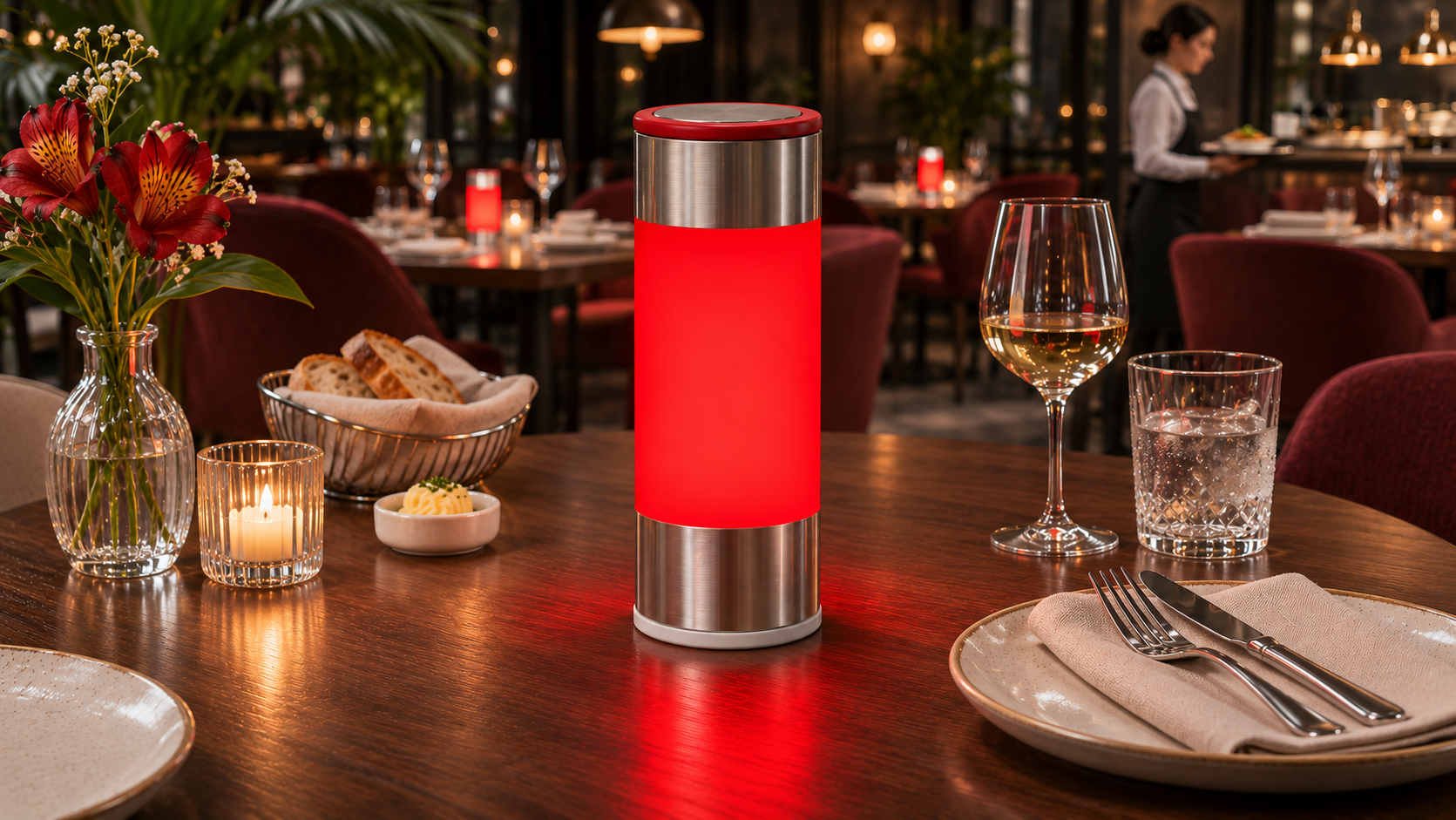
Place a representative lamp on each table type, set the room for service and inspect the red state from the positions where the assigned staff member and backup actually work. Repeat in relevant lighting and seating conditions. Record where the signal is visible, partially obstructed or not reliably visible, then assign a remedy and retest.
A practical review includes table placement, a primary observer, a backup route, normal objects and seated guests, service lighting, guest access and a fallback method. It should not promise that every signal will be noticed within a particular time unless the venue has measured and accepted a process for its own operation.
In an empty restaurant, a lamp may be visible from the center of the room. During service, a person’s shoulder, a tall bottle, a menu holder or a pillar can block that view. Staff may also spend part of a shift at the pass, behind the bar or in another section, where the lamp cannot be seen at all.
Lighting changes matter too. Daylight, a bright window, reflections and decorative red objects can affect how easily a cue is distinguished. A successful review therefore uses the venue’s real tables, normal table objects and representative working positions. It should include the periods in which the space is brightest and darkest, if those conditions are relevant.
Seeing a red lamp and responding to a guest are related but separate steps. The product creates the visible signal described in its current specification. The restaurant assigns who watches, how the table is acknowledged, who follows up and when the lamp is returned to its normal orientation.
A visual cue does not create an electronic log, identify a table on a remote screen or notify staff through a wall. If those functions are required, specify them separately and verify the actual system. A local visual lamp should not be presented as an emergency alert or a guaranteed response mechanism.
Start with a simple floor plan or a list of table numbers. Mark permanent obstructions, entrances, the bar, service stations, pickup points, normal staff routes and areas that open only for special events. The plan need not be elaborate, but it should reflect the layout the team expects to use.
For each zone, identify a primary observer role and a backup. Record where that person normally stands or passes, rather than assigning a point that is convenient only during a demonstration. A service station behind a wall cannot provide a direct view simply because it belongs to the same section.
A two-person table, a large shared table, a booth and a bar counter each place lamps and guests differently. Select representative examples of each. If the restaurant joins tables or changes seating for events, include those arrangements in the review and define when the plan must be repeated.
Identify positions that are not used simultaneously. If a private room is open only for events, give it a separate owner and fallback rather than assuming the main dining room team will always see it. If a table has no reliable line of sight, mark the issue clearly; do not hide it inside an overall pass percentage.
A simple record can distinguish visible, partially obstructed, not visible from the assigned position, and not yet checked. Add the table number, observer position, lighting condition, normal table setting and the corrective action. Use the restaurant’s own acceptance standard; these categories are an organizing method, not a certified performance test.
An issue is resolved only when the agreed action has been implemented and checked again. A lamp may be visible after a table is moved, for example, but the original location remains unsuitable unless the venue changes the operating plan.
Use the actual table dimensions and a representative place setting. Include menus, glassware, centerpieces, condiments and the objects that staff normally place on the table. Position the lamp where it can remain stable, where guests can reach it and where it does not interfere with the venue’s serving and clearing routine.
Do not prescribe one universal distance from a plate or table edge without knowing the furniture and service style. Observe the space from each seat and from the staff approach. Ask whether the lamp obstructs conversation, reduces room for dishes or is likely to be moved behind other objects during the meal.
For JB-TL01, the supplied description identifies the red-ring-up orientation with a solid red alert; the normal position displays the selected ambient color. Confirm those states on the supplied sample, including which end is up and how the chosen ambient setting is applied. A staff instruction should match the actual product and not rely on color alone: orientation and the venue’s written procedure can help explain the state.
The lamp should have a clear position in both orientations. Check that turning it over is practical without disturbing hot dishes, drinks or guests. Do not instruct guests to use a damaged or unstable product. Follow the supplier’s current handling instructions.
With permission from the venue, ask team members to sit in representative seats while another person checks the view from normal staff positions. Include full place settings and commonly used furniture. This is a proposed venue exercise; do not describe it as a factory test or a customer result unless it actually occurred and is documented.
Check what happens when a staff member approaches with a tray or pauses at a service point. A clear view from one static location does not necessarily mean the lamp remains visible throughout the staff member’s real route. Record gaps and the backup arrangement.
Evaluate the sample under the venue’s relevant daytime and evening conditions. A red signal in front of a dark wall can appear different from one against a bright window or red décor. Reflections from glassware and nearby lamps may also make a table harder to scan.
Ask the supplier how ambient color and brightness are configured on the actual station and whether any setting affects the described alert. Do not assume that an ambient setting, a photo or a competitor’s specifications establish how the production unit behaves. Record the sample configuration used in the review so the result can be repeated.
A lamp that is easy for staff to see must also be suitable for guests. Observe it from seated eye level and from across the table. Look for reflections in glasses, direct brightness, a distracting position or interference with menu reading. The venue’s ambient lighting remains part of the overall experience; a table lamp is not automatically a substitute for the room’s general lighting.
If a proposed position causes glare or takes up essential service space, try another position and retest the staff sightline. The objective is an agreed arrangement that supports both guest comfort and the team’s workflow.
Write a short operating rule before the trial. For example: when a guest sets the lamp to the verified red alert orientation, the assigned server or backup acknowledges the table, identifies the request and restores the normal state according to the venue’s agreed procedure. The exact reset and guest instruction must match the sample and the restaurant’s service policy.
Name a backup role for breaks, busy periods and section changes. Explain what happens if two tables signal at once, a lamp is moved or a guest needs help without using it. A visible cue complements attentive service; the restaurant should maintain a practical alternative for guests who cannot or do not wish to use it.
A booth behind a partition or a private room may not have a dependable view from the main section. Options include changing the staff route, assigning a separate observer, adjusting the table position or using another service method. A visual-only lamp should not be described as covering a hidden room merely because it is present on the table.
If the requirement is a routed notification away from the table, compare that requirement with a separately verified system. See the flip-to-call lamp and wireless pager comparison. Confirm the exact features and compatibility before combining products.
Planning a dining-room rollout? Share your table types, seating layout, staff routes and any obstructed zones with Jbian Lighting. Ask for a current JB-TL01 sample and the compatible charging-station configuration. Send Your Requirements.
Before a bulk order, define the sample configuration, tables, observer positions, room conditions and people responsible for recording observations. Use a representative lamp and the exact finish and behavior proposed for the project. Ask the supplier for current instructions and any limitations.
For each position, document what can be seen, what blocks the view, the time of day or lighting setup and the corrective action. If you choose to measure response time, agree on the start and end of the measurement, staffing conditions and number of observations in advance. Do not treat a small trial as a guarantee for future services.
A practical record might read: “Table B4; observer at section entrance; evening lighting; tall menu holder blocks part of the lamp; move holder and retest; backup server checks from aisle.” This is an illustrative entry, not a result from a real venue. The review should include the date, actual sample revision and the person who accepted the revised arrangement.
A group buyer can use the same fields across sites while allowing each property to record its own layout. The goal is comparable information about the decision, not an invented claim that every location has identical conditions.
Repeat relevant checks after moving tables, adding a screen, changing a centerpiece or altering a service route. A table that was previously visible may no longer be in view. Record the change and assign ownership for reviewing it before the next service.
For further product checks, use the flip-to-call sample testing guide. Visibility is one part of an evaluation that may also include charging, handling and supplier documentation.
After the venue has an accepted layout and sample, count lamps required at the busiest simultaneous service. Add any documented charging rotation and a separately planned ready reserve. Do not treat a lamp assigned to a private event as an available emergency spare at the same time.
Request an itemized quotation for lamps, compatible stations, power supplies, plug standard, finish, branding and any agreed accessories. Confirm current price, lead time, packaging and destination with the supplier. For larger projects, ask how identical settings and replacement units will be supplied to each site.
The supplied JB-TL01 information describes contact charging through a compatible station and no Type-C port on the lamp. It states a 2,600 mAh battery, approximately 17 hours of runtime and a 6–8 hour charge time. Ask the supplier for the current configuration and the test conditions behind those figures; actual use depends on settings and operating conditions.
Confirm how many units the exact station can charge simultaneously, the available charging window, staff handling time and where the station will be located. Do not assume a similar-looking base is compatible. A useful sightline plan still needs enough ready lamps for the service schedule.
Record the approved sample, visible alert behavior, finish, settings, station and plug. Agree who reviews the packing list and how replacements are requested. If a distributor is supplying several restaurants, retain the instructions and a clear site allocation so the receiving team can distinguish the agreed configuration from other models.
Avoid adding unverified performance claims to the order. If the buyer needs formal response-time data, wireless notification, a particular IP rating or a specific cleaning method, request evidence for the exact configuration before making it a contractual requirement.
Staff do not work only in one position. Check the actual service station, aisle, bar and backup route for each table group. Mark a blocked view rather than averaging it away.
A clear view with an empty table can disappear behind a tall menu or bottle. Use representative objects and seated positions, and retest when the layout changes.
The described JB-TL01 red state is a visual cue on the lamp. It does not itself demonstrate a connection to a phone, watch, pager or central dashboard. Specify any routed alert separately.
Define guest instructions, staff ownership, acknowledgement, reset and an alternative way to ask for help. The venue’s training and staffing plan remain essential.
A well-placed lamp is useful only if the correct unit is ready for service. Include compatible charging equipment, rotation and reserve quantities in the order and daily handover.
That depends on the room, furniture, people and the employee’s actual location. Walk and record the sightlines with a representative sample. Where a table cannot be seen reliably, define a backup or another service method.
The supplied product description associates the red-ring-up position with a solid red visual service alert. Confirm the behavior on the current sample, then define the meaning and response in the venue’s own procedure.
The described function is a visible cue on the table. It does not by itself establish a remote notification. If staff need an alert through walls or in another room, specify and verify an appropriate routed system.
Not necessarily. Use a stable, accessible position that works with the real place setting and service movement, then check guest comfort and the staff view. Different table types may need different approved positions.
Choose enough representative units and table types to evaluate the proposed layout and operating routine. The appropriate number depends on the venue; record what was checked and avoid presenting an untested area as covered.
Provide table count, venue types, staff routes, lighting conditions, obstructed areas, destination, station needs and delivery schedule. Ask for the current JB-TL01 sample, operating instructions and an itemized quotation.
A flip-to-call lamp works within a restaurant’s sightlines and service routine. Review each relevant table from real staff positions, include guests and table objects, and document a backup for any obstructed view. Repeat the review when layouts change.
The JB-TL01 can be evaluated as a visible ambient and service-signal lamp using the current supplier sample. Its commercial suitability also depends on compatible charging, ready stock and a clear team procedure.
Share your seating layout, table count, service zones, charging window and destination with Jbian Lighting. Request the current JB-TL01 configuration and an itemized proposal for lamps and compatible charging stations. Get a Quote.