
 EN
Quick Links

A restaurant may need one cordless lamp for each table during service, but buying exactly that number can leave no ready unit when a lamp is being charged, checked, or replaced. At the same time, a large box of uncommissioned lamps is not necessarily useful if staff cannot quickly identify, charge, and deploy one when needed.
The right spare quantity depends on the venue’s table count, operating schedule, charging capacity, replacement lead time, and acceptable service disruption. There is no single percentage that fits every restaurant. A buyer should calculate the active fleet first, separate charging rotation from genuine reserve stock, and agree on how replacement lamps and compatible stations will be supplied.
This guide provides a planning method for restaurant groups, hotels, distributors, and importers. It uses the JB-TL01 flip table lamp as an example where relevant. The figures in the examples are illustrative planning assumptions, not measured failure rates or guaranteed product performance.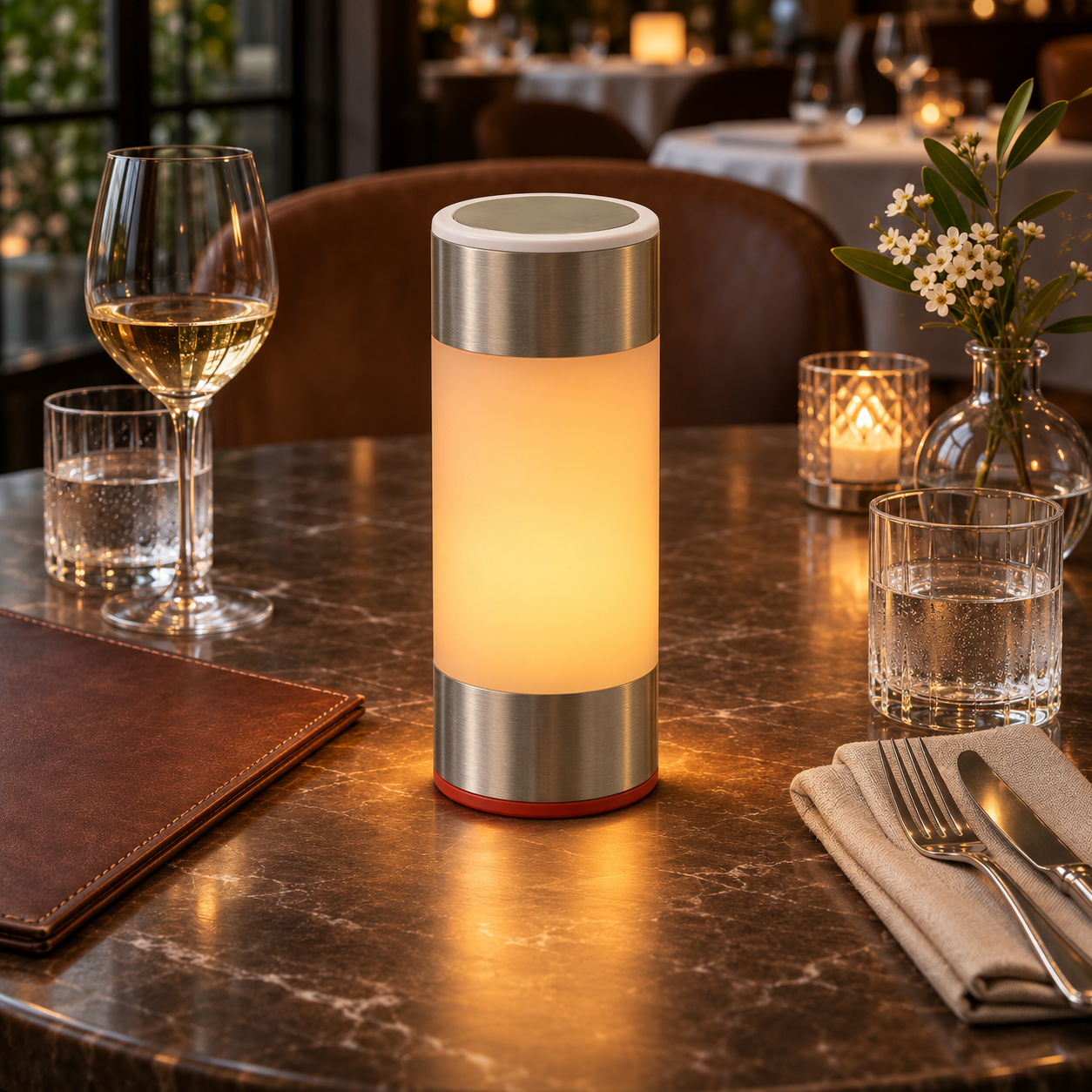
Start with the maximum number of lamps needed simultaneously. Add any units required for a documented charging rotation, then add a separate reserve based on the number of lamps the venue could need to replace before a new supply arrives. Finally, check that compatible charging equipment and staff time can keep both service and reserve units ready.
For example, if 40 tables each need one lamp, the active requirement is 40. If the schedule requires four additional lamps for a planned rotation and management chooses two ready units as an illustrative reserve, the planning total is 46 lamps. The numbers four and two are examples only; calculate them from the actual operation rather than treating 46 as a recommendation for every 40-table venue.
A restaurant’s lamp fleet moves between tables, collection points, charging stations, storage, and inspection. During that cycle, a unit may be unavailable even if it is not defective. A lamp may be on the charger, awaiting a visual check, assigned to another room, or held aside while the supplier answers a question.
Purchasing only the number required on the floor assumes that all units are available at the same time, every day. That assumption may be reasonable for some operations but should be tested against the schedule. Conversely, ordering extra lamps without considering station capacity can create a reserve that cannot be charged in time.
A ready spare should be the correct model and finish, have passed the venue’s agreed checks, be charged using compatible equipment, and be accessible to the staff who will deploy it. For a flip-to-call lamp, the spare should also be configured so that its ambient and service-alert behavior matches the approved fleet.
Keep ready units distinct from unopened stock, units awaiting inspection, and lamps removed from service. A label or a simple inventory record can prevent staff from placing a lamp with an unresolved issue back on a table.
Count the tables or service positions that need a lamp at the busiest expected time. Include private rooms, bar seating, event layouts, and any additional areas only when they actually operate at the same time. If one lamp is shared between two non-overlapping uses, document the changeover rather than automatically counting it twice.
A venue may have 40 dining tables and another 10 event tables, but the event area may operate only when part of the main room is closed. Build a simple schedule showing which areas need lamps for each service period. The highest realistic simultaneous requirement is the active fleet baseline.
Also record whether every position needs the same model and finish. A lamp selected for one area may not be an acceptable replacement in another if its lighting behavior, appearance, or charging equipment differs.
If the venue occasionally opens an additional room, decide whether those lamps are part of the permanent fleet, can be transferred from an unused section, or require a temporary arrangement. Do not treat event stock as an emergency reserve if the same units are already committed to the event.
A rotation unit is needed because the operating schedule and charging window do not allow the same lamp to cover every required service period. A reserve unit covers an unexpected unavailability or another defined contingency. The same lamp cannot reliably perform both roles at once.
For JB-TL01, the supplied product information describes a compatible contact charging station and states that the lamp has no Type-C charging port. It lists a 2,600 mAh battery, stated runtime of 17 hours, stated charging time of 6–8 hours, and four brightness levels. Confirm the current configuration and the conditions behind those figures with the supplier; actual performance depends on settings and use.
Record when lamps are placed on tables, the brightness and ambient color intended for service, and when lamps are collected. Test a representative sample under the venue’s planned conditions if runtime is part of the buying decision. Ask what settings and endpoint the supplier used for any stated runtime.
If a lamp is expected to cover two services, include the actual time between them and the time needed for handling. Do not assume a brief interval is enough to fully charge a unit. If the available window is insufficient, discuss alternative scheduling, additional rotation units, or charging capacity with the supplier and operations team.
Confirm how many lamps the exact station configuration can charge at once and how the supplier defines a charging cycle. Compare that capacity with the number of lamps that must be ready before the next service. Include setup, collection, and staff availability in the plan; a theoretical second cycle is useful only if someone can carry it out.
Do not infer compatibility from a similar-looking station or assume that a station sold with another model fits JB-TL01. Ask for the exact lamp-and-station combination, plug standard, power supply, and replacement accessories in the quotation.
Ask the operating team how much disruption is acceptable if a lamp becomes unavailable. A small café with readily accessible local stock may make a different choice from a remote hotel or a restaurant group preparing a coordinated opening. The planning question is how many units may need immediate substitution before the next replenishment arrives.
Request the current lead time for additional matching lamps and stations, including any customization and freight assumptions. A longer replenishment window may justify a different reserve decision from a project with verified local stock. Treat the supplier’s current written terms as the basis for the calculation, not an old catalog price or a competitor’s delivery estimate.
For a branded lamp, ask whether replacement orders require a minimum quantity, artwork setup, or a new approval. Record the approved logo revision, finish, ambient configuration, and packaging so a future order can be matched to the original project.
Spills, handling damage, misplacement, and temporary removal for inspection are possible operational events, but a buyer should not present an invented percentage as a measured defect rate. Use the venue’s own records where available. Where records do not exist, document the assumptions, test a small pilot, and revisit the reserve after the team has actual operating information.
Examples used in a planning spreadsheet should be labeled as examples. If management assumes two simultaneous substitutions for a particular venue, that is a decision about the venue’s tolerance for disruption, not evidence that two lamps will fail.
Planning a lamp fleet? Share your maximum active table count, service schedule, destination, and desired reserve with Jbian Lighting. Request the current JB-TL01 and compatible charging-station configuration. Send Your Requirements
A complete ready lamp can replace a table unit immediately. A power supply, station, carton, or other accessory may be useful for support, but it is not a ready table lamp. Ask the supplier which replacement parts are available and who may install them under the product instructions and warranty terms.
For a battery-powered lamp, do not assume that an internal battery is user-replaceable or ask staff to open a sealed unit without manufacturer guidance and an appropriate qualified process. The buyer should confirm whether service means replacing a complete lamp, using an authorized repair route, or another agreed procedure.
A spare should match the original model, visible finish, approved branding where needed, service behavior, and compatible station. Confirm whether ambient color settings are applied through the station and how staff should check the configuration before deployment. If the venue uses several ambient settings, record which setup applies to each zone.
For the supplied JB-TL01 information, the normal position shows a selected ambient color and the red-ring-up position shows a solid red service alert. Confirm the actual sample and current configuration with the supplier. The red state is a local visible cue and does not by itself demonstrate an electronic notification to a watch or phone.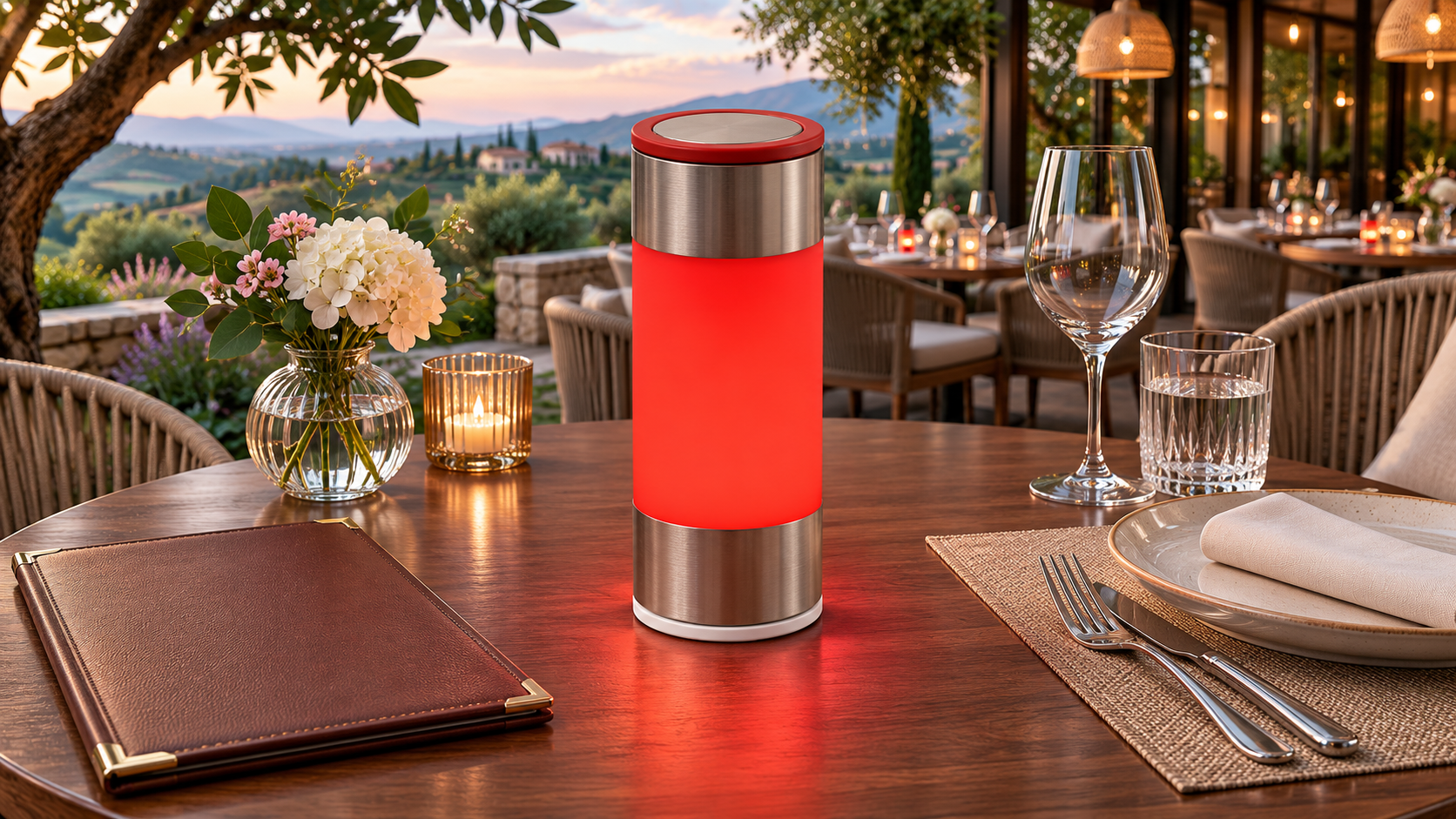
Even a short record can help staff distinguish active, charging, ready, and unavailable units. For a single restaurant, a paper sheet near the charging area may be sufficient. A multi-site operator may prefer a shared record with a responsible person at each location.
Record the model, finish, number of units, location, station compatibility, approval reference, and status. If a unit is removed from service, note the date and observed issue without guessing the cause. Link the record to the supplier’s instructions and the purchase order or warranty process.
Active: assigned to a table or service area. Charging: placed on compatible equipment according to the supplier’s instructions. Ready reserve: checked, charged, and accessible for immediate use. Hold: awaiting inspection, supplier guidance, or another agreed action.
Set an owner for each status change. If a ready spare is moved to a table, another unit may need to be checked and charged to restore the reserve. A count is useful only when it reflects what staff can actually use during the next service.
Ask suppliers to quote the active lamps, rotation units, ready reserve, charging stations, power supplies, plug standard, packaging, and any agreed customization. For a multi-site order, specify the allocation to each venue. Confirm whether additional units are included in the same production batch and how they will be identified in the packing list.
Compare offers on the same scope. A quotation for lamps alone is not directly comparable with a set that includes shared stations, spare power supplies, packaging, and freight. Request current pricing and lead times for the actual quantities; do not extrapolate a bulk price from a sample or assume that a previous quote remains valid.
Before ordering, ask how a buyer can obtain matching lamps later, what minimum quantity applies, whether the same finish and branding remain available, and how warranty claims are handled. For a distributor, ask how replacement stock will be identified and whether instructions and documents match the destination market.
Confirm freight terms and the relevant battery transport documentation with the supplier and freight provider. Requirements depend on the actual goods, destination, and transport method. The reserve plan should include realistic replenishment time rather than assuming that a replacement arrives immediately.
Suppose a restaurant has 40 tables that each require one lamp at the busiest time. The team establishes that the active requirement is 40. It then tests a representative sample and examines the actual time between its lunch and dinner services. In this example, management decides that four lamps must be available for a planned rotation and that two additional checked lamps should be held as a ready reserve.
The arithmetic is 40 active + 4 rotation + 2 reserve = 46 lamps. The team must still verify that the compatible charging stations can support the schedule, that the reserve is not already committed elsewhere, and that the required lamp and station quantities appear in the quotation.
This example is a method for structuring the decision. It is not a measured runtime, a recommended reserve percentage, or a prediction of product failure. Another restaurant with the same table count could reasonably choose different quantities after testing its own schedule and replenishment arrangements.
During the first weeks of service, record how often the team needs a replacement, how long lamps remain unavailable, and whether the charging routine fits the actual schedule. Track events as observations: for example, a lamp was set aside because it had visible damage, or a unit was not ready at opening. The cause may require further investigation.
Compare the recorded events with the reserve assumption. If the team repeatedly borrows the last ready lamp, review the process and replenishment time. If a large amount of stock remains unused while staff struggle with charging, the more useful change may be station allocation or a clearer handover, rather than simply ordering more lamps.
A group-level total can hide a shortage at one property and unused stock at another. Decide whether locations can transfer compatible lamps quickly and who authorizes the transfer. A central reserve should not be counted as an immediate replacement unless transport and staff access make that practical.
A percentage can be a starting assumption, but it should be checked against active demand, rotation, replenishment, and service expectations. Keep the assumption visible and revise it when real operating information is available.
A lamp on a charger may not be available for immediate use. Define when a unit becomes ready according to the supplier’s instructions and the venue’s checks.
Confirm the exact station, power supply, plug standard, and lamp model. Similar appearance does not establish compatibility.
A spare that differs in finish, branding, or service behavior may not be suitable for the intended table. Record the approved sample and configuration.
The JB-TL01 information describes a visible red alert at the table. Staff need a clear view and a response routine. If a buyer requires a pager or app notification, specify and verify that requirement separately.
There is no universal figure in this guide. Calculate the active fleet, planned rotation, and reserve separately using the venue’s schedule, replenishment time, and service requirements.
They serve different purposes. Rotation units support a planned charging schedule; reserve units cover an unplanned substitution. Avoid counting one unit for both needs simultaneously.
Confirm the capacity of the exact compatible station and compare it with the number of lamps that must be charged within the available window. Include handling time and staffing, and verify the proposed configuration with the supplier.
The supplied product information describes charging through a compatible contact station and states that the lamp has no Type-C charging port. Confirm the current sample and instructions before ordering.
The described red state is a visual cue on the lamp. It does not by itself establish a connection to a phone, watch, or pager. Staff need to see the signal or use another verified service arrangement.
Provide the maximum simultaneous table count, operating schedule, planned rotation and reserve, destination, compatible station needs, plug standard, branding, and target delivery. Ask for an itemized quotation and current replacement terms.
A reliable reserve begins with an accurate active count and a realistic charging plan. Separate planned rotation from emergency replacements, define what makes a lamp ready, and check that the right stations and staff routine support the fleet.
For a JB-TL01 project, confirm the current lamp configuration, compatible contact station, operating conditions, and replacement terms with the supplier. Review the reserve after opening using the venue’s own records.
Tell Jbian Lighting about your table count, service schedule, destination, and desired reserve. Request a current JB-TL01 sample and an itemized quotation for lamps, compatible charging stations, and agreed accessories. Get a Quote