
 EN
EN
Quick Links

Short answer: the best commercial cordless table lamps for fine dining restaurants are the ones that create the intended table atmosphere while fitting the restaurant’s service, cleaning, charging, storage and replacement workflow. Buyers should compare light presentation, guest comfort, physical finish, controls, charging evidence, cleanability, supplier documentation and repeat-order support—not only appearance or unit price.
Fine dining places unusual demands on table lighting. A lamp is visible throughout the guest experience, but it is also handled by service staff, moved during table resets, cleaned between sittings and returned to a charging or storage location. The most attractive sample may not be the easiest to operate. A product with a clear specification and practical support may create more value than a cheaper option with unanswered questions.
This guide is for restaurant owners, hospitality procurement teams, interior designers, contract dealers and commercial lighting buyers comparing premium cordless table lamps for dining rooms, private dining, hotel restaurants and other guest-facing hospitality environments. It avoids unsupported universal claims: exact runtime, charging time, material, ingress protection, certification and warranty information must be confirmed for the proposed model and destination market.
A suitable fine-dining lamp must work at the intersection of design and operations. The buyer should be able to explain what the lamp contributes to the table, how guests experience the light, and how the restaurant keeps the fleet ready for every service.
| Evaluation area | Question for the buyer | Evidence to request |
|---|---|---|
| Light presentation | Does the lamp create the desired atmosphere without uncomfortable glare? | Sample review in a representative table setting. |
| Visual consistency | Can the approved appearance be maintained across the order and repeat purchases? | Finish sample, approved sample record and production-control explanation. |
| Daily handling | Can staff place, wipe, collect and store the lamps efficiently? | Care instructions and a simple operating workflow. |
| Charging readiness | How will the restaurant keep the active fleet ready for the next service? | Model-specific charging method, capacity and test conditions. |
| Supplier support | Who handles specification questions, replacements and changes? | Written commercial, service and documentation terms. |
The phrase “premium commercial cordless table lamp” should therefore describe a complete purchasing fit, not a decorative style alone. Start with the restaurant’s service pattern, then assess the product.
Before comparing products, define where the lamps will be used. A main dining room, private dining room, bar, terrace or hotel restaurant may have different table layouts, cleaning routines and closing times. Record the intended zones, table types, approximate quantity, service periods and the route by which staff move the lamps.
These details change the procurement decision. A lamp that suits a quiet private dining room may not be the easiest choice for a high-turnover dining area. A restaurant supplier that asks about staff movement and service timing is helping to identify total operating risk before the quotation stage.
Fine dining buyers should judge a cordless table lamp in the environment where it will be used. Product photographs do not show every interaction between the lamp, table surface, guest sightlines, wall finishes and surrounding architectural light.
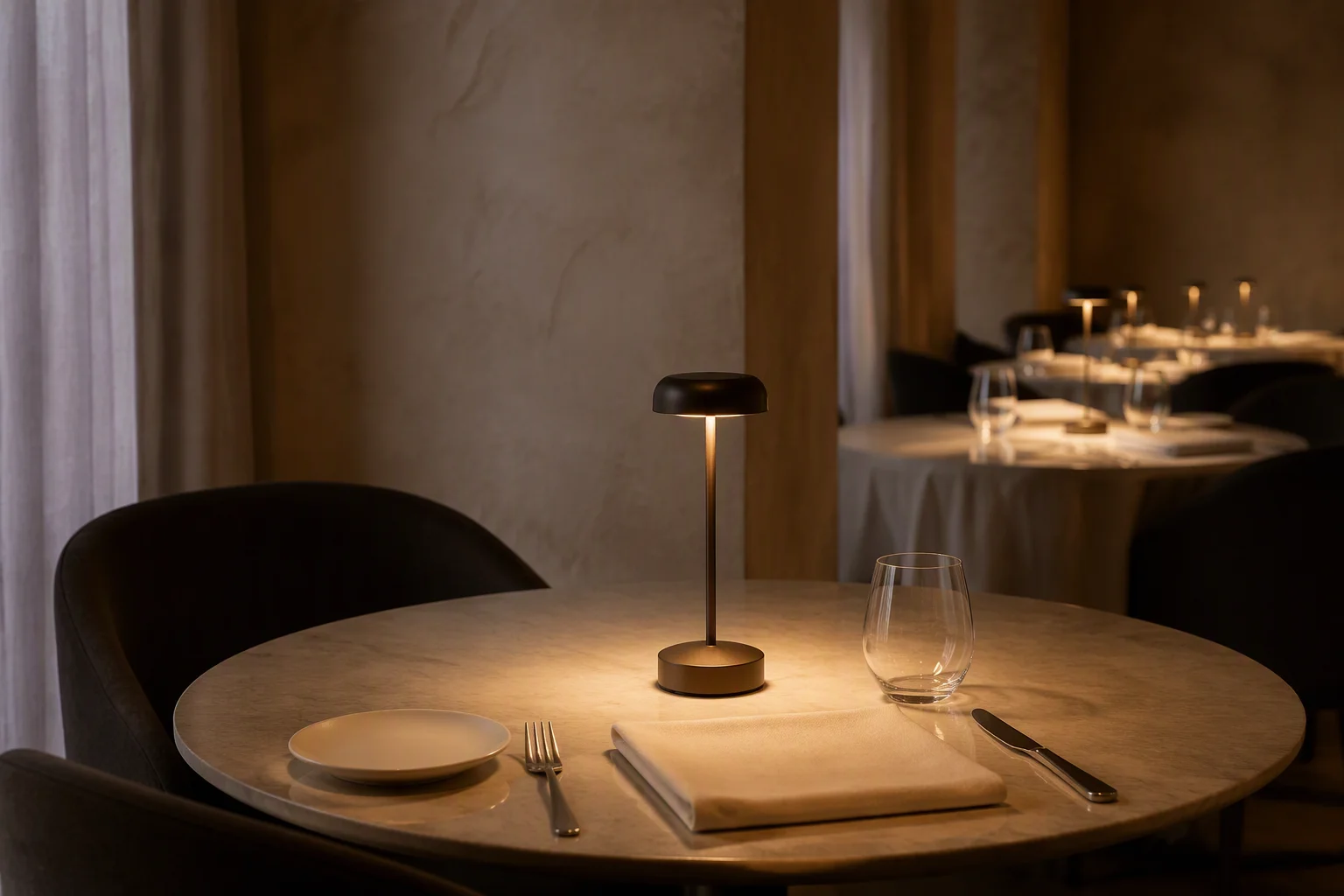
Caption: A representative restaurant setting helps buyers review table presentation, glare comfort, spacing and practical handling.
Do not add a colour temperature, lumen value, colour-rendering claim or glare performance figure unless the exact model documentation confirms it. If the design team has a target, write it as a requirement to verify during sample approval rather than as an assumed product fact.
Fine-dining lamps are guest-facing objects, but they are also working equipment. Staff may move them many times during a service cycle. The buyer should ask how the proposed finish is cleaned, what handling is recommended, and whether visible variation between batches is controlled.
| Topic | What to clarify | Why it affects the purchase |
|---|---|---|
| Surface care | Which cleaning methods are recommended or prohibited? | Protects appearance and reduces avoidable damage. |
| Handling | Where should staff hold and place the lamp? | Supports consistent table resets and reduces drops. |
| Finish consistency | How is the approved appearance referenced in production? | Protects the visual quality of a complete dining room. |
| Service parts | Which parts can be replaced and how are they requested? | Improves maintainability and reduces unnecessary replacement. |
| Packaging | How are units protected and identified during delivery and storage? | Reduces confusion and handling damage before deployment. |
If a restaurant is considering a terrace or outdoor-adjacent application, it should define the environment separately. Decorative appearance is not proof of outdoor suitability. Any environmental rating or compliance statement must be confirmed for the exact model, configuration and market.
Battery operation is a commercial workflow question. Buyers should ask not only how long a lamp operates, but how the restaurant will maintain readiness across the planned service cycle.
Request the supplier’s operating assumptions for any runtime statement, including control mode, brightness setting, battery condition, charging instructions and test method. Numbers from different suppliers should not be compared unless the conditions are sufficiently comparable.
A practical fleet model is:
Total fleet = lamps in normal service + rotation units + an operator-approved maintenance or replacement reserve.
The appropriate reserve depends on the restaurant’s service intensity and maintenance process. It should be agreed with the operator, not copied from a universal percentage. The charging plan should also define where lamps are collected, inspected, cleaned, placed for charging and returned to the dining room.
| Approach | Potential advantage | Question to resolve |
|---|---|---|
| Centralized | One location for counting, inspection and charging. | Can staff move the full fleet efficiently after service? |
| Distributed | Shorter routes for separate dining or event zones. | Who owns each location and how is inventory reconciled? |
| Hybrid | Central reserve with local flexibility. | Which lamps belong to each zone and how are standards kept consistent? |
Ask for usable capacity under the proposed lamp configuration rather than relying on a nominal position count. Confirm compatibility, placement, indicators, cleaning access, storage, power preparation and fault handling for the exact system.
When several suppliers appear visually similar, a scorecard makes the decision more defensible. Use the same evidence standard for every quotation. A written specification or sample demonstration should carry more weight than an unsupported sales statement.
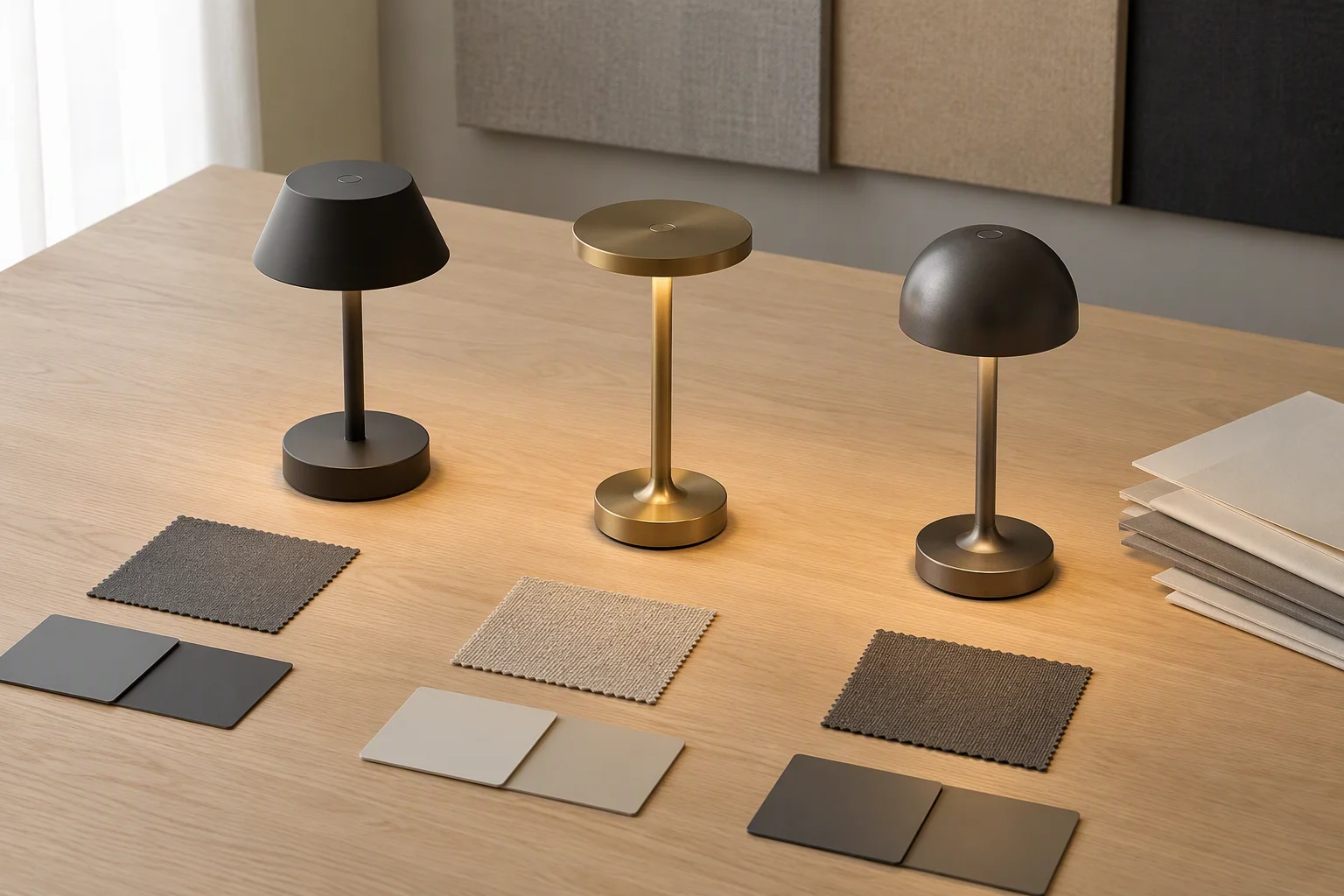
Caption: A structured sample review makes visual, operational and documentation differences easier to compare before ordering.
| Criterion | Decision question | Business outcome |
|---|---|---|
| Application fit | Does the lamp match the dining setting and service pattern? | Fewer unsuitable units and replacements. |
| Guest comfort | Has the product been reviewed at a representative table? | Lower risk of an uncomfortable guest experience. |
| Workflow fit | Can staff clean, charge and redeploy it consistently? | Less handling friction and better readiness. |
| Quality control | Can the supplier explain sample and batch controls? | More consistent guest-facing presentation. |
| Documentation | Are specifications and care instructions model-specific? | Lower approval and operating risk. |
| Continuity | Can the supplier support repeat orders and changes? | Better multi-site and replacement planning. |
| Commercial fit | Are quantity, packaging, lead time and delivery assumptions clear? | Improved budget and project control. |
Mid-article CTA: Planning a fine-dining or hotel restaurant lighting purchase? Send your application, estimated quantity, preferred finish, service schedule and destination market. Our commercial lighting team can help turn those requirements into a comparable cordless table lamp specification and quotation brief.
A single attractive sample does not prove that a full production batch will be consistent. Ask how the supplier checks incoming components, assembly, surface finish, function, charging and packaging. The exact system varies by manufacturer, but a credible process should identify what is checked, when it is checked, who records the result and how nonconforming units are handled.
Before approval, request the documents relevant to the actual model and market:
Do not accept a document for a different model as evidence for the proposed lamp. If a certification, ingress rating or performance claim matters to the project, verify its model scope, issuing body, date and limitations through the appropriate source.
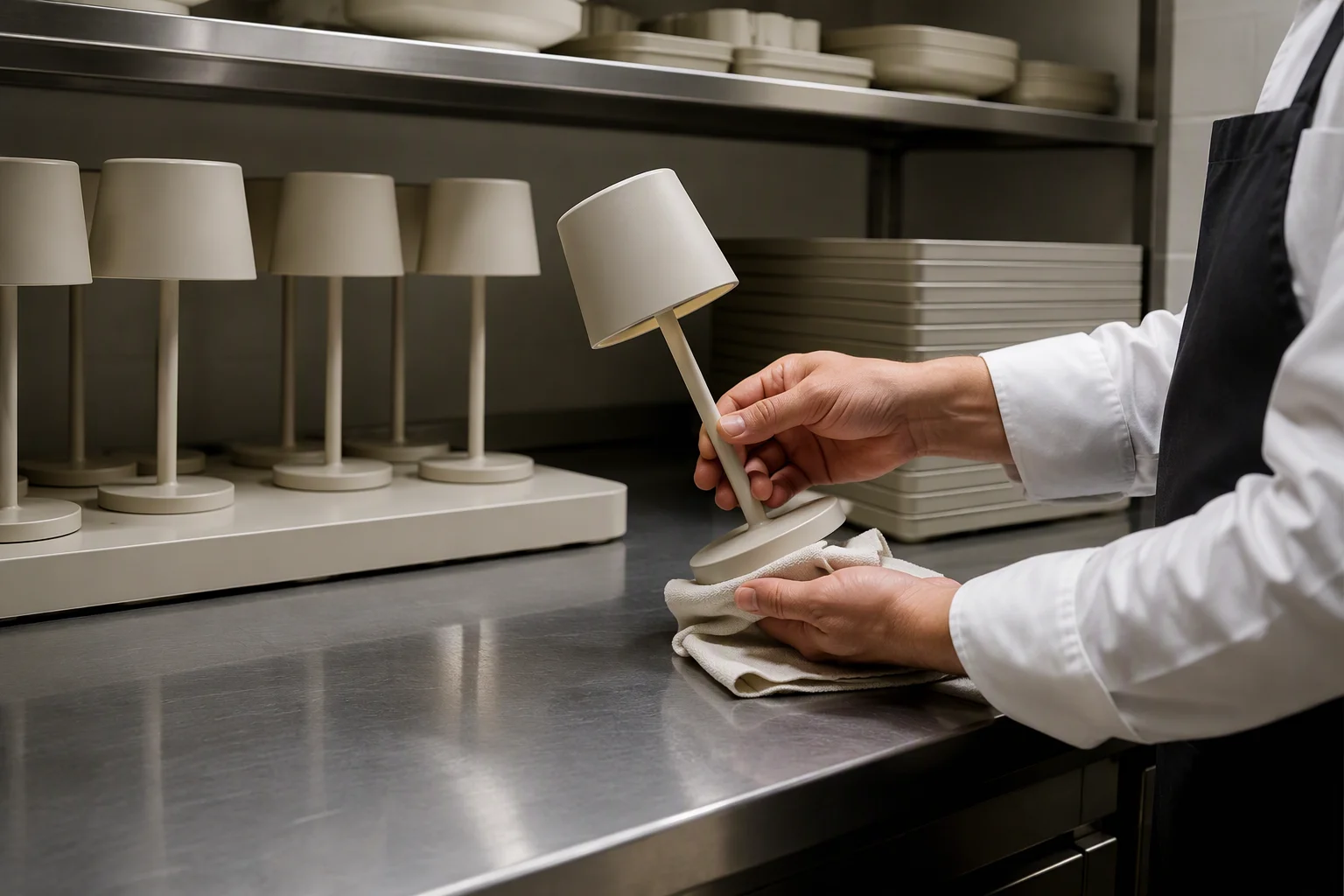
Caption: Cleaning, inspection, charging and return-to-service steps should be included in a commercial lamp buying decision.
Use this checklist before approving a supplier or placing a larger order:
This process connects the product decision to revenue and margin protection. Fewer unsuitable purchases reduce replacement exposure; a smoother charging routine protects service readiness; and consistent table presentation supports the guest experience that fine-dining operators are trying to deliver.
The best option is the lamp that combines suitable light presentation and guest comfort with a practical service workflow, consistent finish, clear charging evidence, cleanability, documentation and supplier support. The correct choice should be based on the restaurant’s application and sample review, not a generic ranking or the lowest unit price.
They can be suitable when the selected product and workflow match the venue. The restaurant should review glare, table presentation, controls, handling, cleaning, charging and storage in a representative setting before ordering. Suitability should be confirmed for the exact model rather than assumed from the category name.
Ask every supplier for the conditions behind its operating-time statement, including mode, brightness, battery condition and charging assumptions. Compare like with like, then assess the complete fleet and recharge workflow. A single headline number is not enough to plan restaurant readiness.
Start with the planned deployment by zone and table type, then add an operator-approved rotation and maintenance reserve. The correct fleet is not always equal to the number of tables because private dining, terraces, events and different table sizes can change the lamp ratio.
Include application, quantity by zone, service schedule, preferred finish, light and control requirements, charging method, cleaning guidance, sample expectations, packaging, delivery destination, documentation needs, replacement support and any approved customization. Ask each supplier to mark requirements as compliant, partially compliant, unavailable or requiring confirmation.
Yes, especially when the product will be visible across a complete dining room or when the charging workflow is new. Review the lamp at a representative table and record appearance, guest sightlines, controls, cleaning, storage, charging and staff handling before approving production.
Customization may be possible, but the buyer should separate standard features from optional changes, tooling, minimum order requirements, sample stages and lead-time impact. Approve a clear physical or otherwise agreed reference before production, and document any change that could affect repeat orders.
The best commercial cordless table lamps for fine dining are not selected by appearance alone. They are selected through a complete review of table atmosphere, guest comfort, finish, cleaning, handling, charging, quality control, documentation and supplier continuity.
Define the restaurant’s operating brief, review representative samples, compare suppliers using the same evidence standard and record the approved configuration. This gives the procurement team a clearer basis for managing cost, replacement risk and service readiness while protecting the visual consistency of the dining environment.
Final CTA: Ready to specify cordless table lamps for a fine-dining restaurant, hotel dining room or hospitality project? Share your application, quantity by zone, preferred design direction, service schedule and delivery market. Our team can review the requirements, identify suitable commercial configurations and prepare a quotation brief based on confirmed product information.