
 EN
EN
Quick Links

Short answer: the right OEM cordless table lamp manufacturer is not simply the supplier offering the lowest unit price. Hospitality buyers should evaluate product suitability, charging and service workflow, quality consistency, customization control, documentation, production communication and total project risk before approving a supplier.
For hotels, restaurants, resorts and contract furnishing projects, cordless table lamps sit at the intersection of design and operations. They influence the guest experience, table presentation, housekeeping routines, charging space, replacement planning and purchasing cost. A supplier may show attractive product photographs but still be difficult to manage at project scale. Conversely, a manufacturer with a clear specification process and dependable communication may create more value even when the initial quotation is not the lowest.
This guide provides a practical framework for evaluating an OEM cordless table lamp manufacturer for hospitality projects. It is written for lighting importers, hospitality procurement teams, restaurant groups, interior designers, contract dealers and distributors who need a reliable basis for supplier comparison.
Start with project fit rather than customization. Before discussing colors, logos or packaging, define the operating environment and purchasing requirements that the lamp must support.
| Evaluation area | What to clarify | Why it matters |
|---|---|---|
| Application | Hotel rooms, lobby lounge, restaurant dining, rooftop, event or outdoor-adjacent use | The environment changes cleaning, handling, placement and weather-exposure requirements. |
| Daily workflow | Who places, cleans, charges, stores and redeploys the lamps? | A product that looks good but is difficult to manage can increase labor and replacement risk. |
| Product family | One model, coordinated models or multiple sizes and finishes | Consistency affects the visual quality of a hospitality project. |
| Supply model | Standard product, OEM adaptation, private label or fully custom development | Different models require different approval stages and documentation. |
| Procurement plan | Sample quantity, initial order, repeat order and expected project phases | Supplier capacity and communication should match the rollout schedule. |
The first supplier conversation should therefore be a structured brief. Include the venue type, intended table or room application, approximate quantity, preferred visual direction, charging approach, required delivery region and any known compliance or packaging requirements. If a supplier cannot translate this brief into a clear quotation and sample plan, it is difficult to assess the offer fairly.
An OEM manufacturer for hospitality projects should be able to discuss more than lamp appearance. Ask how the product is expected to move through a venue: from storage to table, from table to cleaning, from cleaning to charging and back into service.
For restaurants, the evaluation should consider table turnover, service movement, spill exposure, storage between shifts and the need for consistent placement. For hotels, consider lobby and lounge presentation, housekeeping handling, event reconfiguration and the possibility of phased purchasing. A manufacturer that asks these questions is more likely to identify operational risks before the order is placed.
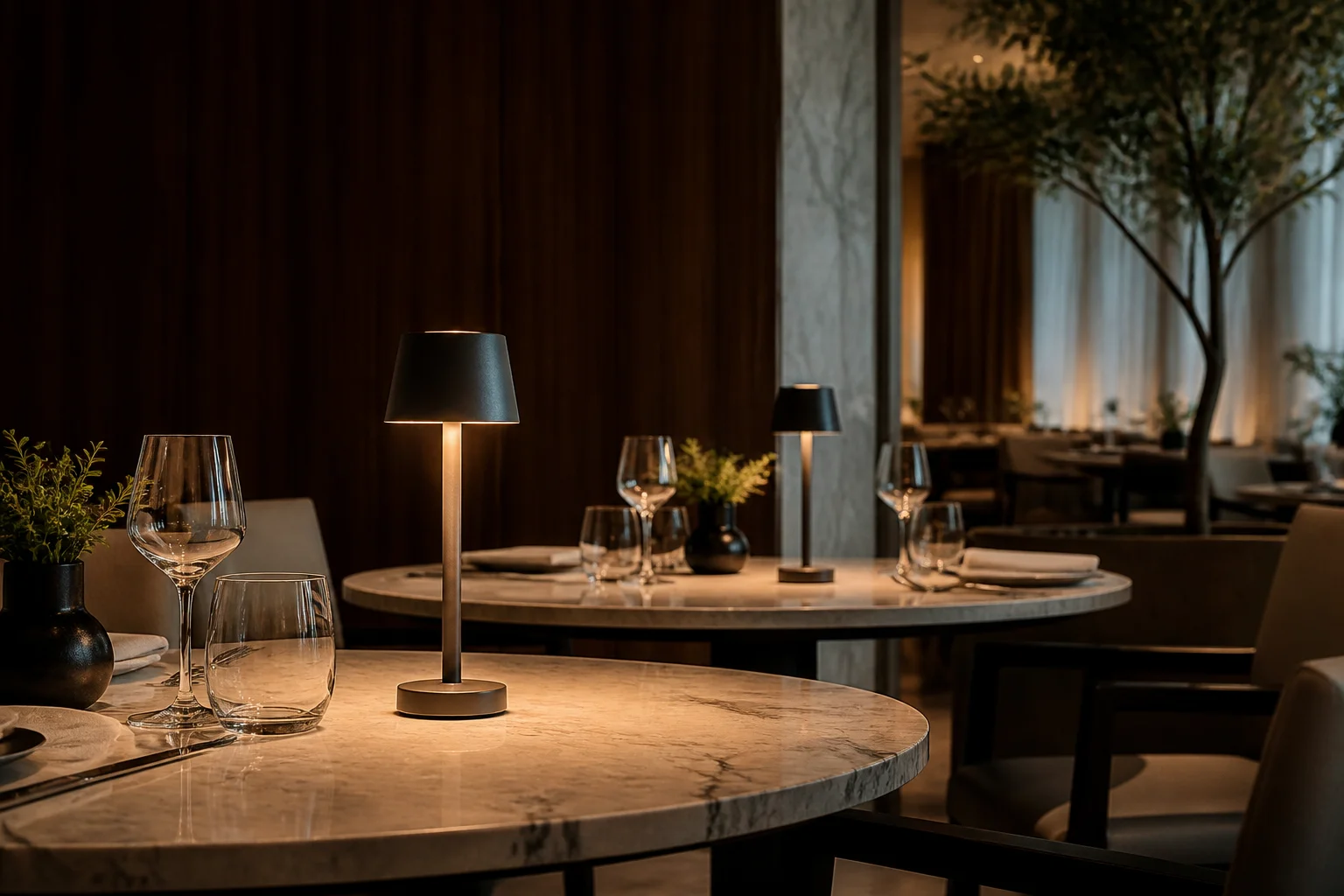
Cordless table lamps deployed on hotel restaurant dining tables. A hospitality sample review should consider visual consistency, table presentation and daily operating workflow.
Ask the manufacturer for a product specification sheet that separates confirmed information from options. The document should identify the model, materials or finishes as applicable, control method, charging method, care guidance, package contents and available customization. It should not rely on vague phrases such as “hotel quality” or “long-lasting” without defining what the buyer will actually receive.
Battery and charging information deserves special attention. Request the supplier's stated operating assumptions, charging instructions and recommended storage practice. Do not compare runtime numbers from different suppliers unless the testing conditions are described consistently. A quoted runtime may depend on brightness, ambient conditions, battery condition and operating pattern. For a commercial project, the useful question is not only “How long does it last?” but also “How will the venue keep the lamps ready for the next service period?”
| Specification topic | Buyer verification question | Evidence to request |
|---|---|---|
| Light control | How is the lamp switched or adjusted during normal use? | Sample demonstration and written operating instructions. |
| Charging | What charging method and accessories are supplied? | Charging instructions, component list and sample review. |
| Battery operation | Under what conditions is any operating-time statement measured? | Supplier test method or clearly marked application guidance. |
| Surface care | Which cleaning methods are recommended or prohibited? | Care instructions suitable for the venue's housekeeping team. |
| Customization | Which changes affect tooling, approval time or repeatability? | OEM option list, sample approval process and revision record. |
| Packaging | How are lamps protected and identified for delivery and storage? | Packaging sample, carton information and packing list. |
Supplier evaluation should include both the product and the manufacturing process. A single attractive sample does not prove that a production batch will be consistent. Ask how the manufacturer checks incoming components, assembly, surface finish, function, charging and packaging before shipment.
During a factory or supplier review, look for a defined inspection point rather than informal visual checking. The exact inspection system will vary by manufacturer, but a credible process should identify what is checked, when it is checked, who records the result and how nonconforming units are handled.
For an OEM project, record the approved sample clearly. Capture the agreed finish, visible controls, charging accessories, packaging arrangement and any permitted tolerance. This gives both parties a reference point for production and helps prevent changes from being introduced without approval.
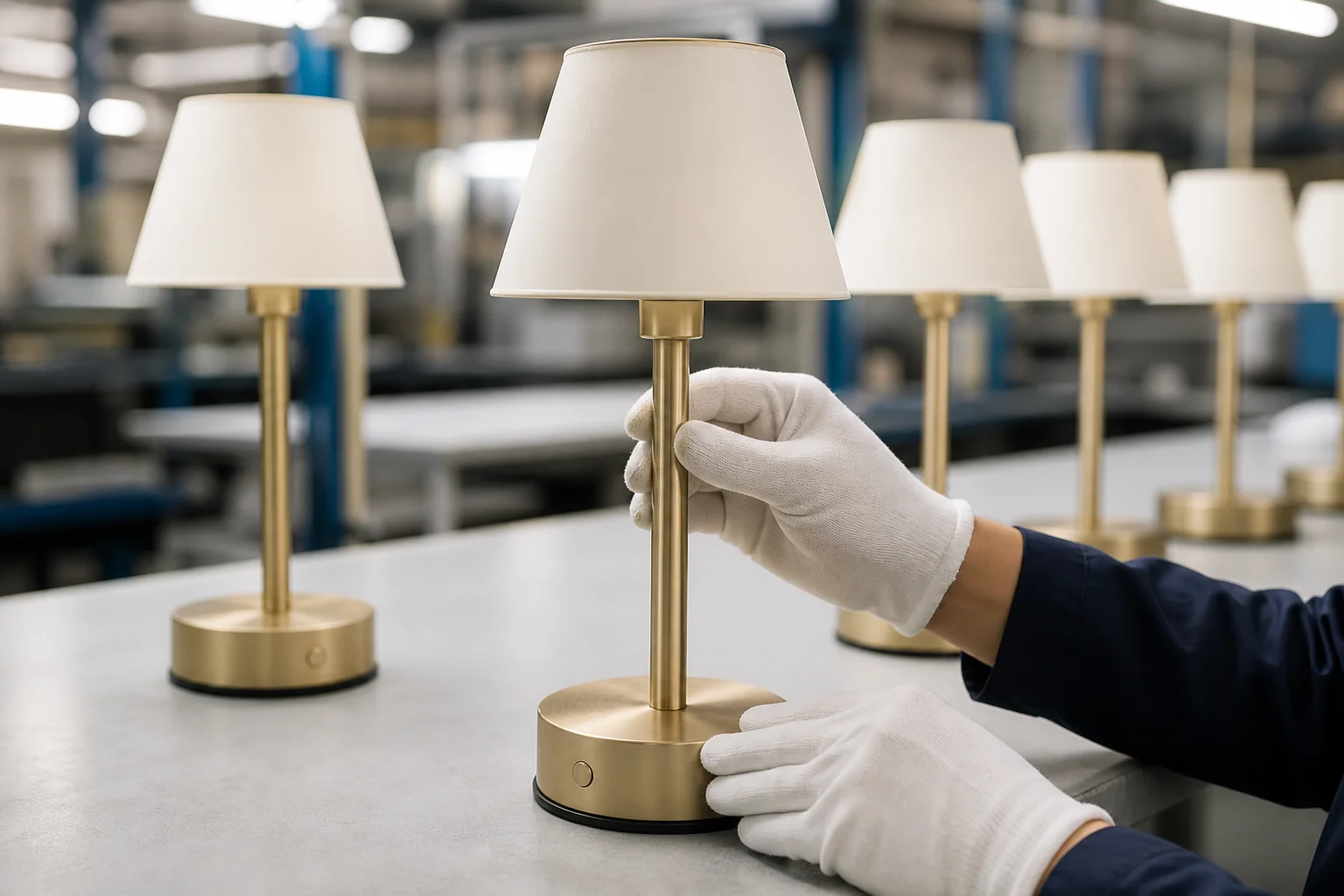
Factory inspection of unbranded cordless table lamps for hospitality projects. Supplier evaluation should include a clear review of assembly quality, finish consistency and production controls.
OEM customization can improve project differentiation, but it also adds approval steps and supply-chain dependencies. Buyers should decide which changes create genuine value and which changes only add complexity.
| Approach | Advantages | Risks to manage | Best fit |
|---|---|---|---|
| Standard product | Faster evaluation, simpler replacement and clearer repeat ordering | Less differentiation and fewer design choices | Fast-opening venues or buyers testing a new application. |
| OEM adaptation | Controlled finish, packaging or coordinated details with moderate development effort | More sample approvals and potential lead-time changes | Hotel groups, restaurant concepts and contract projects with defined design needs. |
| Fully custom development | Distinctive product identity and highly specific project fit | Higher development, tooling, approval and continuity risk | Large or strategically important programs with adequate development time. |
Ask the manufacturer to separate the quotation into product cost, development or tooling cost where applicable, sample cost, packaging changes and other project charges. This prevents a low unit price from hiding the real cost of customization.
Communication quality is an early indicator of project risk. A supplier may be technically capable but still difficult to manage if answers are slow, inconsistent or undocumented. Use the sample stage to test how the manufacturer handles questions, revisions and approval records.
Do not assume that a supplier has a document simply because it is common in the industry. Request the exact document and verify that it matches the quoted model. If a certification or regulatory requirement applies to the project, confirm it through the appropriate official or accredited source rather than accepting an unverified logo or statement in a sales presentation.
Unit price is only one part of the procurement decision. Evaluate the complete commercial picture: sample costs, order quantities, payment terms, packaging, freight assumptions, replacement handling, lead times and the supplier's ability to support repeat orders.
Ask how the manufacturer manages component changes. A battery, charger, finish or internal component may be changed during the product life cycle. The buyer should know how such changes are communicated and whether a new sample approval is required. This is especially important for hotel groups and restaurant brands that expect the same appearance and operating workflow across multiple locations.
| Risk | Early warning sign | Mitigation |
|---|---|---|
| Specification drift | Supplier cannot identify the approved sample or revision | Use a signed or documented sample approval reference. |
| Delivery uncertainty | Lead time is quoted without assumptions or milestones | Request a production schedule and define the start point. |
| Repeat-order inconsistency | Finish or component availability is unclear | Ask about continuity and notice of material changes. |
| After-sales friction | Warranty language is vague or only verbal | Request written terms and an issue-resolution contact. |
| Hidden customization cost | One combined price covers product and development | Separate product, tooling, packaging and sample costs. |
A scorecard makes supplier selection more objective and gives internal stakeholders a common decision framework. The weighting should reflect the project's priorities; there is no universal score that fits every venue.
| Criterion | Suggested decision question |
|---|---|
| Product and application fit | Does the lamp suit the venue's tables, service pattern and handling workflow? |
| Quality and consistency | Can the supplier explain and document its inspection and sample-control process? |
| Charging and operating workflow | Can the venue maintain readiness without creating avoidable labor? |
| OEM capability | Can the supplier control requested finishes, packaging or coordinated details? |
| Communication | Are replies specific, timely and documented? |
| Commercial fit | Are price, quantity, lead time and repeat-order assumptions clear? |
| Risk and continuity | Are changes, replacements and after-sales responsibilities defined? |
Score each supplier using the same evidence standard. For example, a written specification or sample demonstration should score higher than a verbal promise. Keep notes on unresolved questions instead of forcing a supplier to receive a complete score before the evidence is available.
Mid-article CTA: Need help turning your venue requirements into a practical cordless table lamp specification? Send your application, estimated quantity, preferred finish and destination market to our commercial lighting team for a structured specification review.
A sample should answer operational and design questions before production begins. Review the lamp in the context where it will be used, not only on a showroom table. For a restaurant, place it on representative dining tables and consider guest sightlines, service movement, cleaning and storage. For a hotel, review the product in the intended lobby, lounge or dining setting and consider how staff will handle and recharge it.
Record comments in categories: appearance, controls, light presentation, charging, handling, cleaning, packaging and commercial terms. If revisions are requested, create a new revision reference rather than relying on memory. The final production approval should state what is approved and what remains an option.

Buyer and supplier comparing cordless table lamp samples for a hospitality project. A structured sample meeting turns design preferences and operational requirements into a procurement decision.
The best supplier is the manufacturer that can demonstrate product fit, repeatable quality control, clear charging and care guidance, documented OEM options, transparent commercial terms and responsive project communication. A supplier should be assessed against the buyer's venue and operating workflow rather than selected from a product photograph or unit price alone.
An OEM manufacturer typically controls at least part of product development or production and can explain how specifications, components, finishes and quality checks are managed. A trading supplier may still be useful, especially for assortment and sourcing, but the buyer should clarify who owns the specification, who controls production and who is responsible for resolving quality or continuity issues.
Choose standard products when speed, replacement simplicity and low development risk are the priority. Consider OEM adaptation when finish, packaging or coordinated design details are important to the hotel concept. Fully custom development is more suitable when the project has sufficient volume, time and internal approval resources to manage development risk.
Ask every supplier to state the conditions behind its operating-time information, including the operating mode and charging instructions. Compare like with like, and assess the complete charging and storage workflow. A practical restaurant decision should consider service periods, shift changes, spare planning and staff handling rather than relying on one isolated runtime number.
Include the approved model, finish, visible controls, charging accessories, packaging arrangement, care guidance and any agreed customization. Add photographs or other clear references, record the revision date and identify who approved the sample. This reduces specification drift during production and repeat ordering.
Ask focused follow-up questions and set a deadline for the missing information. If the supplier still cannot provide a consistent specification, sample record, quotation or quality explanation, treat the gap as a procurement risk. Do not fill missing facts with assumptions, especially for battery, charging, compliance or delivery claims.
Evaluating an OEM cordless table lamp manufacturer for hospitality projects requires more than comparing catalog images. The strongest procurement decision connects product design with venue workflow, charging readiness, cleaning, quality control, customization, documentation, delivery and repeat-order continuity.
Use a written brief, request comparable evidence, approve a clearly documented sample and score suppliers against the same criteria. This approach helps hotels, restaurants and hospitality distributors choose a commercial cordless table lamps supplier that can support both the guest-facing result and the operational work behind it.
Final CTA: Planning a hotel, restaurant or hospitality lighting purchase? Share your project application, target quantity, preferred design direction and delivery market. Our team can help review suitable cordless table lamp configurations, OEM options and a practical quotation brief.