
 EN
EN
Quick Links

A procurement specification for cordless table lamps should describe the operating result the project needs, the evidence a supplier must provide, and the conditions used to compare quotations. It should cover the application, lamp quantity, light behaviour, operating schedule, charging workflow, materials and finish, cleaning routine, service requirements, packaging, customization, documentation and delivery expectations.
The most important principle is simple:
Specify the use case and verification method first; compare product claims second.
A hotel lounge, fine-dining restaurant, rooftop venue and event space may all need rechargeable table lamps, but they do not necessarily need the same size, finish, charging arrangement or service process. A buyer who specifies only “premium cordless table lamp” leaves too much room for inconsistent quotations. A buyer who defines the service environment and acceptance criteria can compare suppliers more fairly and reduce the risk of unsuitable stock.
This guide is intended for hospitality owners, purchasing teams, lighting designers, contract furniture buyers and commercial project managers. It avoids unsupported universal claims. Exact runtime, charging time, battery configuration, ingress protection, materials, certifications and warranty terms must be confirmed in the supplier’s current technical documentation for the proposed model.
A practical specification should be divided into sections that a supplier can answer directly. The following structure works for hotel restaurants, bars, lounges, fine-dining rooms, terraces and other commercial hospitality spaces.
| Specification section | What the buyer should define | What the supplier should return |
|---|---|---|
| Project application | Space, table type, indoor or covered outdoor use, operating schedule | Recommended configuration and application limits |
| Quantity and deployment | Initial quantity, zone allocation, spare or rotation plan | Quotation by model, finish and quantity tier |
| Light performance | Dimming preference, colour appearance, glare expectations, visual mood | Available control method and test conditions |
| Battery and charging | Required service window, charging location, rotation process | Runtime evidence, charging method and compatibility details |
| Construction and finish | Design language, cleanability, surface expectations | Materials, finish samples and care guidance |
| Compliance and documentation | Project-country requirements and documentation needed | Applicable declarations, reports or certificates where available |
| Service and warranty | Maintenance process, replacement parts, support contact | Warranty terms, spare-part policy and response process |
| Delivery and packaging | Delivery schedule, packing, labelling and inspection | Lead time, packing details and quality-control documents |
This structure prevents a common procurement error: evaluating a lamp as a decorative object while ignoring how staff will collect, clean, charge, inspect and redeploy it.
Start with the locations where the lamps will be used. Record the number of tables, the table dimensions, the expected lamp-to-table ratio and any areas with different operating conditions.
Typical hospitality applications include:
Do not treat “hotel” or “restaurant” as a complete specification. A lamp used on a stable indoor dining table may face different cleaning, handling and weather exposure conditions from one used on a covered terrace. State whether the intended environment is indoor, covered outdoor or another defined application. If a product is not verified for a particular environment, the specification should require the supplier to state that limitation clearly.
The lamp must support the property’s actual service rhythm. Write down whether the venue operates lunch, dinner, late-night, breakfast or event services. Note whether lamps are expected to remain in place between services or return to a back-of-house location after each shift.
The specification should ask suppliers to state the conditions behind any runtime claim, including brightness setting, control mode, battery condition and test method. Avoid accepting an isolated headline number without its test context. Runtime is an operating claim, not a universal property independent of use.
“Warm light” is useful as a design direction but is not enough for supplier comparison. A professional specification should describe the desired visual effect and the evidence required for approval.
Include questions such as:
Do not insert a colour temperature, lumen value or optical performance figure unless the project has a confirmed requirement and the supplier can support it with current documentation. If the project team has a target, state it as a requirement to be verified rather than as a fact about an unselected lamp.
The charging section is often the difference between a lamp that looks suitable in a catalogue and a lamp that works in daily operations. Define how many lamps are active, where they will be charged, who handles them and how much time is available between services.
Use a simple planning model:
Total fleet = lamps in normal service + rotation units + maintenance or replacement reserve.
Then compare the total fleet with the usable capacity of the proposed charging arrangement. A supplier should identify the capacity under the actual proposed configuration, not only quote a maximum port count without explaining usable workflow.
A specification can request the following information:

Caption: Buyers can reduce quotation ambiguity by reviewing lamp samples and a supplier response matrix before approval.
The best charging layout depends on staff movement and the property plan.
| Charging approach | Potential operational advantage | Question to resolve before approval |
|---|---|---|
| Centralized | Easier control and one main charging location | Can staff move the full fleet efficiently after each service? |
| Distributed | Shorter movement routes for separate zones | Can each location be monitored, secured and maintained? |
| Hybrid | Combines central reserve with zone-level rotation | Which lamps belong to each zone and who owns the process? |
The specification should ask the supplier to recommend a charging layout only after receiving the lamp quantity, zone plan and service schedule. A larger station is not automatically the better solution if it creates unnecessary handling or a single operational bottleneck.
Commercial buyers should specify the visual language and the maintenance context without inventing material claims. Describe the project’s desired appearance—such as restrained metal, dark neutral finish, warm decorative tone or coordinated hospitality palette—and request the exact material and finish for the proposed model.
Ask suppliers to clarify:
If the lamp is intended for an outdoor or semi-outdoor area, do not assume that a decorative appearance means outdoor suitability. Require the supplier to state the approved environment and any limitations. Any IP rating, safety certification or compliance claim must be supported by relevant documentation for the offered model and destination market.
A procurement specification should identify the documents needed for the project without asserting that a product already has them. Requirements vary by destination, building type, importer and project contract.
Possible documentation requests include:
Ask the supplier to identify the issuing body, model scope, document date and any limitations when a certificate or report is provided. This helps prevent a document for one model or market from being incorrectly applied to another configuration.
Hospitality projects may require customization, but customization should be described in approval stages. Instead of writing “fully customized,” specify which elements are open for discussion:
Request a written response identifying what is standard, what is optional, what requires a new mould or tooling process, and what affects the lead time or minimum order quantity. Never treat a concept image as proof that a supplier can manufacture the requested design.
A good specification makes quotations comparable. Give each supplier the same response template and ask them to mark every item as compliant, partially compliant, unavailable or requiring confirmation.
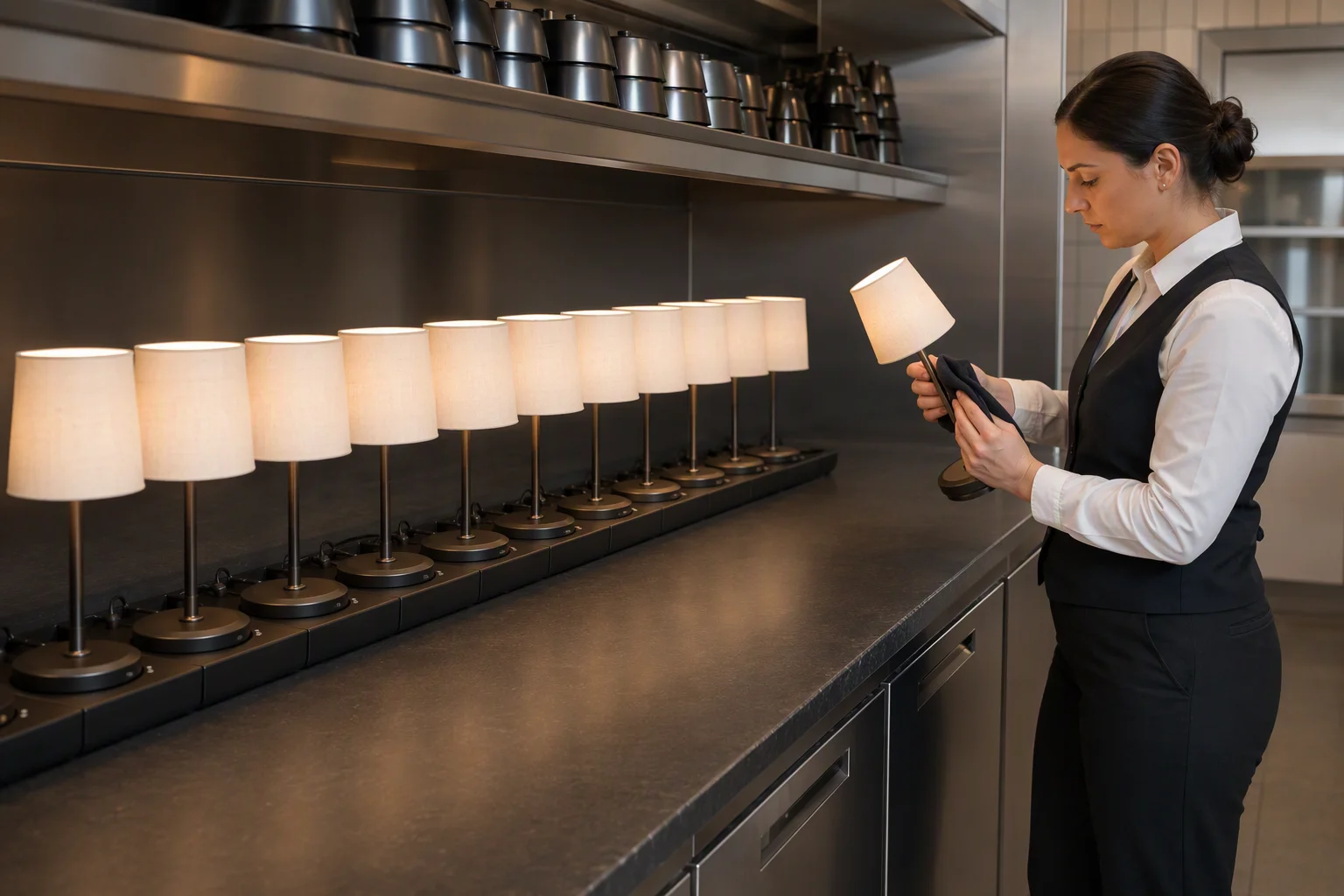
Caption: A lamp program should be evaluated as an operating workflow, including charging, inspection, cleaning and rotation.
Use the following supplier response checklist:
Define acceptance criteria before placing the order. For example, the project may require approval of a physical sample, confirmation of the finish, verification of the charging workflow and receipt of the agreed documentation. The criteria should be specific enough for the buyer and supplier to interpret them consistently.
The following template can be copied into a purchasing brief:
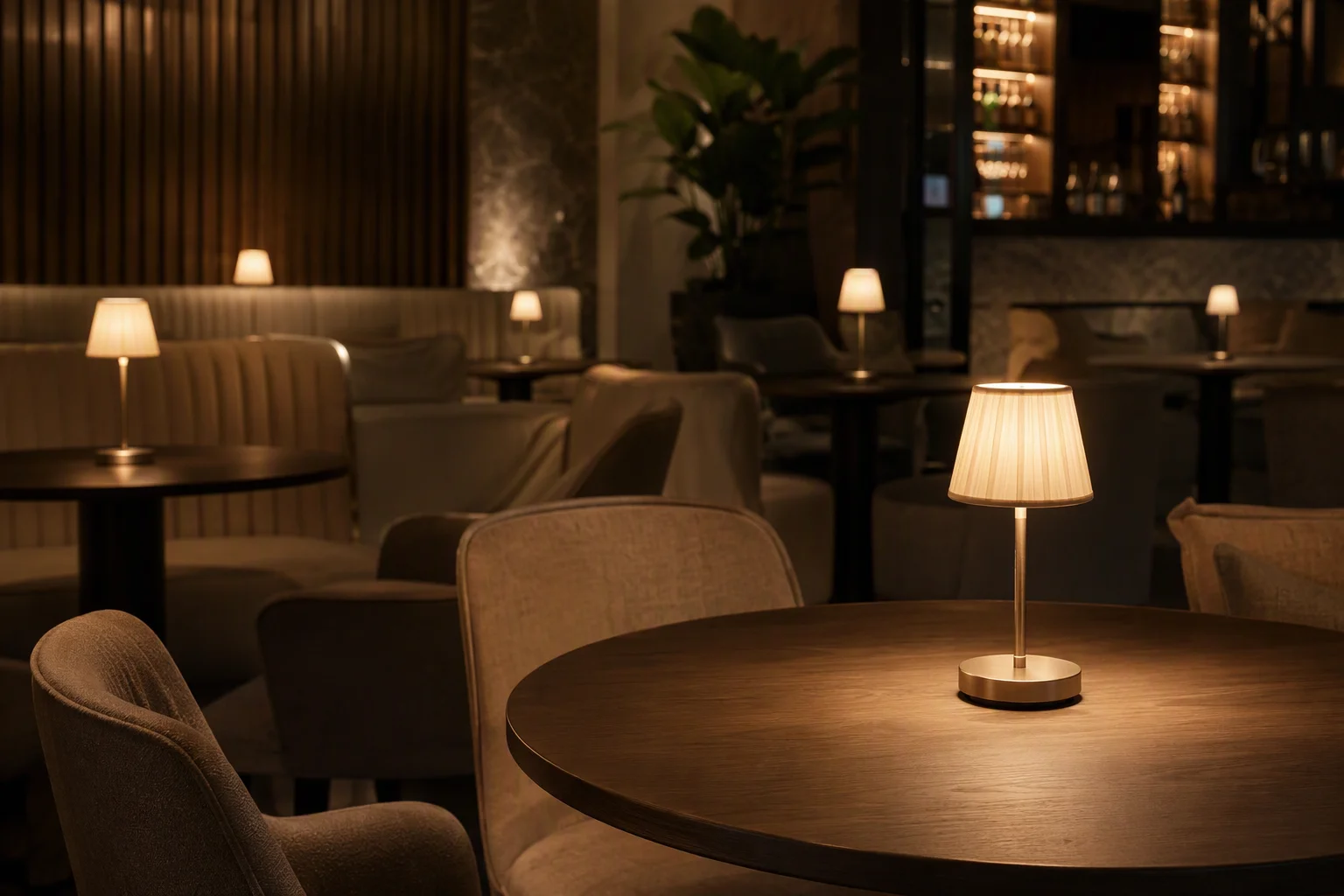
Caption: Application review confirms whether the proposed lamp appearance and handling model fit the guest-facing environment.
Use a weighted comparison rather than choosing the lowest unit price. A commercial lighting purchase can create hidden costs when the charging process is inefficient, spare parts are unavailable, finishes vary, or documentation is incomplete.
A simple evaluation framework may include:
| Evaluation area | Buyer question | Business outcome |
|---|---|---|
| Application fit | Does the proposal match the actual venue and service pattern? | Fewer unsuitable units and replacements |
| Evidence quality | Are runtime, charging and compliance claims documented? | Lower approval and operational risk |
| Workflow fit | Can staff collect, clean, charge and redeploy lamps efficiently? | Lower labour friction and better availability |
| Finish consistency | Can the supplier control the approved appearance across the order? | More consistent guest-facing presentation |
| Serviceability | Are instructions, parts and support available? | Lower downtime and longer usable life |
| Commercial terms | Are MOQ, lead time, packaging and payment terms workable? | Better cash-flow and project planning |
The unit price should be evaluated alongside total landed cost, expected replacement exposure, staff handling time, spare inventory and project delay risk. A supplier that answers the specification clearly may be more commercially useful than one that offers a lower initial price but leaves key operating conditions unresolved.
Planning a hotel, restaurant or commercial lighting project? Send your target application, estimated quantity, finish direction, operating schedule and charging workflow. A supplier can then recommend a suitable cordless table lamp configuration and identify the information still required for a responsible quotation.
The most important item is the defined operating use case: where the lamps will be used, how long they must operate, how they will be charged and how staff will handle them. Product appearance matters, but it should be evaluated together with runtime evidence, charging workflow, cleaning and service requirements.
Only when the project has a confirmed operating requirement and the supplier can provide test conditions. The specification should ask for runtime at the relevant brightness or control setting and require the supplier to explain the test method. A headline runtime without conditions is not enough for a commercial comparison.
Start with the deployment plan by zone, then add the rotation and maintenance reserve agreed with the operator. The total fleet is not always equal to the number of tables. Large tables, terraces, private dining rooms and event areas may change the lamp ratio.
Not necessarily. Centralized, distributed and hybrid charging can all work. The choice should follow staff movement, zone layout, charging windows, storage security and the number of lamps in rotation. Ask the supplier to recommend a layout using the actual project plan.
Request the current data sheet, instructions, charging and battery information, applicable declarations or reports, cleaning guidance, warranty terms and any agreed quality-control or inspection records. The exact document set depends on the destination market and project contract.
Customization may be possible, but the buyer should ask the supplier to separate standard features, optional changes, tooling requirements, MOQ, sample stages and lead-time impact. Final customization should be approved using a physical or otherwise agreed production reference before bulk manufacturing.
Use one response matrix for every supplier. Require each supplier to mark every requirement as compliant, partially compliant, unavailable or requiring confirmation. Compare the same model scope, finish, accessories, shipping terms, documentation and after-sales conditions—not only the lamp unit price.
A cordless table lamp procurement specification is effective when it translates a design intention into an operating and approval framework. Define the venue, zone allocation, service schedule, light behaviour, charging workflow, materials, cleanability, environment, documentation, customization boundaries, delivery terms and acceptance criteria before comparing suppliers.
The goal is not to make the document longer. The goal is to remove ambiguity from the decisions that affect revenue, guest experience, labour efficiency, project timing and replacement cost. When a supplier can respond to the same structured brief with verifiable information, the purchasing team can make a more defensible decision and the operator can launch the lamp program with fewer surprises.
Ready to prepare your project brief? Contact our commercial lighting team with the application, quantity by zone, preferred finish, operating schedule and charging requirements. We can review the specification, recommend a suitable cordless table lamp configuration, and prepare a project quotation with the available technical and service information for your approval.