
 EN
Quick Links

A flip-to-call lamp can provide a visible way for a guest to request attention, but the gesture only helps when the guest understands it and staff know how to respond. A short explanation, a clear view of the table and a reliable alternative for guests who do not use the lamp are the foundations of a practical rollout.
The supplied JB-TL01 description identifies an ambient lighting position and a solid red visual alert when the lamp is flipped with the red ring facing up. Confirm this behavior on the current sample before writing instructions. The red state is a local visual cue: it does not itself send a message to a phone, pager or point-of-sale system.
This guide is for restaurant operators, hotel purchasing teams and hospitality distributors. It outlines a proposed approach, not a report of a completed customer installation or factory test. Adapt the wording and operating procedure to the exact product supplied, the venue's layout and the needs of its guests.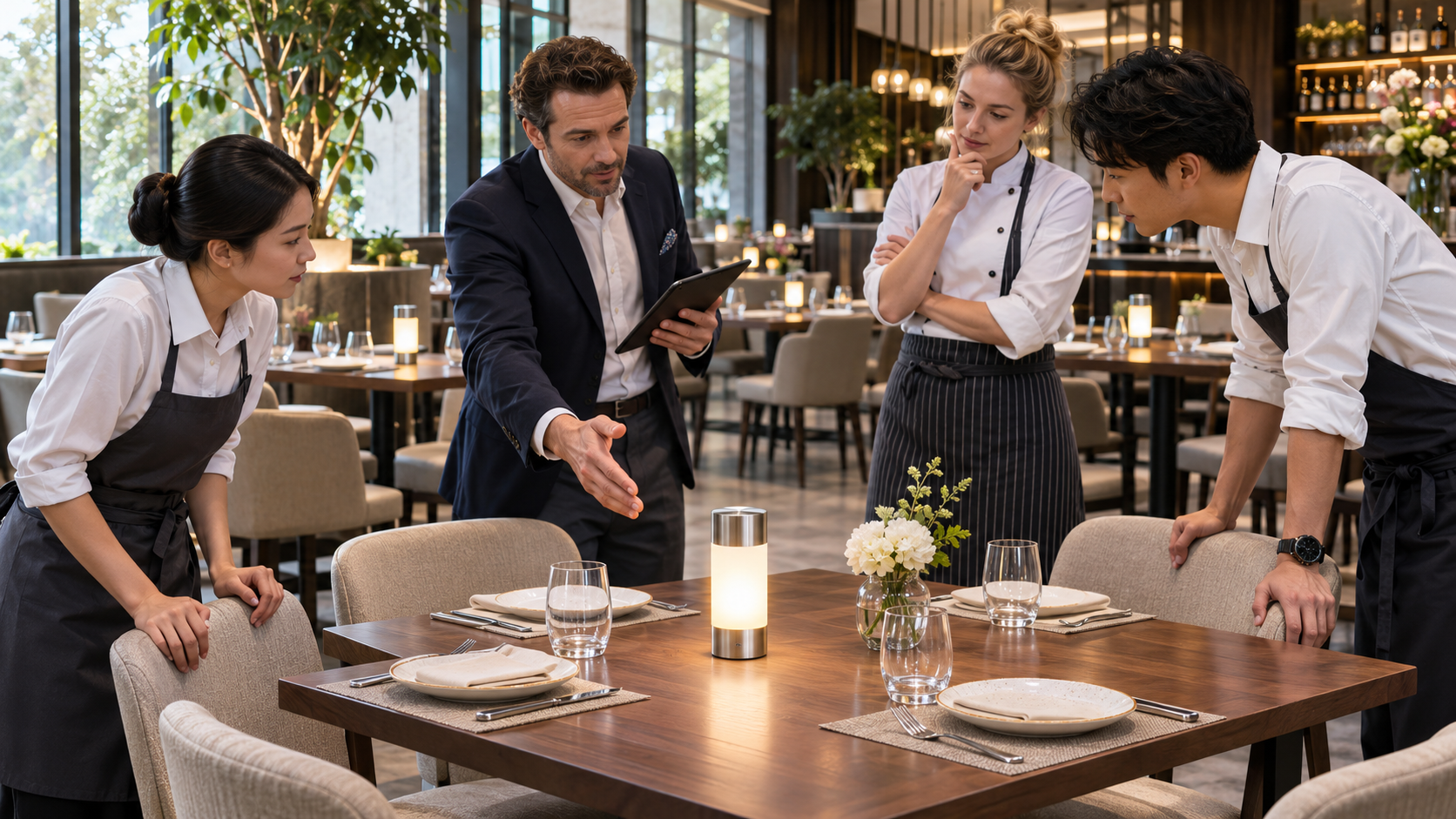
Use a brief, accurate instruction at seating, supported by a demonstration if appropriate: “If you need assistance, turn the lamp so the red ring faces up.” Confirm that the sample actually works that way, explain that staff will respond through the restaurant's normal service process, and tell guests how else to ask for help. Avoid promising a specific response time unless the venue has established and measured that commitment.
A table card can reinforce the message, but it should not be the only way a guest learns how to ask for service. A host or server should be prepared to explain it verbally, demonstrate it without disrupting the table, and use an alternative communication method when needed.
Guests may see a table lamp as decoration and have no reason to assume that it has a second function. Others may recognize a red light but be unsure whether it means a request, a warning or a setting change. The first interaction should make the purpose and action clear without making the guest feel that staff attention depends on using a device.
The instruction also helps staff use a consistent operating rule. The team should know which tables it can see, who is responsible for each zone, how a request is acknowledged and when the lamp is returned to its normal position. These decisions belong to the venue; the lamp cannot establish them on its own.
For the supplied JB-TL01 description, a red-ring-up orientation is associated with solid red light, while the normal position shows a selected ambient color. Ask the supplier to verify these states on the exact sample and charging configuration. Use the physical orientation as well as the color in the explanation so that the instruction does not rely on color alone.
Do not say that the lamp identifies a table on a receiver, notifies a watch or logs a request unless a separately verified system actually provides those features. A visual cue can be obstructed by a guest, menu or partition. Staff must have a practical opportunity to see it.
Choose one simple action and one meaning. For example, a venue might use: “Red ring up means this table would like assistance.” Follow that with an instruction for the team: the assigned server or backup acknowledges the guest and handles the request using the venue's normal procedure.
Agree the reset point before training staff. Some venues may reset the lamp after the guest's request has been understood; others may choose another point in the interaction. The chosen action must match the actual sample and should be explained consistently. The lamp does not create an electronic acknowledgement record.
A host can say: “Your lamp also helps us notice when you need us. Turn the red ring up if you would like assistance, or simply speak to any team member.” This is an example for the venue to adapt, not a claim that all guests will understand it immediately.
Use the restaurant's normal tone and avoid technical descriptions of batteries or sensors at the table. The guest needs to know what action is available, what it means and how to obtain help another way. A longer explanation can be offered if the guest asks.
If demonstrating, choose a moment when the table is clear enough to turn the lamp safely. Show the normal and alert positions on the actual unit and return it to the venue's agreed starting position. Avoid moving hot dishes or drinks. Check that the lamp remains stable and accessible in both orientations.
The product sample should be reviewed before service for condition, safe handling and placement. Follow current supplier instructions. Do not use a damaged or unstable lamp, and do not invent a cleaning method or ingress rating from its appearance.
A card can help guests who arrive after the host's explanation or prefer to read. Use a short heading, the action and an alternative. One example is: “Need assistance? Turn the red ring up, or speak to a member of our team.” The wording should match the approved sample and the venue's actual service routine.
Use legible type, good contrast and a size suitable for the table. Avoid covering the lamp or blocking the staff sightline with a tall cardholder. If an illustration is used, check that it depicts the correct lamp, orientation and visible state. A photograph or drawing should make the action easier to understand rather than adding decorative detail.
Place the card where guests can read it without crowding plates, cutlery and glasses. Review the layout from each seat and from the staff route. On a small two-person table, a card next to the menu may work better than an additional stand. On a large shared table, the venue may need an explanation at more than one seating position.
If the card is moved during service, staff should know the approved location. Recheck the arrangement when menus, centerpieces or furniture change. The visibility guide describes a way to review obstructed tables.
Choose languages according to the restaurant's actual guests and staff capabilities. A translation should express the same action and meaning as the approved English instruction. Have a competent speaker review it in context and check that an illustration is not ambiguous across languages.
Do not add a QR code as the only source of instructions. A guest may not have a phone or may prefer not to use one. If a QR option is separately approved, confirm its destination, maintenance and accessibility, and retain a clear non-digital alternative.
A guest may be unable or unwilling to reach, grip, turn or see the lamp. Some may not understand the instruction, while others may simply prefer to speak to a server. The restaurant should continue normal staff circulation and provide an alternative that works for the actual room.
Ask staff to offer help without drawing attention to a guest's needs. The alternative might be speaking to a team member, a host check-in or another method chosen by the venue. It should not require the guest to explain a disability or use a personal device.
Place the lamp on a stable surface where the intended users can reach it without moving a hot dish or leaning across another guest. Check whether a seated person can see the instruction and whether the lamp is comfortable to turn. A single central location may not suit every table or seating arrangement.
Do not prescribe a universal distance from a table edge without measuring the furniture and considering service movement. Test a representative place setting, including menus and decorations. If the position prevents a guest from using the lamp comfortably, provide another method and revise the arrangement.
Color can support a signal, but orientation, text and staff communication can give additional context. On the approved JB-TL01 sample, the instruction can reference the red ring facing up as well as the resulting light. Check the actual markings and states before printing the card.
If lighting, glare or the background makes the signal difficult for staff to distinguish, revise the table position or the staff route. A restaurant should not assume that a lamp is visible from a service point behind a wall or partition.
For each table group, identify a primary observer and a backup. Record where they normally work, including breaks and section changes. The lamp is a local visible cue, so a person must be able to see it from a real working position. A clear view from the center of an empty room is not sufficient proof for every table during service.
The venue can adopt a short sequence: notice the red state, acknowledge the table, understand the request and return the lamp to the agreed normal position at the chosen point. Explain what happens if two tables signal at once or if the assigned server is occupied. These are proposed operating steps and should be adapted to the restaurant's own standards.
A guest should be able to tell that the team has noticed the request. The exact acknowledgement can be verbal or visual, according to the venue's procedure. Staff should avoid silently returning the lamp to ambient mode before they understand why the guest requested help.
A reset does not prove that the request was completed, and the light is not a permanent record. If the restaurant needs a record or routed notification, specify and verify those functions separately. Do not use a decorative service lamp as an emergency alert.
A booth, private room or corner behind a partition may not be visible from the main service station. Options include changing the staff route, assigning another observer, adjusting furniture or using another service method. Record the chosen backup and check it during the actual service pattern.
Use a simple status such as visible, partially obstructed, not visible or not checked. Add the table number, observer position, table setting and corrective action. Retest after a change rather than assuming the problem is solved on paper.
Preparing guest instructions for a rollout? Share your table types, service zones and guest needs with Jbian Lighting. Send Your Requirements and request the current JB-TL01 sample and operating information.
A short briefing should cover the lamp's normal and alert orientations, the agreed guest script, table placement, zone ownership, acknowledgement, reset and fallback. Use the actual sample and compatible charging station. Ask staff to demonstrate the procedure at a representative table, then invite questions about unusual situations.
Explain what the system does and does not do. A staff member should not assume that turning the lamp sends an electronic message, that every table is visible from every location or that a guest has received a response simply because a light changed. The service process still depends on the team.
A handover should identify which tables are open, the assigned observer and backup, any changed table layout and lamps removed from use. Temporary staff need the same short demonstration as permanent staff. Keep the written instruction near the normal operating documentation so it can be found quickly.
The shift handover guide offers a sample record for ready lamps, charging and exceptions. The example is a planning tool; each restaurant should adapt it to its own staffing and service hours.
Before a broader order, use a representative sample in the intended room. Check the normal table setting, seated positions, staff route and relevant day and evening lighting. Record any instruction that guests or staff find unclear. If the layout changes, repeat the relevant check.
If a venue chooses to measure response time, define the start and end points, staff conditions and number of observations in advance. Do not turn an illustrative scenario into a customer result or promise performance based on an unperformed test.
A guest instruction is useful only when the correct lamp is ready for service. Count the tables open simultaneously, any justified ready reserve and the units assigned to other rooms. Distinguish ready lamps from those charging or awaiting inspection. Confirm who collects, charges and places them between services.
The supplied JB-TL01 material describes a 2,600 mAh battery, approximately 17 hours of runtime and a 6–8 hour charge time. These are supplied figures; ask for the current specification and test conditions. Actual performance depends on use and settings. The lamp is described as charging through a compatible station, with no Type-C port on the lamp.
Confirm the station model, number of charging positions, power supply, destination plug and actual charging window. Do not infer simultaneous charging capacity merely from the number of lamps in a set. Compare configurations using the 15- and 25-lamp set guide.
After a pilot, ask staff which explanation was easiest to deliver and where guests appeared uncertain. Record table locations where the lamp was moved, blocked or difficult to reach. Guests can be invited to give feedback without being required to use the lamp or identify themselves.
Document the sample revision, room layout, dates and conditions of any review. Separate a staff observation from a measured result. A small pilot can reveal practical issues but cannot guarantee the same outcome in every room or during a busy service.
If a station, lamp revision, ambient setting or guest-facing card changes, check that the message remains accurate. Repeat the demonstration for staff and update any multilingual versions. A property group can use a common template while allowing each site to record its own table plan and backup arrangement.
Keep the approved sample, quotation and instructions aligned. If a distributor supplies several restaurants, agree which documentation is delivered to each site and how questions or replacement requests are handled.
A guest may not know that a decorative light can signal staff. Provide a short introduction and make another way to request help clear. Do not assume every guest will notice a small printed card.
Agree one local operating rule and include it in training and handovers. Staff should use the same description of the approved sample's orientation and know who responds in each zone.
The described JB-TL01 alert is a visual state on the lamp. It does not establish an electronic message to a phone, watch or point-of-sale system. If that capability matters, identify a separate verified solution.
An instruction that blocks the staff view undermines the process it explains. Check the card, menu and centerpiece with guests seated and staff at their actual working positions.
A guest needs to know that someone has noticed the request. Define the acknowledgement and reset point in the restaurant's procedure, and make sure backup staff understand it too.
The supplied product information associates the red-ring-up position with a solid red visual service alert. Confirm the current sample and define the restaurant's response in its own procedure.
The described function is a visible cue on the table. It does not by itself establish a remote notification through a wall or to another room. Use an assigned observer or a separately verified service method where direct visibility is unavailable.
The venue should choose a practical introduction for its guests and service style. A brief verbal explanation, a clear card and an available alternative can work together. Offer a demonstration when useful and avoid making it a condition of receiving service.
Yes. Select languages relevant to the venue and have each version reviewed against the approved product and operating rule. Keep the text legible and retain a non-digital way to ask for help.
Staff should offer an alternative way to request assistance and continue normal service. Review placement and communication with the guest's comfort and the venue's accessibility practices in mind.
Ask for the current JB-TL01 sample, compatible station configuration, instructions, power and plug details, pricing, lead time and relevant destination-specific documentation. Provide table count, operating hours, charging window, delivery destination and any branding requirements.
A clear guest instruction turns the lamp into part of a coherent service process. Explain the actual action briefly, confirm the sample's visible states, assign staff ownership and provide a practical alternative. Test the arrangement in the real room and revise it when tables, staff routes or equipment change.
Tell Jbian Lighting about your venue, table layout, service zones and charging needs. Request the current JB-TL01 configuration, instructions and an itemized proposal. Get a Quote.