
 EN
Quick Links

Choosing cafe table lamps wholesale is not simply a matter of selecting a decorative shape and multiplying the quantity. For a cafe, restaurant, bar or hotel dining area, a table lamp becomes part of the guest experience and part of the daily operating routine. It must fit the table, support the intended atmosphere, work with the room’s lighting plan and remain practical for staff to handle, clean and recharge.
For buyers, designers and hospitality operators, the best purchasing decision starts with the use case rather than with a catalogue image. The right shortlist defines where the lamps will be used, how many tables need them, whether power cords are acceptable, how the lamps will be stored between services and what information a supplier must confirm before quotation.
Direct answer: the best cafe table lamps wholesale choice is a commercially suitable lamp whose size, beam, brightness control, charging method, materials, cleaning routine and replenishment process match the venue’s operating needs. For flexible table layouts, cordless or rechargeable table lamps can reduce visible cabling and make table changes easier, but the buyer should confirm the actual product configuration and charging workflow instead of relying on generic claims.
This guide provides a procurement framework for hospitality buyers looking for premium commercial cordless table lamps and indoor ambient lighting.
Before comparing suppliers, divide the project into practical zones. A cafe may need a different lamp format for a compact two-person table than for a long communal table. A hotel may use table lamps in a lobby lounge, breakfast area, bar, restaurant or private dining room. Each zone has a different visual and operational brief.
Create a simple application map:
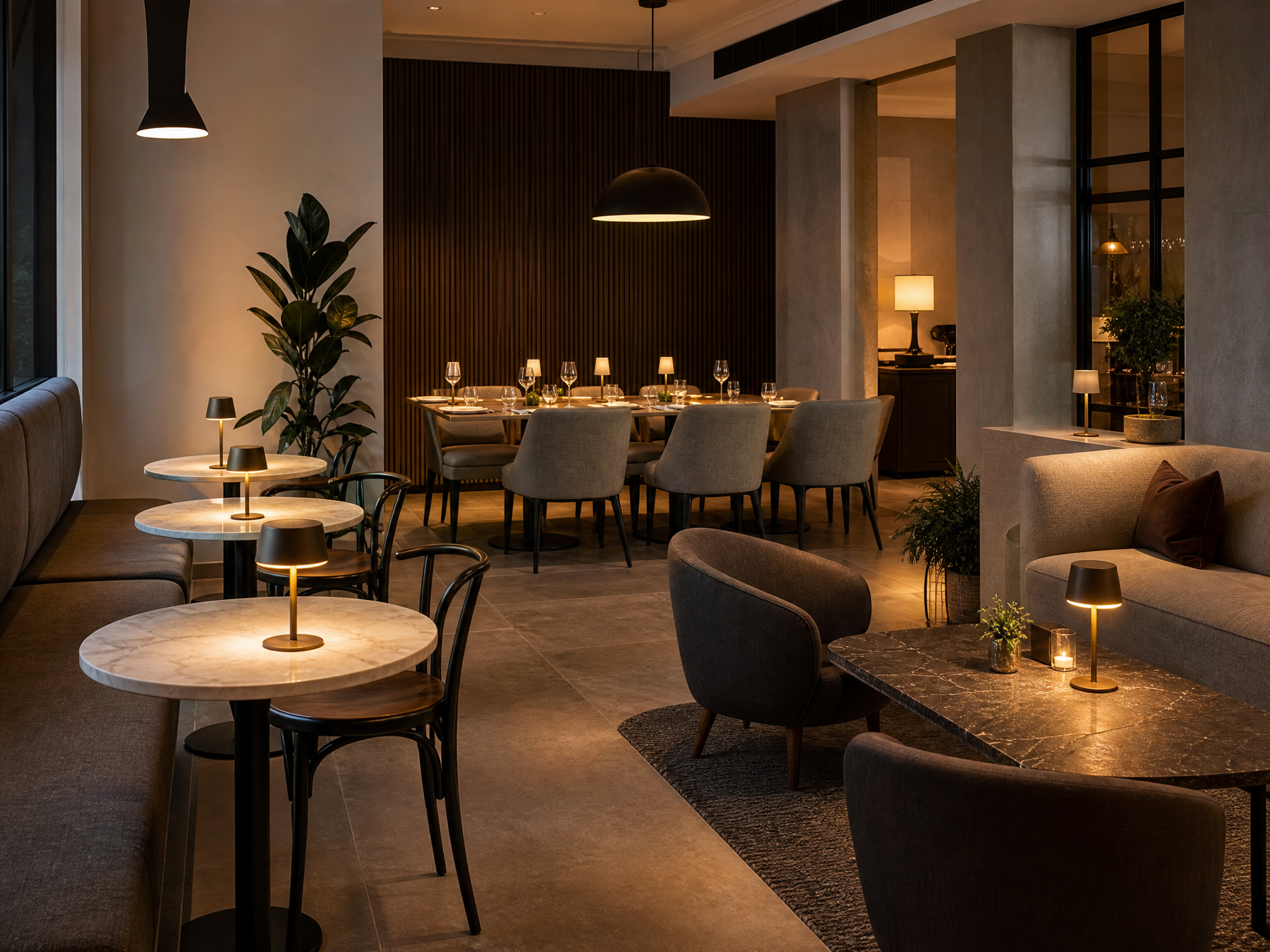
Table lamp selection should reflect the needs of each hospitality zone.
| Area | Buyer question | Typical lighting priority | Operational consideration |
|---|---|---|---|
| Cafe tables | Does the lamp leave enough usable table space? | Warm, controlled ambience | Fast table reset and easy cleaning |
| Restaurant dining tables | Does it support the desired dining mood without glare? | Comfortable focal light | Consistent placement across sections |
| Bar counters | Is the footprint stable and visually appropriate? | Accent and atmosphere | Frequent wiping and spill exposure |
| Hotel lounge tables | Does it coordinate with the interior palette? | Layered decorative light | Flexible furniture layouts |
| Private dining | Can the format be repeated across a set? | Refined, even appearance | Project quantity and replacement planning |
This map also helps prevent a common procurement mistake: choosing a lamp because it looks attractive in a product photograph without confirming how it will behave across the whole service environment.
Cordless table lamps are valuable when tables move, floor outlets are limited or visible cables would conflict with the interior design. They can help operators reconfigure seating, create seasonal layouts and keep tabletops visually cleaner. Rechargeable operation may also simplify placement where a fixed power connection is not available at every table.
However, “cordless” should be treated as a use format, not a complete performance specification. During supplier evaluation, ask:
Do not assume that cordless means wireless charging, waterproof, suitable for outdoor use or capable of a particular operating time. Those are separate product attributes and should be confirmed against the supplier’s actual documentation.
For venues with stable table positions and accessible power, a corded decorative lamp may still be suitable. For venues that frequently move tables or want a clean tabletop presentation, a rechargeable commercial cordless table lamp may offer greater layout flexibility. The decision should be based on total operating convenience, not only on the visual absence of a cable.
Hospitality lighting normally works as part of a layered scheme. A table lamp is often an accent or ambient source rather than the only light for the whole room. Buyers should define the role of the lamp before requesting technical details.
For a cafe or bar, the desired effect may be a warm pool of light that helps a table feel defined without creating glare for guests or staff. For fine dining, the lamp may need to complement tableware, food presentation and the interior materials. In a hotel lounge, the lamp may need to sit comfortably alongside decorative pendants, wall lights and daylight.
Ask suppliers to clarify, where applicable:
Avoid publishing or approving an exact lumen, colour temperature, battery capacity or runtime unless it is supported by the actual product specification. A responsible procurement brief can state the required lighting effect and ask the supplier to confirm the measurable values for the selected model.
A lamp can be visually premium and still be wrong for a hospitality table if its footprint is too large, its height blocks sightlines or its base competes with tableware. Request the product’s confirmed dimensions and review them against the smallest table in the intended application.
A practical table-fit review should consider:
For a multi-zone project, prepare a small physical or visual mock-up using the actual table sizes and centrepieces. This is more reliable than selecting a single size from a catalogue and assuming it will work everywhere.
Commercial hospitality products are exposed to repeated handling, cleaning and contact with food or beverages. The material and finish should therefore be considered alongside the appearance.
Ask what surfaces are supplied, how they should be cleaned and whether the finish is intended for indoor hospitality use. A buyer should avoid making unsupported claims such as “scratch-proof,” “stain-proof” or “maintenance-free” unless the supplier provides evidence for those claims.
Useful questions include:
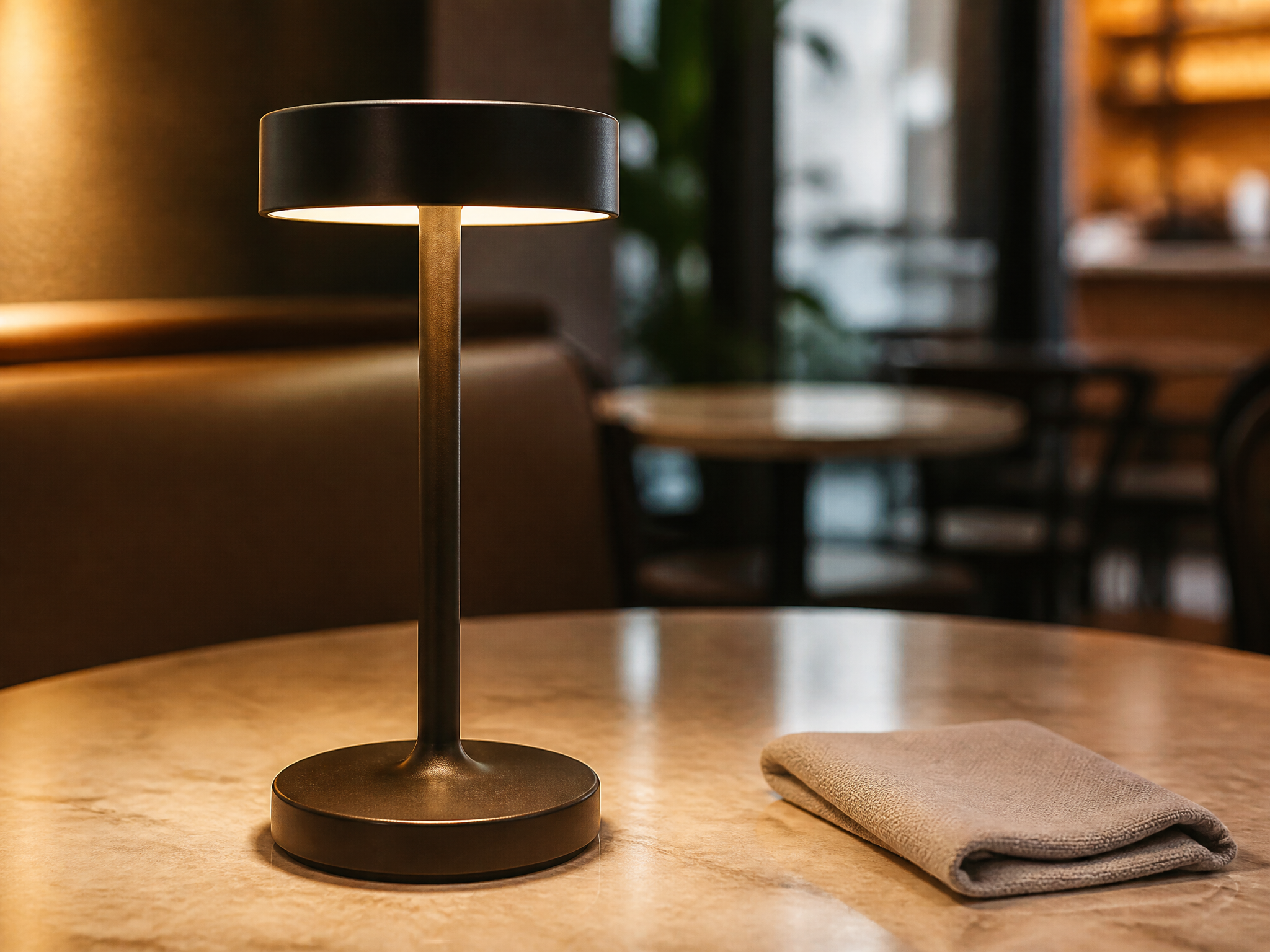
Material, finish and cleaning requirements should be reviewed before wholesale approval.
When several lamps are used together, finish consistency matters. Ask how colour and surface variation will be managed across the quoted batch, especially when the lamps will be placed in the same dining room.
Charging is an operational process, not a detail to be left until after purchase. A venue should decide where lamps will be collected, charged, stored and returned to service. This is especially important when the quantity is large or when the lamps are used across more than one service period.
A basic workflow may include:
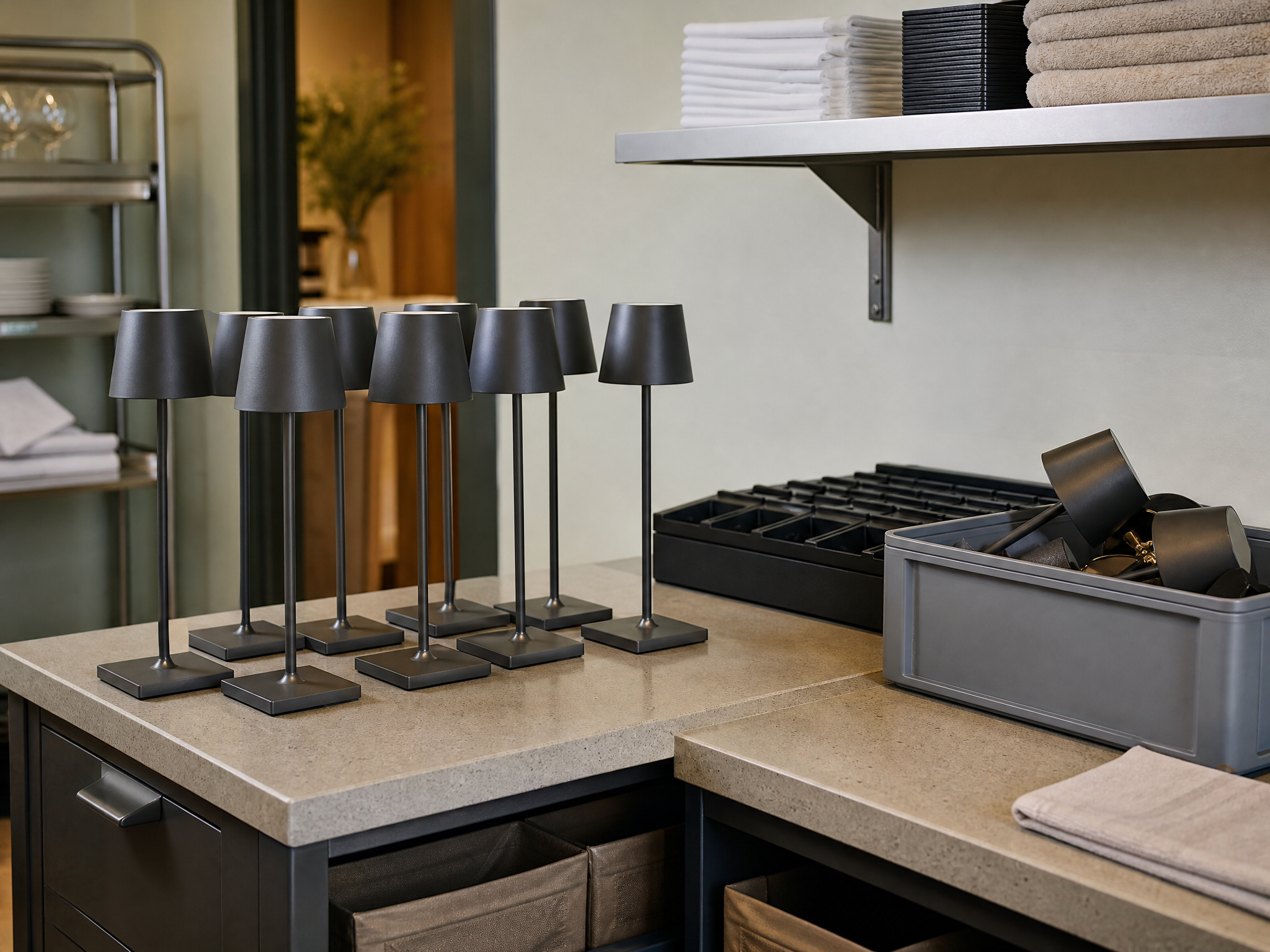
A clear charging and replenishment workflow supports consistent daily service.
| Stage | Responsibility | Control point |
|---|---|---|
| Collection | Floor or service team | Used lamps are returned to one location |
| Inspection | Assigned staff member | Damaged or abnormal units are separated |
| Charging | Staff or housekeeping team | Charging positions are labelled |
| Readiness check | Shift leader | Units for the next service are counted |
| Deployment | Floor team | Lamps are placed consistently by zone |
| Record update | Operations owner | Missing or failed units are logged |
A supplier may offer individual charging or a multi-lamp charging station. Select the arrangement only after confirming the available space, electrical setup, staff routine and quantity required per service. Do not assume that a charging station is included with every lamp quotation.
For a first enquiry, give the supplier the estimated number of tables, service periods, deployment zones and desired replacement approach. The supplier can then respond with the relevant charging options instead of sending a generic product list.
Procurement checkpoint: before requesting a final quotation, prepare the table count, lamp quantity by zone, preferred finish, required light-control behaviour, charging approach, delivery destination and sample-approval process. This reduces avoidable back-and-forth and creates a clearer basis for comparing suppliers.
A wholesale supplier should be assessed on how clearly it responds to the project brief. The lowest quoted unit price is not necessarily the lowest total cost if the lamp creates extra handling, inconsistent finishes or difficult replacement work.
Use a supplier comparison table like this:
| Evaluation area | What to request | Why it matters |
|---|---|---|
| Product fit | Confirmed dimensions, materials and controls | Prevents mismatch with tables and interior design |
| Commercial configuration | Available quantity, packing and accessories | Clarifies what is included in the quotation |
| Charging | Connector, charger arrangement and optional station | Supports daily operations |
| Quality review | Product sample or representative sample process | Allows physical approval before a larger order |
| Customisation | Available finish, colour or branding scope | Separates confirmed capability from assumptions |
| Documentation | Product sheet and care guidance | Supports internal approval and training |
| Service support | Replacement and issue-handling process | Protects continuity after delivery |
| Lead-time communication | Order milestones to be confirmed | Helps coordinate a project schedule without inventing a promise |
The buyer should ask the same questions of each shortlisted supplier. Keep confirmed facts separate from assumptions, and mark any item that needs sample verification or written confirmation.
A high-quality enquiry helps the supplier recommend the correct commercial cordless table lamps rather than simply quote a popular model. Include:
This information gives the supplier enough context to respond with relevant options while avoiding unsupported promises about price, minimum order quantity, certifications or delivery dates.
They can be suitable when the venue benefits from flexible table layouts, clean tabletops and reduced dependence on fixed outlets. The buyer should confirm the actual charging method, control behaviour, cleaning guidance and operating workflow for the selected model before ordering.
Ask for confirmed dimensions, materials, finish options, light-control details, charging configuration, sample availability, quotation inclusions, packaging, replacement support and the information needed to confirm production and delivery. Ask the supplier to distinguish standard capability from custom requests.
The terms are often used broadly, but they should not be treated as identical specifications. “Rechargeable” describes the power method, while “wireless” may describe the absence of a power cable during use. Confirm the product’s charging connector, charging accessories and intended operating method in writing.
Start with the table count by zone, then add a clearly defined reserve only after considering the venue’s replacement and service routine. The appropriate quantity depends on the layout, service schedule, charging workflow and desired continuity. A supplier should not invent a universal ratio without the project details.
Some suppliers may offer custom finishes, colours or branding, but availability, sampling, minimum order quantity, artwork requirements and timing must be confirmed for the selected model. Do not assume that a catalogue product automatically supports every custom option.
A sample is useful when the decision depends on scale, finish, light appearance, control feel, stability or cleaning practicality. Use the sample to check the lamp on the actual table type and under the venue’s intended lighting conditions.
The strongest cafe table lamps wholesale decision connects design intent with daily operation. Begin with the venue zones and table scenarios, then compare cordless suitability, light behaviour, dimensions, materials, cleaning requirements, charging workflow and supplier evidence. For hospitality projects, a premium appearance is only one part of value; repeatable placement, manageable charging and clear support can influence the long-term operating experience just as much.
For a practical shortlist, choose suppliers that answer the same procurement questions consistently and provide enough confirmed information for sample approval. If the project includes cafes, restaurants, bars or hotel spaces, request a solution based on the actual table count, deployment zones and service routine rather than a generic catalogue recommendation.
Share your table count, venue type, preferred finish and cordless requirements with DISLUNA. We can help organise a product shortlist and the questions needed for a clearer B2B quotation.
Send your project details, target quantity, delivery country and sample requirements to discuss suitable indoor ambient table lamp options. Name, Email and Phone can be collected through the enquiry form so the sales team can respond with the right procurement information.